

We're going to hear this question a lot, looking back
/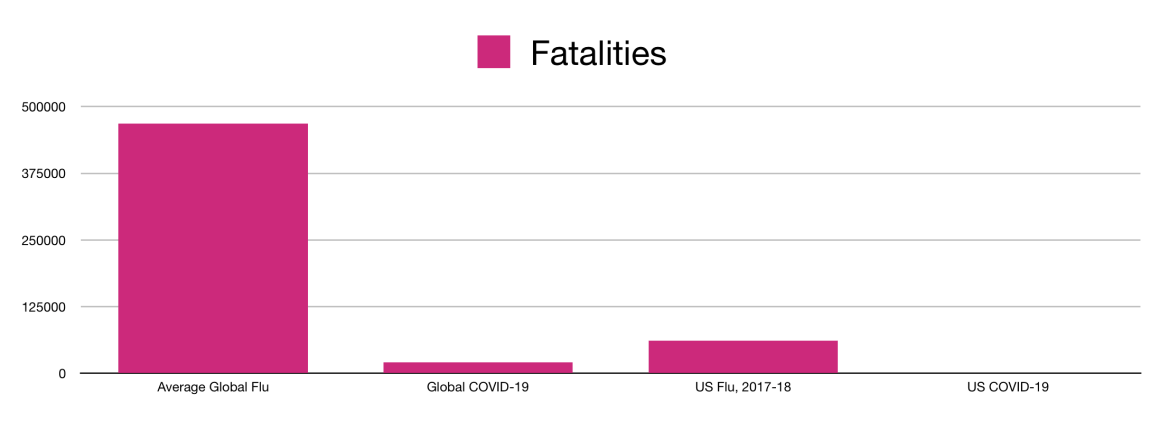
COVID-19 deaths so far. Where’s the crisis?
POSTED ON MARCH 26, 2020 BY JOHN HINDERAKER IN CORONAVIRUS
I have updated this chart a number of times, based on data from the World Health Organization and the Centers for Disease Control, and will continue to do so. It shows, for one thing, how far COVID-19 has to go before it equals the average seasonal flu mortality, worldwide. If I had to predict, I would guess that it will eventually reach the average level. Will it get to 2x the average number of flu deaths, worldwide? Looking at current trends, I don’t see how that will happen. But time will tell.
Likewise in the U.S. You still can’t see the bar for COVID-19, but it is there: 994 deaths so far, per the CDC, compared with 61,000 caused by the flu virus just two years ago. The Wuhan virus might equal or even exceed that total, but it is hard to forecast that at this point. And anyway, the 2017-18 flu deaths barely merited a news story, let alone a radical, economy-destroying shutdown. What has changed?
Even if the U.S. death total eventually amounts to, say, three times the toll of the flu just seasons ago–around 180,000 dead–what is the justification for the extraordinary measures our governments have taken, which are in the process of crushing our economy?
It's a mystery
/
So furries are safe?
Study: COVID-19 impacts men, women more than all other genders combined.
According to the study, 100% of coronavirus cases have affected men and women and not a single other gender.
"It's incredible - we've found this virus is far more likely to affect biological males and biological females than any other biological gender," said Head of Gender Research Dr. Benji Charmin. "We thought the data had to be flawed, but we checked again and again, and sure enough, this thing is aggressively going after men and women and ignoring the other genders entirely."
He shrugged. "It's just science."
Hmmm - now even Cuomo is rethinking "shelter in place"
/
Same Page?
Not sure if shutting everything down was best health strategy
New York Gov. Andrew Cuomo said Thursday that his stay-at-home order for the entirety of New York State was “probably not the best public health strategy.”
In a press conference in Albany, Cuomo said the smartest way forward would be a public health strategy that complemented a “get-back-to-work strategy.”
“What we did was we closed everything down. That was our public health strategy. Just close everything, all businesses, old workers, young people, old people, short people, tall people,” said Cuomo. “Every school closed, everything.”
“If you rethought that or had time to analyze that public health strategy, I don't know that you would say quarantine everyone,” Cuomo admitted. “I don't even know that that was the best public health policy. Young people then quarantined with older people was probably not the best public health strategy because the younger people could have been exposing the older people to an infection. “
I’m so old I remember when Trump was accused of being a raving, ignorant murderer for even considering easing the restrictions based on county-by-county analysis of the fifty states. Oh, that was this morning.
it will be interesting to see if the Democrat house organ, the media, now refuses to broadcast Cuomos’ press conferences, as it has Trump’s at MSNBC, CNN, and NPR, for “telling lies and spreading false hope”.
Greenwich continues to open its doors to refugees
/
33 Willowmere
33 Willowmere Circle, which was purchased just last month for $3.625 million, is available for a short term rental @$25,000 unfurnished, or if you prefer, a stager will bring in her stuff and the total package will set you back $33,000 per.

Add The Zebra and it’s $45,000.
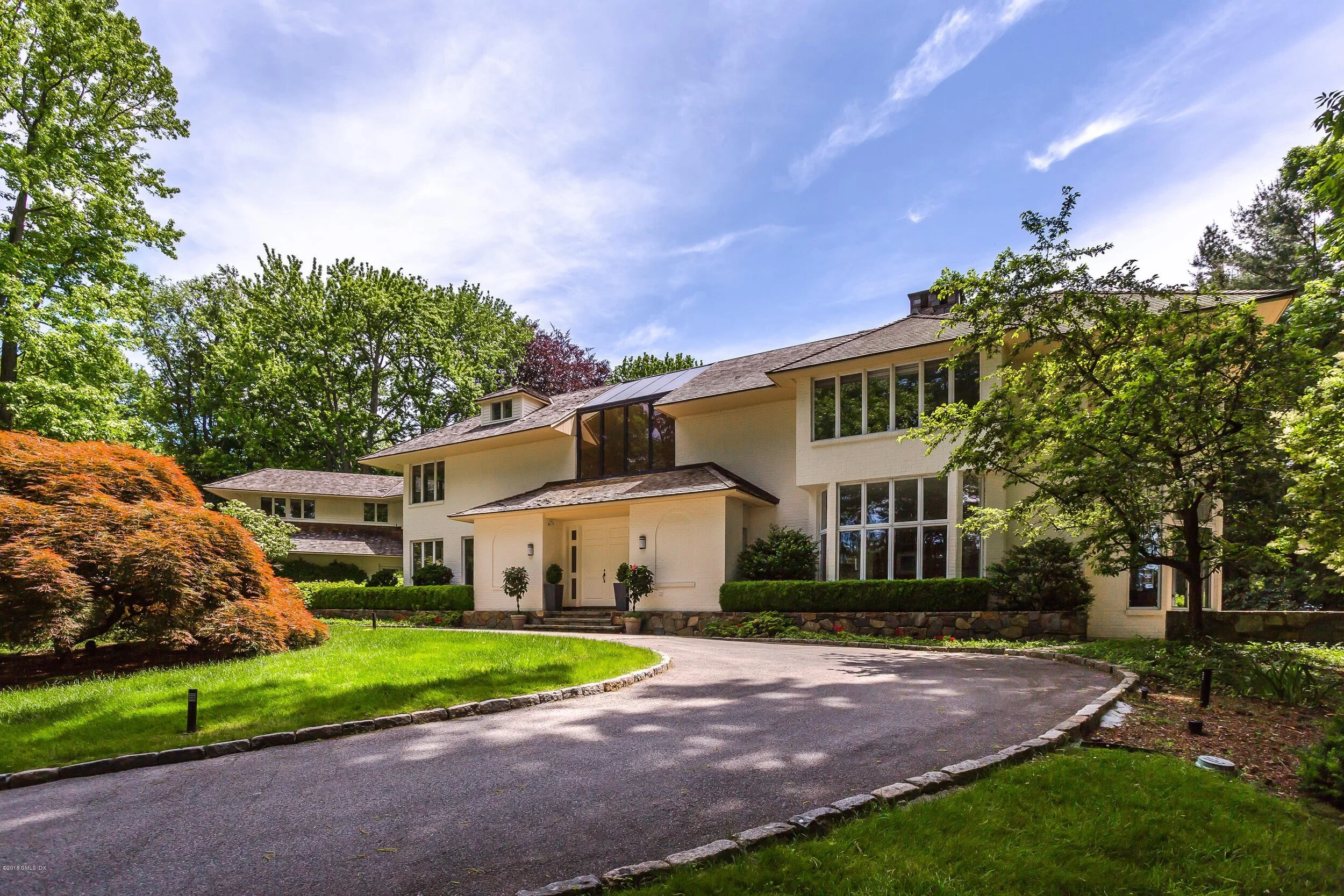
21 Windrose Way
And you can buy 21 Windrose Way in Mead Post for $5.9 million or, as of today, rent it for $25,000. I’ve always felt this house was best viewed looking out.
A Kerfluffel after all — maybe
/
ConVid 19?
A few hundred thousand dead people, worldwide, is hardly a non-event, but some epidemiologists have increasingly questioned the methodology used to estimate the flu’s death total, estimates that originated at London’s Imperial College and which have been used by all other countries to frame their response to the Chinese Virus. But now, those criticisms seem to have been heard and listened to by, of all places, the Mother Star itself:
Imperial College scientist who predicted 500K coronavirus deaths in UK revises to 20K or fewer
A scientist who warned that the coronavirus would kill 500,000 people in the United Kingdom has revised the estimate to roughly 20,000 people or fewer.
Scientist and Imperial College author Neil Ferguson said Wednesday that the coronavirus death toll is unlikely to exceed 20,000 and could be much lower, according to New Scientist. He added that he is “reasonably confident” that Britain’s health system can handle the burden of treating coronavirus patients.
“There will be some areas that are extremely stressed, but we are reasonably confident — which is all we can be at the current time — that at the national level we will be within capacity,” Ferguson said.
The Imperial College had previously warned of modeling that suggested over 500,000 would die from the virus.
“This is a remarkable turn from Neil Ferguson, who led the @imperialcollege authors who warned of 500,000 UK deaths - and who has now himself tested positive for #COVID,” former New York Times reporter Alex Berenson wrote on Twitter.
My prediction: once the flu burns out and the world realizes that their leaders have destroyed the global economy for what was a dangerous, and destructive but not world-destroying pandemic, they’ll look to these leaders for an explanation. And those leaders, in turn will do what this Ferguson is already doing, and say, “yeah, but if we hadn’t done all that, all those horrible things would have happened —you’re lucky we were here”. Here’s Ferguson beginning the backtrack:
Ferguson credited the U.K.’s lockdown for stopping the spread of the virus, but as Berenson points out, the country “only began its lockdown 2 days ago, and the theory is that lockdowns take 2 weeks or more to work.”
I’m hoping that Glenn Reynold’s prediction is also accurate:
We may learn a lesson about the usefulness of models. Some people were saying that the pandemic would strengthen the case for “climate change” activism, but it ironically may instead teach us a lesson about relying on unproven models.
Here’s my point; Idaho has exactly eleven reported cases within its borders. You could (a) isolate those individuals, follow their contacts and seal up that group and encourage everyone else to take precautions such as “social distancing”, which is pretty much what Japan has done, or (b) shut down the whole state, and order the entire population to stay indoors until the all clear is sounded six weeks to six moths from now. Idaho’s governor has gone with option b. Better numbers might have allowed him to use a far less devastating approach.
Is the great toilet paper shortage ending already?
/
One sheet doth not a whole roll make, or put poetically, It is not one swalowe that bryngeth in somer, but I notice that a short-term rental listing at 23 Meadowbank Road, Old Greenwich that came on ten days ago at $24,000 has dropped today to $18,000.
Are we running out of panicked Manhattanites so soon, or did this owner’s reach merely exceed his grasp? I’ve got nothing much else to do these days so I’ll keep my eye on the short-term market and report back.
As an aside, what caught my eye about this listing is that its owners have stubbornly refused to make any serious adjustment to its asked-for sale price, cutting it just $200,000 despite a full-year’s failure to sell, from $2.950 million to $2.750. The quick price drop on the rent shows a flexibility and perhaps accommodation to market forces hitherto unseen on their part.
John Stossel on bureaucracy, coronavirus, and us
/
That ship has sailed
It didn't have to get to this point.
Coronavirus deaths leveled off in South Korea.
That's because people in Korea could easily find out if they had the disease. There are hundreds of testing locations -- even pop-up drive-thru testing centers.
Because Koreans got tested, Korean doctors knew who needed to be isolated and who didn't. As a result, Korea limited the disease without mass quarantines and shortages.
Not in America. In America, a shortage of COVID-19 tests has made it hard for people to get tested. Even those who show all the symptoms have a difficult time.
Why weren't there enough tests?
Because our government insists on control of medical innovation.
That's the topic of my new video.
When coronavirus appeared, the Centers for Disease Control and Prevention made its own tests and insisted that people only use those CDC tests. But the CDC test often gave inaccurate results. Some early versions of the test couldn't distinguish between coronavirus and water.
Private companies might have offered better tests, and more of them, but that wasn't allowed. …[All] tests must go through the government's cumbersome approval process. That takes months. Or years.
Hundreds of labs had the ability to test for the virus, but they weren't allowed to test.
As a result, doctors can't be sure exactly where outbreaks are happening. Instead of quarantining just sick people, state governors are forcing entire states to go on lockdown.
At the same time, many people who show no symptoms do have COVID-19. Without widespread testing, we don't know who they are, and so the symptomless sick are infecting others.
A few weeks ago, the government finally gave up its monopoly and said it was relaxing the rules. There would be quick "emergency use authorizations" replacing the months- or years-long wait for approval. But even that took so long that few independent tests were approved.
So President Donald Trump waived those rules, too.
Now tests are finally being made. But that delay killed people. It's still killing people.
Other needlessly repressive rules prevented doctors and hospitals from trying more efficient ways to treat patients.
For example, telemedicine allows doctors and patients to communicate through the internet. When sick people consult doctors from home, they don't pass on the virus in crowded waiting rooms.
But lawyers and bureaucrats claimed such communications wouldn't be "secure," and would violate patients' privacy.
…
Now doctors fear that as more people get sick, hospitals won't have enough beds for the critically ill.
But the bed shortage is another consequence of bad law. Critical access hospitals in rural areas are not allowed to have more than 25 beds. Trump has now announced that he's waiving those rules.
In some states, there's a shortage of doctors or nurses. That, too, is often a product of bad law -- state licensing laws that make it illegal for professionals licensed in one state to work in another. Trump said he would waive "license requirements so that the doctors from other states can provide services to states with the greatest need." Then it turned out that he could only allow that for Medicare; he didn't have the power to override stupid state licensing rules.
….
It's good that governments finally removed some rules.
But the time that took killed people.
Once coronavirus passes, America should leave those regulations waived.
And we should repeal many others.
Bloomberg's Oshrat Carmiel on the rental rush
/
Write when you find lawn!
Oshrat covers the Metropolitan-area for Bloomberg and does it well. She’s out with an interesting article on the new, virus-inspired rental market, and you can read it here,
It wasn’t long after Katy Bekiarides listed a home for rent in suburban New Jersey that a client from New York City came by, had a look, and said he’d think about it. Two weeks later, as coronavirus cases mounted, he was done thinking. He wanted the house in Tenafly immediately.“I didn’t realize what he was doing at first, but then it dawned on me,” said Bekiarides, a broker with Sotheby’s International Realty. “He wants to get out of Brooklyn.”
New York City has benefited from a decades-long renaissance, reversing an exodus that was ignited by crime and a fiscal crisis in the 1970s. Now, the virus is revealing anew the disadvantages of urban living, as anxious city-dwellers flee to greener -- and more sparsely populated -- pastures. Playgrounds and subways are suddenly a no-go, and apartment buildings, where neighbors pass in narrow hallways, seem risky. Families, huddled in close quarters while working remotely and homeschooling children, also could use some space to stretch.
That means the suburbs -- battered for years by concerns over sky-high taxes and crumbling commuter lines -- are having a moment. Homes stagnating on the sales market are now being fought over as rentals. One Greenwich mansion for lease, promoted in a Manhattan moms Facebook group, drew 60 inquires the first day. Some buyers in the Hamptons are forgoing home inspections in a race to get a deal closed and move in.
“There are clearly a lot of people who prefer to put 4 acres of social distance between them and their neighbors rather than 12 inches of wallboard,” said Mark Pruner, a broker with Berkshire Hathaway Home Services in Greenwich, the Connecticut suburb popular with Wall Street elites.
By Pruner’s count, 33 Greenwich homes sold or went into contract in the seven days through March 15, the highest weekly tally this year. Last week, as bans on gatherings began to take effect, there were still 17 sales transactions, he said.The demand for short-term rentals is even greater -- so much so that Pruner called all six sellers listing homes with him and asked if they’d like to lease them out while waiting for buyers.
Just north of the city in Westchester County, the brokerage Houlihan Lawrence lined up a furniture-rental company to help repurpose empty homes as agents fielded calls from clients seeking immediate short-term leases, said Debbie Doern, senior vice president of sales. One listing -- a five-bedroom home in Bedford with a swimming pool and movie theater that was seeking $2.87 million -- is now being rented through September by a family of four from New York City, for $25,000 a month.
Stefanie Lacoff had a similar idea for the 16,000-square-foot Greenwich home her parents bought but hadn’t moved into yet. The Berkshire Hathaway broker posted a picture of the property, with its perfectly manicured hedges, on a Facebook Group for Upper East Side moms, offering it for short-term lease without specifying the $35,000 monthly price tag.
‘Get Me Out’
The messages poured in fast -- and while there are still no takers for the place, many asked for help finding other out-of-the-city options.
“Usually they’ll tell me a little about themselves, their kids’ ages, their price ranges,” Lacoff said of her standard client introductions. “Now it’s just like, ‘Get me out of here.’”
The land rush is on
/
3 Hill Road had been available for a short-term rental since last September at $16,000, but that listing has been yanked and a new one substituted. Same house, but the asking price is now $25,000.
The owner will certainly appreciate the extra jolt, if he gets it. He paid $4.250 for the property in 2006 and has had it up for sale for a full year now, starting at $4.495 million and currently at $3.5.

1 Macpherson
And the new owner of 1 Macpherson Drive changed her mind about moving in after buying it in February for $3.550, told the packers to stand by, and has placed it on the rent rolls, short term lease, instead. Asking $15,000.