Unless, of course, you’re attending a politically approved protest or funeral, in which case you have the state’s approval. So say a bunch of medical workers, whose letter outlining what is and is not acceptable is receiving a lot of attention from their fellow wokers.
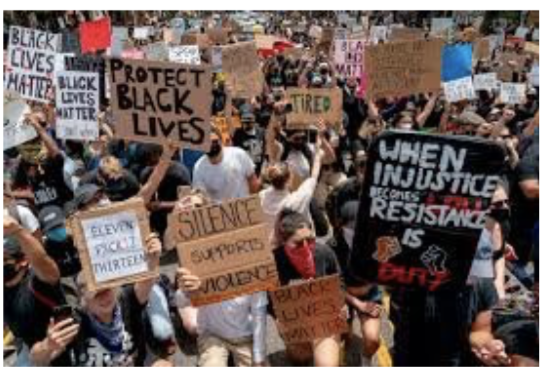
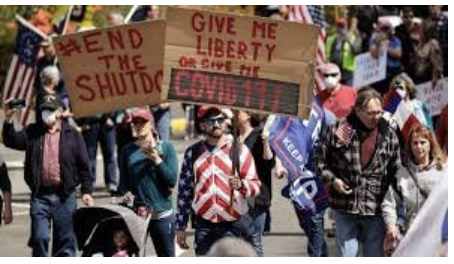
[A]s public health advocates, we do not condemn these gatherings as risky for COVID-19 transmission. We support them as vital to the national public health and to the threatened health specifically of Black people in the United States. …. This should not be confused with a permissive stance on all gatherings, particularly protests against stay-home orders. Those actions not only oppose public health interventions, but are also rooted in white nationalism and run contrary to respect for Black lives.
Leaving aside for the moment the charge that it’s racist to want to open your commercial campground or bookstore in order to save your livlihood and the business you’ve put your life and your savings into, there’s a bigger issue: should we yield to the state the power to decide which part of the First Amendment that recognizes the right of citizens to peacfully assemble can be curtailed and supressed? Meghan Mcardle, who has supported the home-confinement rules until now, has some thoughts on this:
In the happy scenario, the protests will have performed an enormous public service, even beyond agitating for justice. They are basically running a natural experiment that scientists could never have ethically undertaken: Do massive outside gatherings — including singing, chanting, screaming and coughing — spread covid-19, or not? Along with evidence from the Memorial Day weekend parties at Missouri’s Lake of the Ozarks, they may well demonstrate, once and for all, that the risk of spreading covid-19 outdoors is negligible. At which point, throw open the bar patios and backyard barbecues! Bring on the beach-blanket bingo! Move church pews into the parking lot and sing away!
Unfortunately, it’s also grimly plausible that in a few weeks we’ll see new outbreaks that will soon surge out of control, taking many American lives. Because we’ll never be able to lock down our cities again; once you’ve let the cat out of the bag, kitty won’t allow himself to be stuffed back in. . . .
First, as was pointed out when red states were protesting, you may have every right to risk your own death, but with infectious disease, protesters also risk killing other people, who might not have volunteered to die for your cause. Which brings us to the second caveat: In a diverse and highly pluralistic society, authorities don’t get to declare some causes worthy and others worthless. . . .
It may seem obvious to you that ending police brutality rises to a level of importance that, say, church services don’t. But the impossibility of rank-ordering competing ideas about what is “most important” is the reason liberal democracy had to be invented. If you were a religious believer, you might rank church higher; if you were about to lose your house unless your business reopened, you might put nail salons high up on the list.
As individuals, we can make those distinctions. But our authorities may not except on broadly neutral terms. Some public officials seem to imagine that if they can distinguish between selling food and offering Communion, they must also have the authority to make even finer distinctions: allowing people to exercise their First Amendment right to protest police brutality, while circumscribing their First Amendment right to worship in public. Legally, I doubt it, but I’m quite positive that courts won’t let governments distinguish between assembling to protest police brutality and assembling to protest public health policy.
One can, of course, argue that there’s a moral difference. But moral distinctions have no force outside the community that makes them. However satisfying it feels to call one sort of protest “suicidal,” “reckless” and “mind-bogglingly selfish,” while describing the other as a noble and necessary fight against injustice, this will not restrain the disdained. Indeed, the perceived hypocrisy will deafen them to anything said after that.