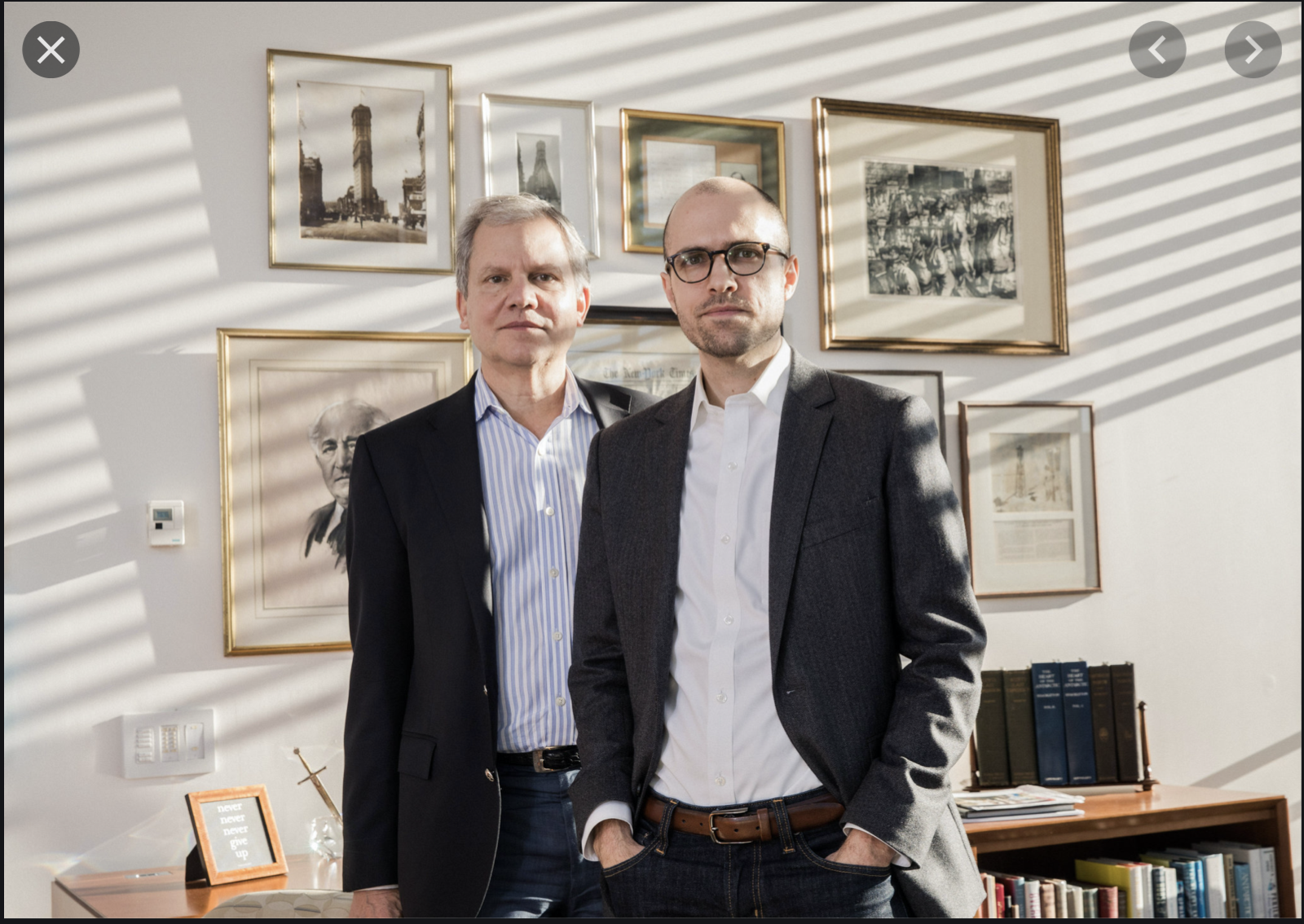
Dear A.G.,
It is with sadness that I write to tell you that I am resigning from The New York Times.
I joined the paper with gratitude and optimism three years ago. I was hired with the goal of bringing in voices that would not otherwise appear in your pages: first-time writers, centrists, conservatives and others who would not naturally think of The Times as their home. The reason for this effort was clear: The paper’s failure to anticipate the outcome of the 2016 election meant that it didn’t have a firm grasp of the country it covers. Dean Baquet and others have admitted as much on various occasions. The priority in Opinion was to help redress that critical shortcoming.
…
But the lessons that ought to have followed the election—lessons about the importance of understanding other Americans, the necessity of resisting tribalism, and the centrality of the free exchange of ideas to a democratic society—have not been learned. Instead, a new consensus has emerged in the press, but perhaps especially at this paper: that truth isn’t a process of collective discovery, but an orthodoxy already known to an enlightened few whose job is to inform everyone else.
Twitter is not on the masthead of The New York Times. But Twitter has become its ultimate editor. [emph. added]As the ethics and mores of that platform have become those of the paper, the paper itself has increasingly become a kind of performance space. Stories are chosen and told in a way to satisfy the narrowest of audiences, rather than to allow a curious public to read about the world and then draw their own conclusions. I was always taught that journalists were charged with writing the first rough draft of history. Now, history itself is one more ephemeral thing molded to fit the needs of a predetermined narrative.
My own forays into Wrongthink have made me the subject of constant bullying by colleagues who disagree with my views. They have called me a Nazi and a racist; I have learned to brush off comments about how I’m “writing about the Jews again.” Several colleagues perceived to be friendly with me were badgered by coworkers. My work and my character are openly demeaned on company-wide Slack channels where masthead editors regularly weigh in. There, some coworkers insist I need to be rooted out if this company is to be a truly “inclusive” one, while others post ax emojis next to my name. Still other New York Times employees publicly smear me as a liar and a bigot on Twitter with no fear that harassing me will be met with appropriate action. They never are.
….
I do not understand how you have allowed this kind of behavior to go on inside your company in full view of the paper’s entire staff and the public. And I certainly can’t square how you and other Times leaders have stood by while simultaneously praising me in private for my courage. Showing up for work as a centrist at an American newspaper should not require bravery.
Part of me wishes I could say that my experience was unique. But the truth is that intellectual curiosity—let alone risk-taking—is now a liability at The Times. Why edit something challenging to our readers, or write something bold only to go through the numbing process of making it ideologically kosher, when we can assure ourselves of job security (and clicks) by publishing our 4000th op-ed arguing that Donald Trump is a unique danger to the country and the world? And so self-censorship has become the norm.
What rules that remain at The Times are applied with extreme selectivity. If a person’s ideology is in keeping with the new orthodoxy, they and their work remain unscrutinized. Everyone else lives in fear of the digital thunderdome. Online venom is excused so long as it is directed at the proper targets.
Op-eds that would have easily been published just two years ago would now get an editor or a writer in serious trouble, if not fired.
….
The paper of record is, more and more, the record of those living in a distant galaxy, one whose concerns are profoundly removed from the lives of most people. This is a galaxy in which, to choose just a few recent examples, the Soviet space program is lauded for its “diversity”; the doxxing of teenagers in the name of justice is condoned; and the worst caste systems in human history includes the United States alongside Nazi Germany.
Even now, I am confident that most people at The Times do not hold these views. Yet they are cowed by those who do. Why? Perhaps because they believe the ultimate goal is righteous. Perhaps because they believe that they will be granted protection if they nod along as the coin of our realm—language—is degraded in service to an ever-shifting laundry list of right causes. Perhaps because there are millions of unemployed people in this country and they feel lucky to have a job in a contracting industry.
Or perhaps it is because they know that, nowadays, standing up for principle at the paper does not win plaudits. It puts a target on your back. Too wise to post on Slack, they write to me privately about the “new McCarthyism” that has taken root at the paper of record.
All this bodes ill, especially for independent-minded young writers and editors paying close attention to what they’ll have to do to advance in their careers. Rule One: Speak your mind at your own peril. Rule Two: Never risk commissioning a story that goes against the narrative. Rule Three: Never believe an editor or publisher who urges you to go against the grain. Eventually, the publisher will cave to the mob, the editor will get fired or reassigned, and you’ll be hung out to dry.
For these young writers and editors, there is one consolation. As places like The Times and other once-great journalistic institutions betray their standards and lose sight of their principles, Americans still hunger for news that is accurate, opinions that are vital, and debate that is sincere. I hear from these people every day. “An independent press is not a liberal ideal or a progressive ideal or a democratic ideal. It’s an American ideal,” you said a few years ago. I couldn’t agree more. America is a great country that deserves a great newspaper.
…. I can no longer do the work that you brought me here to do—the work that Adolph Ochs described in that famous 1896 statement: “to make of the columns of The New York Times a forum for the consideration of all questions of public importance, and to that end to invite intelligent discussion from all shades of opinion.”
Ochs’s idea is one of the best I’ve encountered. And I’ve always comforted myself with the notion that the best ideas win out. But ideas cannot win on their own. They need a voice. They need a hearing. Above all, they must be backed by people willing to live by them.
Sincerely,
Bari