And their other job is collecting grants serving as global warming experts

“Garbage! Their claims are garbage, and so are they!”

Here’s how many bees you’re killing with your car — and why that’s dangerous for the environment

New research finds that millions upon millions of bees are killed in collisions with cars in the United States annually — posing a major problem for the economy and environment, experts insisted in a buzzy new report.

The study, published in the journal Sustainable Environment, was conducted in Utah using sticky traps fixed to the bumpers of mid-sized cars — that were then driven at length around The Beehive State.

… “We estimate that hundreds of millions [of] bees could be killed every summer, just considering the roads on which we conducted our surveys,” they wrote.

“Regardless of what the number is — if it’s millions or billions — it’s a large number of bees that are being impacted,” author Joseph Wilson told Sciencenews.org.

“My gut says we’re likely underestimating, because every time I drove, I hit at least one bee.”

Reed Johnson, a researcher in Ohio State’s Department of Entomology with no affiliation to the new data, has warned for years that bee populations are at serious risk.

Losing so many winged insects — he said bees are the most important pollinators around — will sting worse than we imagine.

Johnson explained that bees pollinate about a third of the world’s food supply and their natural services are valued at nearly $20 billion annually.

He also noted that the populations are “declining at a rapid, unprecedented rate.”

Scary stuff, and absolute bullshit:

Honeybee populations are hitting record numbers. Weren’t they dying off before?

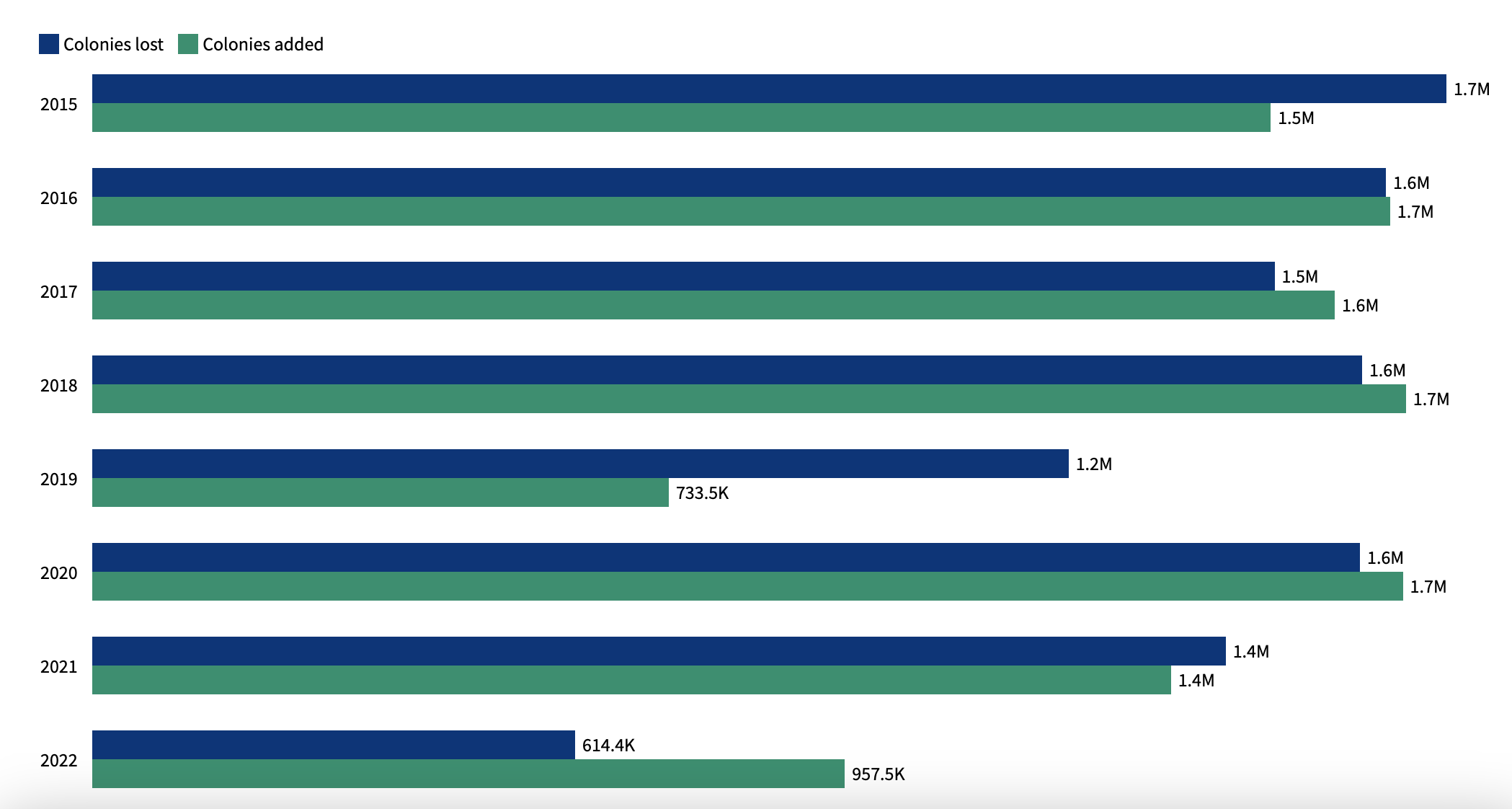
Between January 2015 and June 2022, the US lost 11.4 million honey bee colonies and added 11.1 million.[2]

Annual loss rates for honey bees have improved compared to previous decades, such as the 1980s when rates were as high as 9% nationwide. The highest loss rate over the past decade has been 4%, indicating a concerning but manageable decline for those who rely on bees for crop pollination.

A little more than a decade ago, environmentalists and agriculturalists were sounding the alarm for bees. Some 10 million beehives had been lost in the previous years, and scientists weren’t completely sure why. The consequences of this widespread loss could have been dire for crops and humans.

Today though, bees are still around. In fact, the U.S. might have more honeybees than ever, with more than 1 million bee colonies added in the last five years, bringing the total to nearly 4 million. Bees are still struggling in many ways, but they’re far from endangered.

Bryan Walsh, editorial director at Vox, joined “Marketplace” host Kai Ryssdal to talk about how we all got it so wrong, and what the reality is for bees today. An edited transcript of their conversation is below.

Kai Ryssdal: So you wrote in Time Magazine, like 10-ish years ago, about bees. The headline was “A World Without Bees.” And yet we still have bees. What happened?

Bryan Walsh: We clearly do. Yes. I mean, sometimes that happens. When you’ve done this as long as I have, like 20 or 25 years, sometimes you were right and sometimes you’ll be wrong. As it turns out, the bees were a lot more resilient than perhaps some of us expected. But also, I think the reason why they are is because they turned out to be really valuable to us. I think a lot of it came down to the fact that we just looked at honeybees in the wrong way. We saw them as kind of a wild species at risk of extinction. They’re actually more like a domesticated species.

I'd take it; but then, I would have to take it — I'm shy a one and a four.

52 Carriglea Drive, Riverside, is new today and asking $14.250 million. Nice house, nice street, and a very nice view, even it looks across Cos Cob Harbor rather than down the Sound. Mud flats at low tide, but you’ll want to keep your yacht at the RYC, just a few hundred yards away.

The owners bought the property as a building lot in 2003 for $4.425 million, and it’s obvious that much more money was put into building new. I don’t know what it will eventually sell for, but my best scientific guess is “a whole lot”.

you can keep an eye on your boat from the terrace

gone and mercifully forgotten – 1969 was not a banner year for architecture

It won’t surprise me if they get this price, or more

Newly listed, 3 Bennett Street is priced at $3.850 million. Bennet is a small dead end south of the Village, this house has been recently renovated, and it sits on 0.4-acres, which, in this part of town, passes for an over-sized lot. With no inventory to choose from, buyers who want to live down here are going to have to pay a premium to do so, and I have no doubt that there’s at least one of them out there who’s willing to do so.

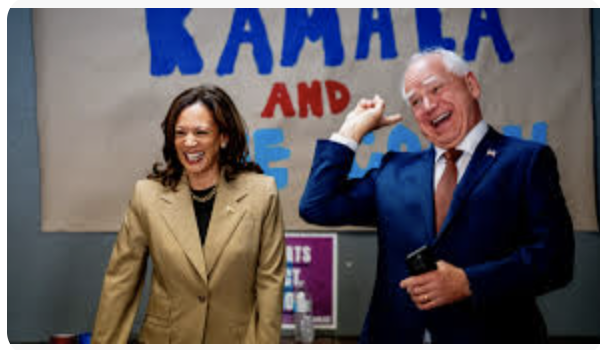
Amusing headline, but also an interesting look at Kampalla's handler's marketing program from a public relations pro

They Did Nazi It Coming: How Comparing Trump to Hitler Cost Kamala the Election

I’d say it was more one of a thousand cuts that, combined, killed her campaign, but allowing for the author’s bit of hyperbole (leave it to a PR guy to think that his industry controls the world) he makes a valid point.

Of all the Harris-Walz team’s boneheaded, braindead decisions, riding with the Fuhrer until the bitter end was nummer eins. Throughout the entire presidential campaign, their primary PR message was “Trump is Hitler,” and they did everything possible to tie the Right to the Reich. They were relentless and unyielding.

It was also PR malpractice.

Look, if you honestly, truly believe a candidate is Adolf Hitler, you’re not going to vote for him. Of all the constituencies Harris-Walz didn’t have to fight tooth and nail for, it was the “Trump is Hitler” true believers! They were going to vote for Kamala Harris anyway, irrespective of ANYTHING she said or did.

Why? You guessed it: Because “Trump is Hitler.”

It’s PR malpractice to squander resources on captured demos, especially when you’re trailing badly elsewhere!

For crying out loud, it’s 2024. Trump has “literally been Hitler” since 2016. We’ve all heard it ad nauseum. For the life of me, I don’t understand why the Democrats assumed voters who were unconvinced the first 50 gazillion times would change their mind after 50 gazillion and one.

They would’ve been better served by lighting their money on fire. They wasted so much time and energy.

But it also cost them something else — and in doing so, it (at least partially) cost the Democrats the entire election.

… [T] hink about the average, run-of-the-mill American who heard yet ANOTHER pitch from the Democrats about “Trump is Hitler.”

Do they pay attention? Did it move them?

Or did the Democrats “train” them to ignore whatever they say next because they’re unserious, dishonest, and unworthy of their time? 

To any level-headed American, comparing someone to Hitler is the lowest of the low. He’s the ugliest, most loathsome monstrosity of the modern age — the architect of the Holocaust and a genocidal Nazi warmonger. It’s not a trivial allegation. 

If you’re gonna call someone Hitler, you better bring the receipts!

And once again, the year is 2024. The American people have a pretty good feel for who Donald Trump is — and who he isn’t — by now. They know his strengths, weaknesses, silliness, and eccentricities. They know sometimes (to quote Joe Rogan) he says “crazy s**t.”

But they also know he’s NOT Adolf Hitler!

That was the hidden cost of the Democrats’ “Trump is Hitler” PR campaign. It wasn’t just time and money they lost. It also cost them their credibility. 

And it made the American people ignore everything else they had to say.

In retrospect, it’s actually kind of impressive: The Democrats couldn’t even get calling someone Hitler right! Even THAT backfired. 

Now that takes talent!

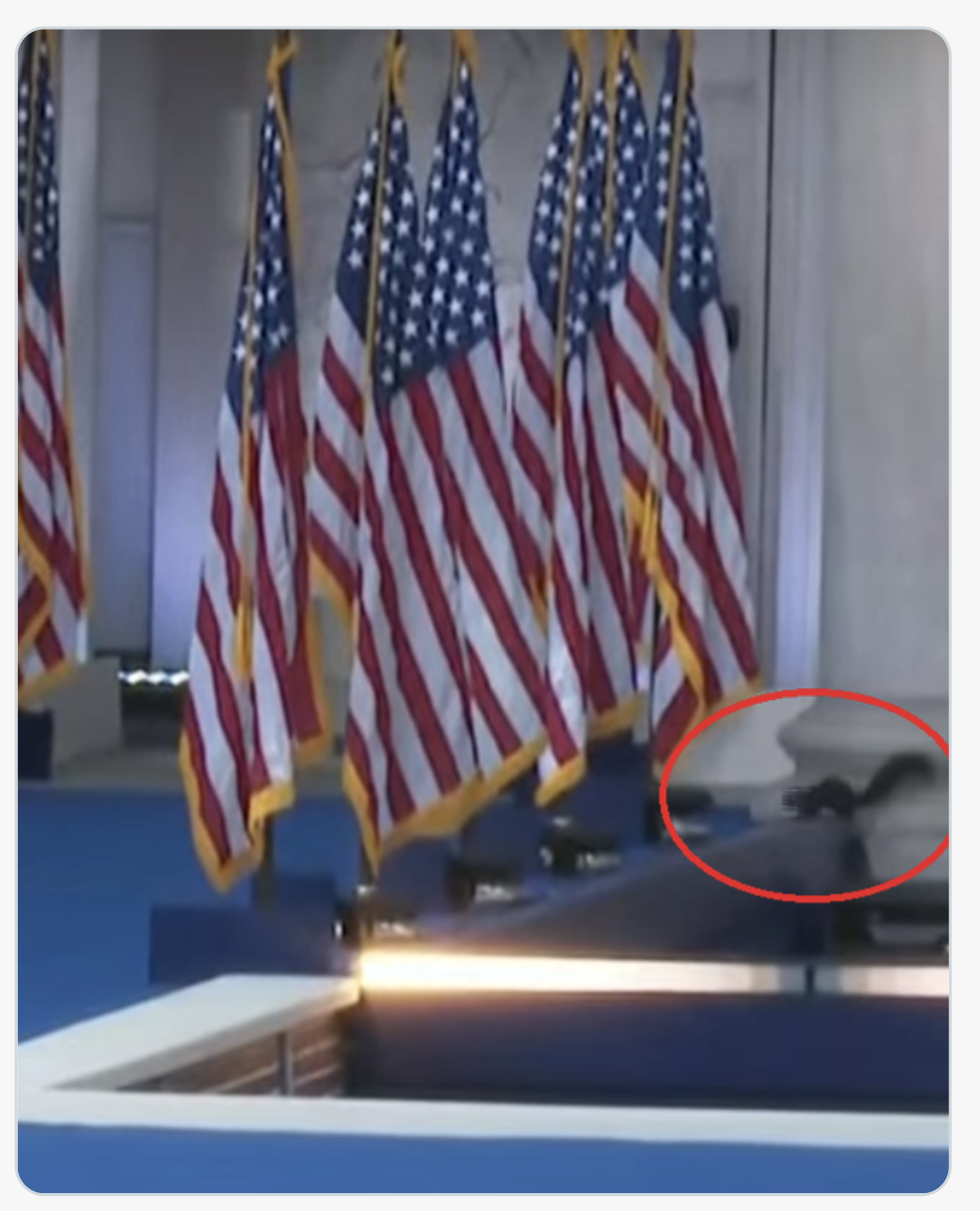
Trump: "I can call spirit squirrels from the vasty deep." Kampalla: "Why, so can I, or so can any man; But will they come when you do call for them?"

P’Nut’s revenge

In this case, yes. (Thanks, Burning Man, for the tip)