Rushing to bury the bodies

“All I know about it is that it’s bigger than a choo choo train, and Hunter’s friends like it.”

Free Beacon: Dem Lawmakers Hinder Federal Investigation Into Biden Admin's $400 Billion Green Energy Loans

Democratic lawmakers are seeking to hinder a federal watchdog investigation into misconduct within the Biden administration’s $400 billion green energy loan program—a sign Democrats could be growing concerned about what the long-running probe has uncovered.

The inspector general for the Department of Energy has spent over a year investigating the Loan Programs Office, which has been accused of dishing out billions in government loans to politically connected recipients, including companies teetering on bankruptcy and entities linked to foreign adversaries.

Now Democrats on the House Energy and Commerce Committee have taken the unusual step of launching an investigation into the investigators. In a letter last week, Democrats accused DOE inspector general Teri Donaldson of "bypass[ing] competition requirements that exist to ensure taxpayer dollars are not wasted" when she hired an outside law firm, Rabalais & Associates, to assist in her probe.

Energy insiders said the Democrats’ move to target the inspector general was "weird" and indicates that the Biden administration is concerned about what the forthcoming IG report will reveal.

"To be investigating the IG, that’s a little weird," one former DOE official told the Washington Free Beacon. "They’re trying to discredit the report before it’s even released."

"That probably means the report’s pretty bad," the former official added.

Donaldson, who defended the law firm’s hiring in a written response on Wednesday, is expected to release a report on the loan office that could contain damaging revelations about the Biden administration's program. The once-sleepy loan office, whose budget was expanded more than 2,200 percent under President Joe Biden, now has a lending authority that rivals the commercial loan portfolio size of Wells Fargo and other international banks.

In recent weeks, the loan office has been scrambling to push out multibillion-dollar loans before President-elect Donald Trump takes office.

Donaldson told lawmakers in 2023 that her office was "looking at conflicts of interest particularly in the Loan Programs Office," following Free Beacon reports that the loan program’s director had personal, professional, or financial ties to some of the companies receiving loans. Last summer, Donaldson expanded the probe by hiring Houston-based energy law group Rabalais & Associates.

She also defended her probe as "long over-due," noting that the loan office had a "checkered history" and hasn’t been properly reviewed in over a decade. In 2012, the Loan Programs Office was embroiled in scandal after issuing a $500 million loan to Solyndra, a politically connected solar company that went bankrupt and defaulted.

The type of person who would base his buying decision on a neighbor’s politics is not who I’d want moving in next to me, but still … creepy.

on the other hand, if it saved me from buying next door to a house filled with crippled transvestites and illegal aliens, maybe this app would be useful

From FWIW’s Taos correspondant, this:

New real estate platform lets homebuyers check their neighbors’ political affiliations

A new real estate platform is giving homebuyers an unprecedented peek into their potential neighborhoods — revealing everything from political leanings to local demographics — before they even commit to buying.

Oyssey, a tech startup soft-launching this month in South Florida and New York City, lets buyers access neighborhood political affiliations based on election results and campaign contributions, along with housing trends and other social data.

The platform is betting that today’s buyers care just as much about their neighbors’ values as they do about square footage or modern finishes.

“It’s about getting buyers homes that they love,” CEO Huw Nierenberg, a former Boston real estate agent told Axios, which reported news of the tool. Nierenberg didn’t immediately respond to The Post’s request for comment.

He says buyers’ priorities have evolved, explaining that during house tours, “buyers often move from asking whether the water heater is leaking to wondering if their neighbors are folks they’d like to invite to dinner someday.”

Surprisingly, only three students volunteered to waste their time on this course; the professor will still be paid, of course (UPDATED)

From The Maine Wire

Down the Crapper: Maine University Offers Class on Bathrooms

Students of the taxpayer-funded University of Maine at Augusta will have the opportunity to take a college-level course all about bathrooms starting in the spring semester, studying under gender studies professor Lisa M. Botshon.

The upcoming class, “An Interdisciplinary Exploration of the Bathroom,” promises to consider the various “values” surrounding the act of using the bathroom in different cultures and examine the way the “politics of identity” influences our thoughts on restrooms.

“Everyone has to go to the bathroom. However, where we go, how we go, when we go, and the ideas and values that surround that act vary among cultures and across time and space,” said a flyer advertising the course.

…. Professor Botshon, a member of the English department, focuses her research on female writers, gender, race, and ethnicity, along with American pop culture.

Botshon is a registered Democrat and, according to publicly available payroll information, makes $93,616.23 a year in her taxpayer-funded salary as a professor at one of Maine’s many state-funded universities…. Her other Spring 2025 classes include the distinct courses “Women Writers” and “Major Women Writers.”

Botshon’s bathroom class is not the only outlandish course funded by Maine taxpayers at UMA.

Students can bask in the knowledge of “Feminist Praxis for Radical Self and Community Care,” which boldly claims, “Radical self-care is inside-out work,” and promises to teach attendees how to develop their own self-care routines.

Education students can take the “Mindful Teachers Teaching Mindfulness” course, which promises vaguely to enumerate the benefits of “practicing mindfulness.”

“Mindful teachers teaching mindfulness can reduce stress and anxiety, promote focus and deeper engagement, and improve both academic and behavioral outcomes,” said the class description.

English majors can take the “Embodied Writing” class, which will “explore approaches for writing about our bodies (e.g., athleticism, disability, habitual actions) as well as what it means to be a body writing (i.e., physical ways of composing).”

Here’s hoping the DOGE program starts off by focusing on governmental subsidies for the nation’s colleges and universities.

UPDATE: Fewer potty training classes, more of these:

As predicted

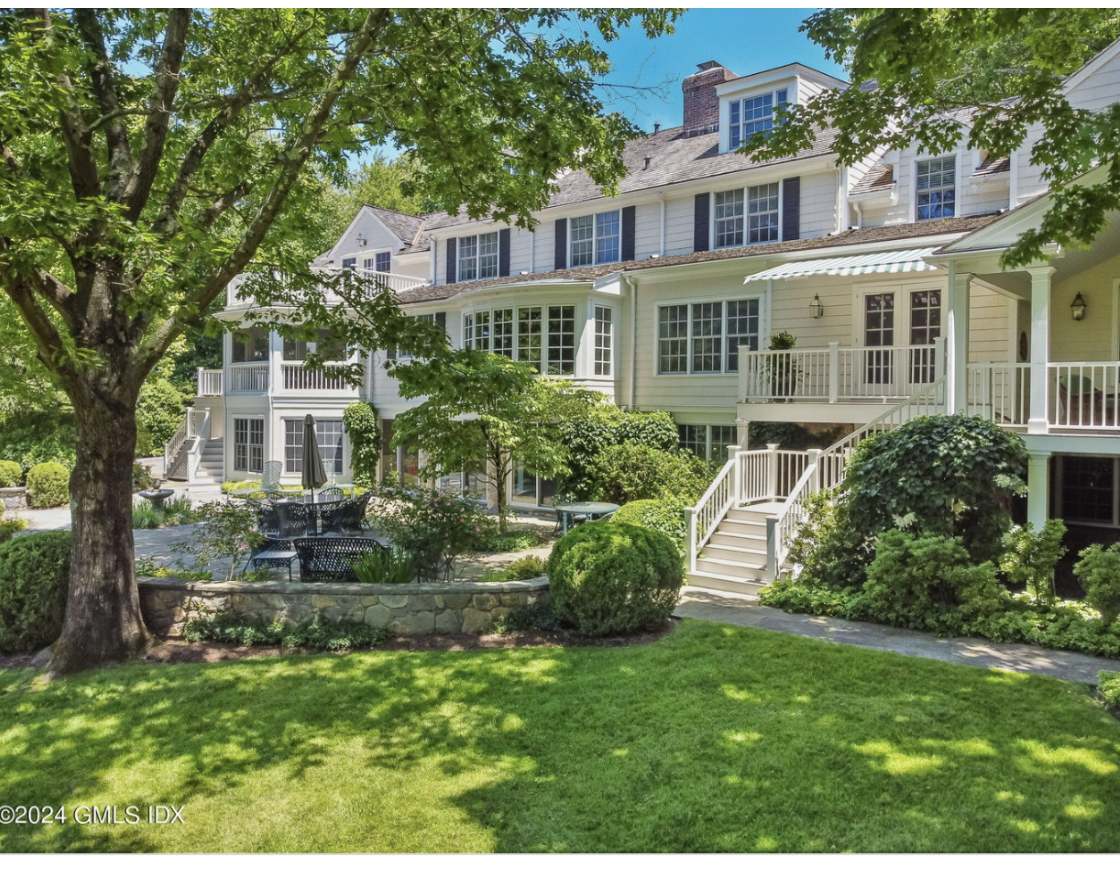
When 169 Old Church Road first appeared on the MLS back in November I wrote “[Being] sold ‘as is’, it’s not unfair to say that it’s worth whatever an acre of land of Old Church is worth, and no more.” Today it’s been reported sold for $2,210,000; the selling agent often represents builders, as I’m sure he did here.

So now we know what an acre of land on Old Church is worth.

Well, golllee — surprise, surprise surprise!

how much!!!???

Cost to convert entire Greenwich fleet to electric leaf blowers 'shellshocking,' officials say

GREENWICH — Town officials voted to enact a summertime ban on gas-powered leaf blowers earlier this year and now the bill is coming due.

The Departments of Public Works and Parks and Recreation have asked finance officials for $476,000 to buy new electric leaf blowers and upgrade facilities to store the new gear.

… DPW and Parks and Recreation leaders told the Board of Estimate and Taxation on Dec. 10 that the $476,000 is basically the bare minimum they need to go electric and comply with the legislation.

“We're not over-asking,” Parks and Recreation director Joe Siciliano said. “We're just asking for what we think we need based on our work capacity and also the amount of acreage, which in Parks — it's over 2,000 acres.”

The total would allow the two departments to convert half of their respective blower fleets to electric, Deputy Commissioner of Public Works Jim Michel said.

"If we were to truly do this for the whole fleet, full power and so forth, we'd probably be looking at all new (electric) services, basically from the (utility) poles out on the street," he said. “Which would have been a significantly higher number than you even have in front of you today, which we knew was going to shellshock (the BET) because it was shellshocking us.” 

Parks and Recreation wants to buy 21 Stihl backpack leaf blowers, dozens of accompanying batteries, handheld leaf blowers and 21 portable power stations to charge up in the field. DPW is requesting the same equipment in smaller quantities.

The bulk of the cost, Siciliano said, comes from the batteries. The Parks Department asked for 21 primary backpack batteries which cost $1,529 each, according to BET documents, and each of the 42 backup batteries cost $1,299.

The departments have also asked for money to upgrade electrical panels in storage sheds so they can handle the excess power demands as well as money to buy specialized cabinets to hold the batteries. The cabinets are designed to stop the spread of fire if a battery fails and combusts.

Each battery lasts about two hours, officials said, but that can vary depending on how vigorously the batteries are being used. A light job may extend battery life past two hours, but intense blowing will drain the charge quicker.

Given that capacity, officials are working off the assumption that a blower will start a work day with two full batteries and one filling up on a mobile charger. As batteries are drained, they will go on the charger — and even then crews may run out of juice.

“I do think that the three (batteries) are gonna get us through the day, just barely, in most of our jobs,” Daniel Carlsen, assistant director of parks and recreation, said.

Those of you who employ private yard services can expect to add similar costs to your own bill, as well as joining your fellow tax payers in paying for this particular harebrained scheme. Did no one really not price this out before whooping it through the legislative process? Of course not; government by good intentions doesn’t work that way.

Fat, dumb and clueless is no way to go through life, Timmy

Hey, I know what we should do next time: double-down on woke!

The failed VP candidate has been returned by his handlers to Minnesota, where he’s given an interview to a sympathetic local newspaper, expressing his disappointment and wondering where things went wrong.

"How in the world did we lose to a billionaire or a venture capitalist, when we were making the case of a country attorney and a high school teacher?" he asked later in the interview, contrasting his ticket with Trump’s.

Walz made the point that he thought his more humble economic status should have appealed to voters, and seemed puzzled that wasn’t the case.

"And I thought that would be something people say, ‘Well, this guy knows where we’re coming from. He’s had to pay his bills and still does,'" he said, referring to himself. [Vance grew up even poorer than Walz, but unlike this assistant high school football coach, made something of himself.]

Earlier in the discussion, Walz stated, "And this is the one that keeps me up at night, is I focused my whole career in focusing on the middle class… And it seemed like a lot of good ideas were coming from the Democrats."

"I still believe that," he continued, "but apparently in this election, not the majority of Americans did. They chose to vote with a billionaire, who’s talked about not paying overtime, who has a long history of not paying his workers, someone who wants to take away the ACA." [Heavens, how could the peasants possibly not be worried that ObamaKare might be repealed?]

Seeing this, Walz concluded that this happened because his party did not communicate their middle-class appeal well enough.

"So, I come back to the conclusion, is we did not do a good enough job – we as a Democratic Party and we as a ticket – did not do a good enough job of showing them that we understand where they’re coming from," the governor said.

He added, "And I feel like one of my roles is – going forward here is – figuring out a way to make the case to the public, the American public, is that the Democratic Party really is focused on the things they care about."

Clueless to the end, and beyond, Walz doesn’t realize that he has no role “going forward”; worse, he still believes that his party is “focused on things the American public care about”, like genital mutilation of minors, open borders for the world’s poor, forced purchase of $70,000 battery cars, elimination of cheap, abundant energy, destroy our military, and, of course, mandate tampon dispensers in boys bathrooms.

Keep it up, guy; may your party stay out of power forever.

Environmentalists eat their own

I’ve been pointing this out for a long time now, but it bears repeating: all of the grand schemes for building “green energy” projects: solar farms, windmills, new transformer sites, power lines to bring off shore and wind power from where it’s generated to where it’s needed, etc. will be and are being blocked by other groups, equally fanatical, who oppose them. The story below actually involves, not a green advocate but two adjoining property owners with their own private agendas, but it’s a perfect illustration of how the environmental laws enacted over the past decades provide opponents the legal warfare tools to obstruct, delay, and block energy projects.

Have I mentioned the mines that will be needed to provide the minerals and ores necessary to build a new power infrastructure, let alone Trump’s plans to revive traditional ones? Forget them

Bay Area food bank move could be blocked by lawsuit citing ‘historic parking lot’

The Alameda Food Bank and the environmental startup Natel Energy would seem to have little in common.

One supplies grains and proteins and vegetables each week to about 1,200 Alameda households. The other has come up with new “fish safe” hydropower turbines that don’t kill or maim the eels and trout and catfish that swim through their blades.

But in the past two weeks [this rticle is from September 2024] the two organizations, both located among the eclectic and vibrant evolving neighborhood at the former Naval Air Station Alameda, were delivered similar bad news: lawsuits challenging plans to expand their operations. 

Behind the lawsuits are two longtime Alameda residents, Building 43 Winery owner Tod Hickman and Shelby Sheehan, a former Alameda Point resident involved in a rent dispute with the city. Using similar language, both lawsuits say the city violated state law by not requiring the food bank and Natel to complete full studies on how the projects would impact the environment.

“Critics say the lawsuits are extreme examples of how a couple of residents can weaponize the state’s well-intentioned California Environmental Quality Act law, known as CEQA, to block developments.”

“Who attacks a food bank?” said Alameda Mayor Marilyn Ezzy Ashcraft. “They are using CEQA law and the judicial process to attack an absolutely essential service and an important environmental business. If they get away with this, what will come next?”

On a recent Tuesday, Alameda Food Bank Executive Director Teale Harden gave a tour of the nonprofit’s current home at 650 West Ranger. The building, a single cavernous warehouse, has no place for the food bank’s 1,200 weekly customers to wait, no offices in which to conduct business, inadequate refrigeration and nowhere for the 500 volunteers to take a break. Rain blows in through the roll-up doors in the winter. 

“We make a lot of effort to provide food in a respectful and dignified way, and that’s not possible here,” Harden said. “This building wasn’t designed to have people in it.”

As an alternative, the food bank purchased a smaller 5,000-square-foot building across the street on Ranger Avenue for $3 million and won city approval to expand it with a prefabricated 10,000-square-foot warehouse with walk-in refrigeration and plenty of space for food storage. Demolition of the existing building has already started, and the food bank was planning to be in the new facility by June. The lawsuit may make that impossible.

“It’s a very, very fast timeline, which is why this is so frustrating and urgent,” Harden said.  “We don’t have any wiggle room. If anything gets delayed, we are pushing into time that we don’t really have.”

A demolition crew works outside 677 W. Ranger Ave, a building where the Alameda Food Bank wants to move to. But the community food bank’s move is on hold after neighbors sued using the California Environmental Quality Act.

Both Hickman and Sheehan are well known around the neighborhood. Sheehan was evicted from a city-owned property after she stopped paying rent in 2020 over a dispute, according to court records. Hickman regularly speaks at City Council meetings and has been critical of the way the city has handled the redevelopment of the base. In a 2022 Chronicle story Hickman complained that the neighborhood was “in a state of disrepair.”

Hickman, on Friday, told the Chronicle he is a supporter of both Natel and the food bank but is objecting to what he characterized as the city’s “criminal violation of the second most important law after the First Amendment.”

“We are not suing anyone but the city of Alameda,” Hickman said. “The city did not follow CEQA law by issuing fraudulent notices of exemption.”

He said he plans on filing three more CEQA lawsuits in Alameda Point in the next 30 days, despite the fact that his targeting the food bank has generated “hundreds” of one-star reviews of his winery on social media. “I’m going to have to start going to the food bank, myself, because they have done a good job of destroying my business.”

….

In the lawsuit, Hickman and Sheehan argue that the warehouse would destroy a portion of “an in-use, historic parking lot” and called the proposed 35-foot tall prefabricated building “historically-offensive.” They said the city violated CEQA laws by not analyzing the project for its impacts on “noise, historic resources, water and quality, impacts to adjacent uses, traffic, and safety.” Hickman has also argued in public testimony that the food bank would be better off at a different location “down the road.”

….

Gregor Cadman, chief operating officer of Natel Energy, says the turbine company’s expansion is necessary to close two contracts “critical to the continuation of our business.”

Natel, which employs 33 people, developed its blunt-bladed turbines in the warehouse. Just outside the building’s roll-up doors is a “pumped hydraulic test facility,” a network of white tubes connected to a tank of water. It’s about the size of a play structure at a playground. 

“It’s pushing flow through the turbine so we know how much hydraulic power is going into the turbine and how much electrical power is coming out,” said Gregor Cadman, the company’s chief operating officer.

Cadman said the expanded testing equipment, which will not increase the height of the current facility, is needed to close two contracts “critical to the continuation of our business.”

Kate Stirr, vice president of external affairs for Natel, noted the irony of using a law meant to protect the environment to disrupt a business doing “critical environmental protection work.”

“We need to complete the expansion in order to scale this technology up,” she said. “The impact it could have on the global hydro power fleet is profound. It would transform the current fleet that kills fish into a hydro fleet that still provides the renewal energy we need … but to also reverse the biodiversity decline that we are seeing in fresh water fisheries.”

In the CEQA challenge, Hickman and Sheehan call Natel’s proposed expansion “the most recent egregious example of complete disregard for environmental and zoning regulations” at Alameda Point. 

They say the existing test equipment has caused “long term obstruction of scenic and historic vistas, violation of the Public Trust, degradation of the historic character of the District, and unknown negative impacts to the endangered California least tern, noise, water, and air quality and health effects and others that are unknown because they have not been disclosed or evaluated.”

….“Our neighbor across the street is motivated by the financial interest of his business,” Cadman said. “I can appreciate that. If we didn’t have to have the equipment here we would have it elsewhere, but due to fish and wildlife restriction with the least tern colony we can’t have the equipment behind the building.”

Cadman said the use of CEQA to block Alameda Point redevelopment projects “sets a concerning precedent.”

“I’m not sure how much further this could go. It could affect the city’s ability to have a healthy civic and economic development path,” he said.