
Sale Price Reported
/81 Hendrie Avenue, Riverside, listed January 15th @$4.1 million, sold today for $4.250.
I’ve given up expressing surprise at these prices.
Greenwich, Connecticut real estate, politics, and more.
Greenwich, Connecticut real estate, politics, and more

81 Hendrie Avenue, Riverside, listed January 15th @$4.1 million, sold today for $4.250.
I’ve given up expressing surprise at these prices.

Maine awards the girls’ state pole vault title to a male athlete competing in the girls’ division.
— ICONS (@icons_women) February 18, 2025
Greely High School’s male star vaulter, Katie Spencer, not only won the event but also helped secure his girls’ team the overall state championship by just one point. https://t.co/gORzzNp7Xt pic.twitter.com/kEEUH8k3kc
UPDATE: Maybe Maine’s problem is that it’s too close to Canada. This, from October 2024:


A transgender aide to Justin Trudeau's minister for women has defended her participation in a race where she beat a 12 year-old girl to the 'fastest female' title.
Nathanielle Morin won a women’s 5km road run by almost six minutes in Ottawa, Ontario in February 2024, demolishing the rest of her competition in the 30-39 year-old female category with a finish time of 25 minutes and 32 seconds.
The second fastest runner across all women's tournaments that day was 12 year-old Saoirse Hoogenraad with a time of 26 minutes and eight seconds, who ran in a separate age group to Morin.
But the runner-up in Morin's age category, Maude Bisson, finished a full five minutes 44 seconds behind Morin, in 31 minutes 16 seconds.

All it took for Pete Buttigieg to finally take an interest in transportation was for him to no longer be the Secretary of Transportation.
— Charles C. W. Cooke (@charlescwcooke) February 18, 2025
'Pete Buttigieg is so bad at his job people actually know who the Secretary of Transportation is.'
— John Ringo SF Author (@Jringo1508) February 17, 2025
(can't remember who said it.) https://t.co/eXSQw3sqXo

To protect the public, scientists must unite against administration’s encroachment
The Trump administration is brash in fighting science and evidence that does not fit its COVID-19 ‘messaging.’
Why yes, I believe I did, just two days ago. So bring them down, and hang them again.
NEW: Dr. Deborah Birx admits the COVID shots were pushed on the wrong people, saying the rollout on young people ignored the science.
— The Vigilant Fox 🦊 (@VigilantFox) February 18, 2025
Now, she tells us.
“The messenger RNA vaccine should have been rolled out for the people that were at risk for severe disease because that’s… pic.twitter.com/4tCnaDA7Bo
David Strom:
Saying what Deborah Birx just did to Piers Morgan got people banned across social media, called "conspiracy theorists," "vaccine deniers," and accused of killing grandmas.
We are in the "now it can be told" phase of history, in which all the liars who made their fortunes and reputations by lying to you are now increasing their fortunes and reputations by admitting that they lied to you.
Ever wonder why officials exaggerated COVID-19 risk?
— Kevin Bass PhD MS (@kevinnbass) November 7, 2024
Here's why:
"When people start to realize that 99% of us are going to be fine, it becomes more and more difficult [to get people to comply]."
- Deborah Birx, Trump's lockdown architect
They lied to us. On purpose. pic.twitter.com/oR34tOjjsf

Or, apparently, buy it. 29 Lockwood Drive, Old Greenwich, spent 208 days on the market before its listing expired December 31st. It’s back again today, at that same failed price of $4.495 $4.995 million. I’ve written on this house before, back when it took its first and so far, only price “adjustment”, and I’ll probably have occasion to revisit it again — perhaps in June? :
September 30, 2024Chris Fountain
29 Lockwood Drive, slashed from $5.095 million to $4.995. 4,566 sq. ft. plus an additional 1,587 sq. ft. for, it is claimed, “garaging” that will accommodate 8 cars. The house itself is outside of the flood zone — barely — so we’ll assume that your underground Ferrari collection will stay dry, maybe; not so sure about that backyard pool, but isn’t it in the nature of pools to be wet?
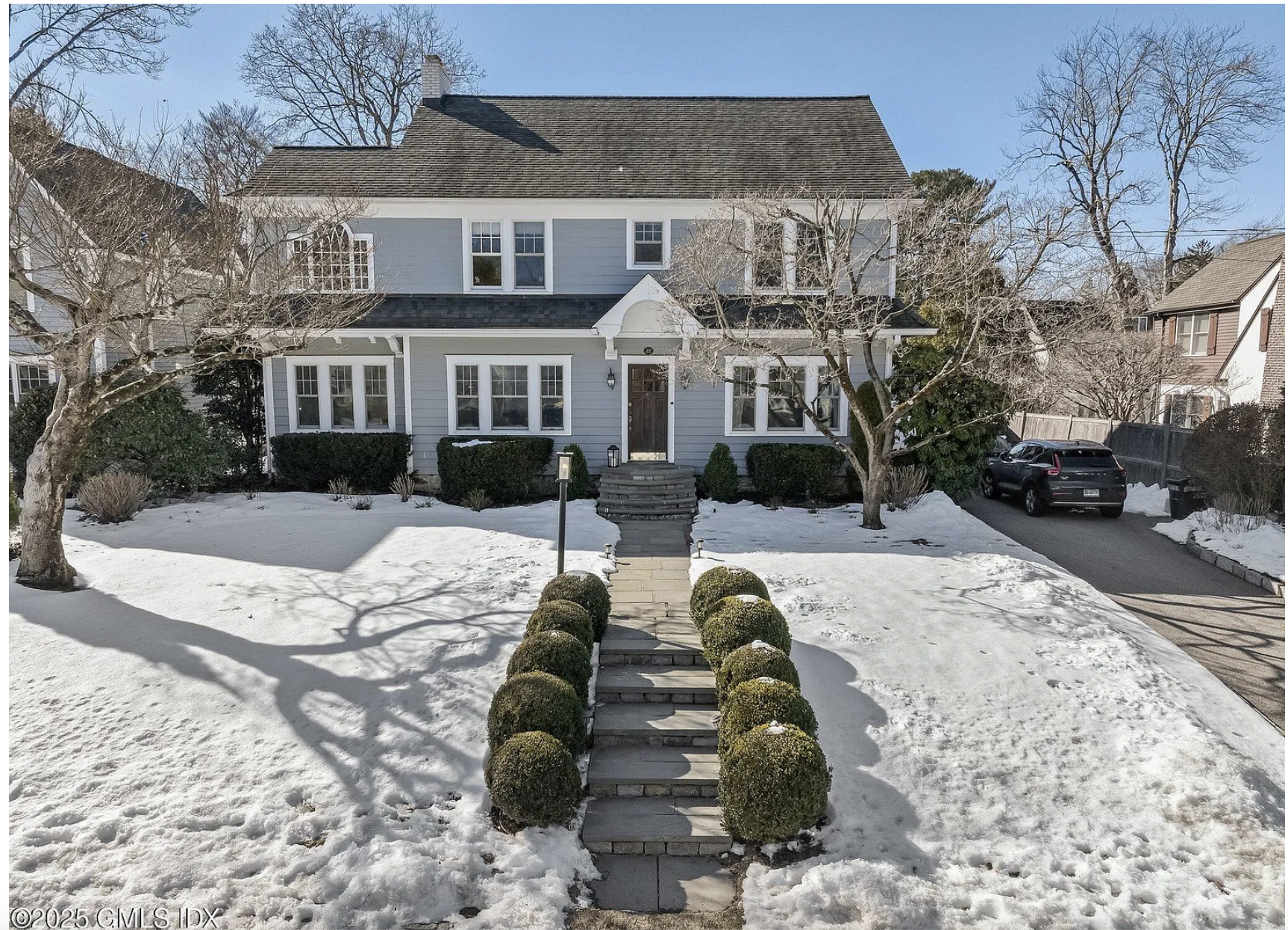
22 Oval Avenue, Riverside, $2.850 million. Built in 1928, it sold for $2.110 million in 2013 and has been upgraded since.
And there’s no available inventory in Riverside.

230 Taconic Road has taken another price cut from its 2022 price of $11.475 and is now asking $7.995 million. The owners bought it new in 2006 for $8.750 million.

And trains! DON’T FORGET TRAINS!
Fat, stupid, and predictable is no way to go through life, Democrats.
SHOT
Dem elites are feverishly working on ways to blame a plane crash in Canada on President Trump. https://t.co/JsUk6e9OwL
— SFK (@stephenkruiser) February 17, 2025
How awful is the legacy media? NBC is trying to blame President Trump and DOGE right now for a plane crash that happened in Canada. 🤦🏻♂️ pic.twitter.com/m6Ufrd5FmK
— Robby Starbuck (@robbystarbuck) February 17, 2025
CHASER:
NBC’s Tom Costello ties Donald Trump, @ElonMusk, and @DOGE to the Delta Airlines crash in Toronto, Canada: “[T]his is going yet again raised a concern about FAA staffing — air traffic control staffing. Now, this is a Canadian air traffic control tower and this is under Canadian… pic.twitter.com/KOecnP1A0n
— Curtis Houck (@CurtisHouck) February 17, 2025
More fake news from the @AP
— Karoline Leavitt (@PressSec) February 17, 2025
1. DOGE doesn’t even have a Facebook page
2. No air traffic controllers nor any professionals who perform safety critical functions were terminated https://t.co/vhrusRu3NS
Even before the Canadian air crash, Chinese spy Eric Swalwell was already at it:
BREAKING: Plane crashes in Covington, GA, leaving two dead. https://t.co/nQFZnWpBzW
— Brian Tyler Cohen (@briantylercohen) February 16, 2025
No president has had more planes crash in their first month in office than Donald Trump. https://t.co/3nyRtR1xeb
— Rep. Eric Swalwell (@RepSwalwell) February 17, 2025
This is false. According to the NTSB’s official CAROL database of aviation accident investigations, there have been 50 accidents since Trump was inaugurated. By contrast, NTSB recorded 94 aviation accidents during Biden’s first month in office in 2021. https://t.co/vpkR8R3g9v
— Sean Davis (@seanmdav) February 17, 2025

Here are brief portions of a couple of articles outlining the issue (no mentioned, but discussed here before, many times, is the Greens’ successful operations to block the construction of any new LNG terminals on the East Coast, from Florida to Maine. Anything that involves adding to the existing fossil fuel infrastructure: pipelines, refineries, transmission lines, and LNG terminals are to stopped, and so far, they have been.)
A 1920 law, Merchant Marine Act (the Jones Act), makes water-based methods for shipping goods within the United States not price-competitive with trains and trucks, causing most freight to be transported via land.
In the absence of this law, water-based transit of goods would likely be much cheaper and more widely utilized.
A transition to water-based transit would likely increase industrial demand in well-positioned markets such as New Orleans, Tampa, Houston, and eastern port markets.
Due to the Jones Act, a law passed in 1920, any vessel transporting freight from one U.S. port to another is subject to a strict set of legal criteria. Any ship engaging in such activity is required to 1.) be made in the United States, 2.) be owned by an American citizen, and 3.) be crewed by American citizens or legal residents. The motivation of this was to promote a domestic merchant-marine force and ship-building industry for national security and strategic reasons. However, these requirements substantially increase the cost of domestic trade by water.1 In part for this reason, the majority of U.S. domestic freight is carried by rail and truck, despite the U.S. having an extensive coastline and navigable waterways. According to data from the Census Bureau, 68.5% of U.S. domestic freight is carried by truck (41.6%) and rail (26.9%). Including freight carried by both train and rail (18.4%), this figure comes out to 86.9%. Only 5.6% of freight is carried by water, mainly via inland water in the Mississippi River.
So, how do these requirements increase shipping costs for the U.S. economy? How could supply chains improve in the absence of these restrictions, and how would this affect the industrial real estate sector?
This law imposes higher costs for domestic trade via water in two primary ways: reducing supply and competition and increasing capital and operating costs.
The simplest way this law reduces the supply of vessels to transport goods within the U.S. is by banning foreign-flagged vessels from moving goods. Effectively, the entire stock of ships (except for U.S. flagged ones) across the globe is banned from operating between U.S. ports. For example, if an international container ship going from Houston to Shenzhen were to stop at Tampa, it would be unable to unload any goods there. International carriers are competitive with the cost of trucking. One analysis found a potential cost savings of 36% for transporting from Long Beach, CA to Memphis, TN via ship (assuming international costs) relative to train.
And then there’s this, from 2023:
The Jones Act is a challenge for the LNG industry in the United States. The Jones Act requires that all vessels used to transport merchandise between points in the United States satisfy certain requirements: to be Jones Act compliant, vessels must be U.S.-built, U.S.-owned, U.S.-flagged, U.S.-operated and U.S.-crewed, subject to certain limited exceptions.
No Jones Act Compliant LNG Tanker
There is currently no Jones Act compliant LNG tanker, and therefore, no LNG tanker can move LNG between U.S. terminals—for example from the Gulf region, where many LNG plants are located, to regions where there is a need for LNG, such as Puerto Rico or New England. As a result, the vessels that pick LNG up from U.S. terminals are all directed to non-U.S. terminals, and the vessels that deliver LNG to U.S. terminals all come from non-U.S. terminals. There are some Jones Act compliant barges that can handle minor operations, such as moving a small quantity of LNG from the shore to a tanker that is waiting at a U.S. anchorage point in order to cool its tanks down. These barges cannot move large quantities of LNG between the regions of the United States that export LNG, and those that need it.
This situation is unlikely to change in the near future. From a commercial perspective, there is probably no business case to invest in building the first Jones Act compliant LNG tanker, because such a vessel will be too expensive to be competitive in the international market, and there is currently not enough domestic need to keep such a vessel employed in the United States only. And from a legal perspective, the federal agency in charge of enforcing the Jones Act’s requirements on the coastwise transportation of merchandise, Customs and Border Protection (“CBP”), has not given any indication that it intends to relax these requirements for the LNG industry.
New CBP Ruling on Two-Part-Loads Scenario
CBP issued on November 14, 2023 a Jones Act ruling (HQ H335463) that further limits the types of operations that foreign LNG tankers can undertake in the United States. As a result of this new ruling, in addition to being precluded from loading U.S.-bound LNG, foreign tankers will be precluded from loading several part cargoes of foreign-bound LNG at several U.S. terminals.
This is because, when an LNG tanker loads a first part cargo at a first U.S. terminal, and then loads another part cargo at another U.S. terminal, a small portion of the LNG loaded at the first terminal must be released through the vapor return lines at the second terminal, in the form of vaporized LNG or boil-off gas, in order to control pressure levels in the tanks of the LNG tanker during the second loading operation. CBP has held that this is not permissible because the vaporized LNG is transported from the first to the second terminal on a vessel that is not Jones Act compliant in violation of the Jones Act.
CBP noted in the ruling that the release of vapor at the second terminal is necessary for safety reasons, but emphasized that the Jones Act does not contain any exception for safety considerations. CBP has also previously refused to recognize any de minimis exception to the Jones Act, such that the minimal quantity and value of the product—in this case, the boil-off gas—does not avoid the need to use a Jones Act compliant vessel for any intra-U.S. movement.
Implications for the U.S. LNG Industry
The new CBP ruling effectively prevents the loading of two part cargoes of LNG at two different U.S. terminals, and it can have broader implications as well. For example, even the transfer of a small quantity of LNG to a tanker for gas-up or cool-down purposes at a location in the United States, prior to a loading operation at a different location in the United States, could be found to violate the Jones Act in view of CBP’s reasoning in the recent ruling: a small part of the LNG transferred for gas-up or cool-down purposes will also be returned to the shore through the vapor lines during the loading operation, and that LNG will arguably have been transported between two points in the United States on a vessel that is not Jones Act compliant.
But there’s a Trump card available:
Jones Act provisions can be waived by the Secretary of Homeland Security.
The Jones Act
The most far reaching of the coastwise trade statutes, is the Jones Act (46 U.S.C. § 55102), a section of the 1920 Merchant Marine Act that strictly speaking, only applies to merchandise being transported by water between U.S. points. The law requires that this cargo is to be shipped solely aboard vessels that are U.S.-built, U.S.-citizen owned, and, registered in the U.S., which means crewed by Americans. This encourages a strong U.S. Merchant Marine for both economic security and national defense by fostering a U.S.-flag fleet that can contribute to our financial wellbeing, and act as a sealift resource for the transportation of supplies in time of contingency.
The Jones Act Waiver Processes 46 U.S.C. § 501
An often-asked question is “can the U.S.-owned, -built, -crewed, - registered requirements of the Jones Act be waived to allow foreign-flag vessels in some circumstances?” The answer is yes, however, Jones Act exemptions are rare as the only basis for an exemption is “interest of national defense.” There are two types of Jones Act waiver request processes, one for the Secretary of Defense and one for non-Defense entities.
It is important to note that regarding both processes the final issuer of any Jones Act waiver is the Secretary of Homeland Security. The Maritime Administration does not issue Jones Act waivers.
For waivers requested by the Secretary of Defense (SECDEF), under 46 U.S.C. § 501 (a), U.S. Customs and Border Protection (Customs) has been delegated the authority to waive the Jones Act immediately as the SECDEF is the Federal authority on “interests of national defense”, the only grounds for Jones Act waivers.
For all other (non-Department of Defense) waiver requests, the Secretary of Homeland Security is only authorized to grant a waiver if it is considered necessary in the interest of national defense under (46 § 501(b)).
Consequently, when a waiver request is submitted, the Department of Homeland Security screens civilian entity requests and makes a rapid assessment regarding whether there is sufficient “interest of national defense” to proceed.
If the waiver application passes the test for sufficient “interest of national defense”, the Maritime Administrator is formally consulted regarding the availability of qualified United States flag capacity to meet the national defense requirements. The Maritime Administrator is also directed to provide advice regarding how the coastwise qualified U.S.-flag fleet can be enabled to meet the national defense needs. With these formal determinations onboard, the Secretary of Homeland Security makes the final Jones Act waiver decision.
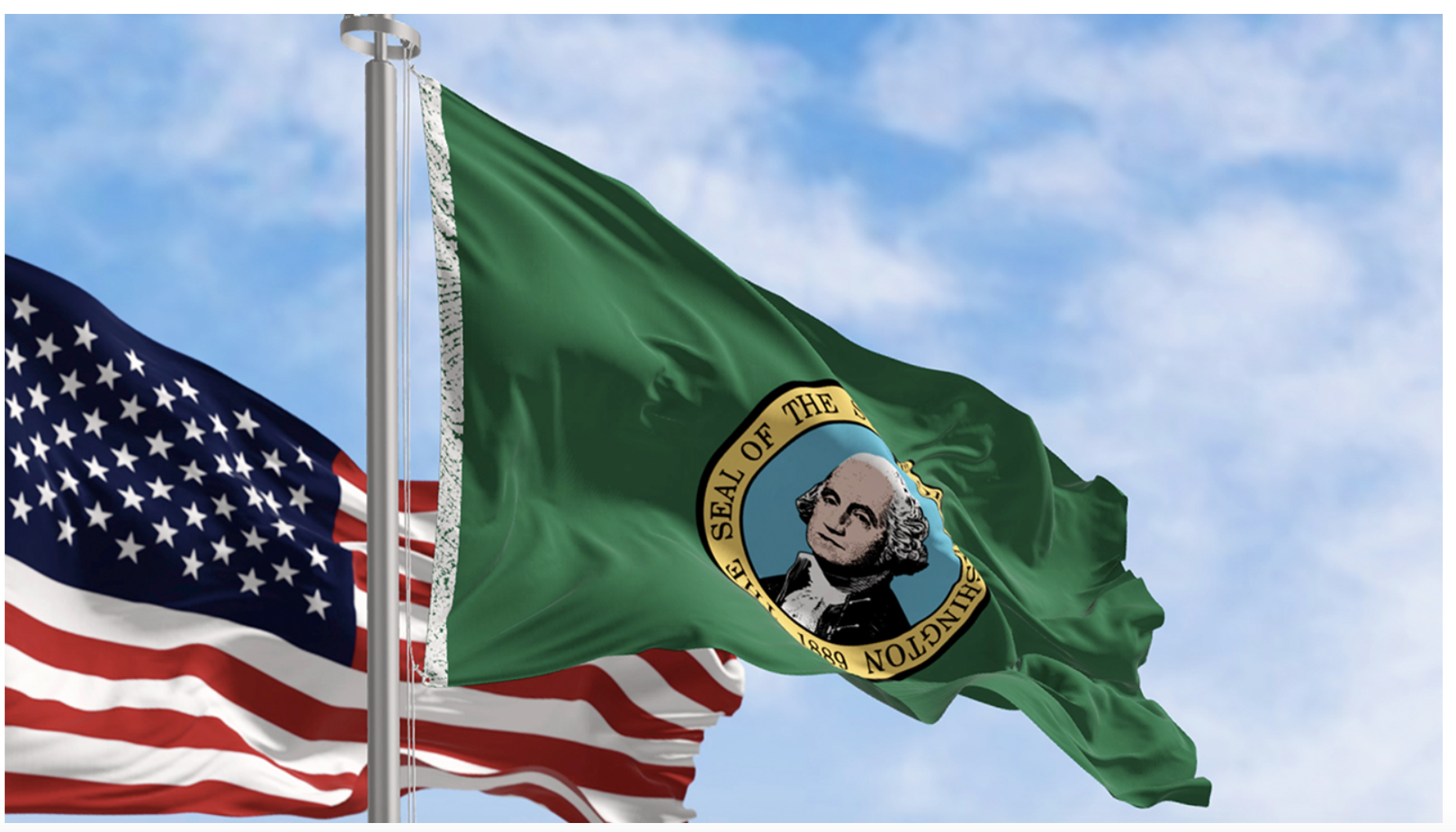
Washington Democrats introduce legislation to remove George Washington from state flag
Because when you live in paradise and there are no serious problems left to address, there’s time to turn one’s attention to neglected issues, such as designing a flag that depicts a true historical perspective of the state; Like when the founding pioneer received the Salmon to the Territory from the indigenous people whose land he’d just stolen.
Or something like that.

Be notified of new posts! Sign-up here:
Want to comment without registering?