Robert Spencer, no fan of Islam he, asks an obvious question that hasn't really been focused on (by me, anyway):

Why Does Iran Hate Israel?

In all the excitement over the bombings of Tehran by Israel and Tel Aviv by Iran, the question has too seldom been asked: what exactly is Iran’s beef with Israel? Why does the Islamic Republic consider the Jewish state to be a mortal enemy, to the extent of repeatedly vowing its imminent destruction?

The answer is not immediately clear or obvious. After all, the two countries don’t border upon one another. They have no competing territorial claims. They have no competing economic interests. From the standpoint of the issues that have ordinarily caused conflicts among nations, Iran’s hostility to Israel makes about as much sense as if the leaders of the United States were suddenly to decide that the chief enemy of our nation was Costa Rica, and began to shower that small Central American nation with endless threats and saber-rattling.

The real reason, however, for the Islamic Republic’s hostility to Israel is quite clear, and is found in the official name of the nation itself. Iran is an Islamic republic. It is dedicated to the scrupulous implementation of Islamic law. The Qur’an, meanwhile, says that the Jews are among those who are “the most vehement of mankind in hostility to those who believe” (5:82). This has the effect, along with the tidal wave of antisemitic material that is elsewhere in the Qur’an, as well as in the traditions of Muhammad, of making Muslims vehement in hostility toward Jews. 

That, in sum, is the basis of the Iranian government’s hostility to Israel, as Iranian officials themselves have made clear on numerous occasions. As they launched drones toward Israel last week, Iranian officers recited passages from the Qur’an.

On Oct. 1, 2024, as he prepared to launch 200 ballistic missiles against Israel, the late commander-in-chief of the Islamic Revolutionary Guards Corps, Hossein Salami, recited another passage from the Qur’an, saying: “In the name of Allah, the Merciful, the Compassionate. [The Quran says:] ‘Fight them, and Allah will punish them at your hands, put them to shame, help you overcome them, and soothe the hearts of the believers.’” That’s Qur’an 9:14-15, which tells Muslims that they are the executors of Allah’s wrath on earth, as Allah will punish unbelievers through the actions of the believers. The ballistic missiles that Salami was launching were, therefore, a manifestation of the divine punishment of the Jews.

….

Ahmad Alamolhoda, a member of the Assembly of Experts, which chooses and supervises the Supreme Leader, said in 2013: “The destruction of Israel is the idea of the Islamic Revolution in Iran and is one of the pillars of the Iranian Islamic regime. We cannot claim that we have no intention of going to war with Israel.” Iran doesn’t just want to destroy Israel; it sees the destruction of Israel as one of its foremost goals as an Islamic republic. If Iran were not trying to destroy Israel, it would not be fulfilling its mission as an Islamic regime. 

Salami summed it up back in March 2014. “Despite the geographical distance,” he said, “we are attached to the hearts of the Palestinians. How is it that our slogans and goals are identical to the slogans and causes of the Palestinians? Why do we strive to become martyrs and risk our lives for the Palestinian cause? The answer is that the religion of Islam has designated this for us — this goal, this motivation, this belief, this energy — so that we, here, can muster all our energies in order to annihilate the Zionist entity, more than 1,400 kilometers away. We are ready for that moment in the future.” 

And here it is.

A bit of “news” here, from another source:

B-2 stealth bombers appear to be on the move hours before Trump expected at White House

Six B-2 stealth bombers from Whiteman Air Force Base in Missouri appear to be en route to a U.S. Air Force base in Guam, according to flight tracking data and voice communications with air traffic control. 

The bombers apparently refueled after launching from Missouri, suggesting they launched without full fuel tanks due to a heavy onboard payload, which could be bunker-buster bombs.

The B-2 can carry two 15-ton bunker-buster bombs—which only the U.S. possesses.

This is Fox News, and Fox is as capable of hysterical speculation as any of its competitors, so who knows? We may find out though, soon.

Update: Just a reminder that the Boys of Iran refer to Israel as the “Little Satan” and the US as ‘Great Satan” and have vowed to destroy both. Fortunately, the wisest people in Washington, the experts whose negotiation skills brought us to the current state of affairs, aren’t alarmed by that, and can explain all.

Sure: at The French Laundry, or at your winery?

“I can’t hear you!”

In 2020, California’s milksop locked the Little People in their homes while he and his fellow millionaires whooped it up at The French Laundry (no they weren’t scrubbing their facemasks, they were dining on illegal foie gras and deadly pufferfish). That didn’t go over well with voters, but Governor Hairgel remains oblivious to optics and contemptuous of constituents, so he repeated the performance earlier this month:

As riots engulfed Los Angeles and mobs vandalized public buildings, incinerated vehicles, and assaulted law enforcement officers, California governor Gavin Newsom was enjoying a swanky wine-tasting party in Napa Valley.

The wine-tasting was held on the afternoon of June 7, 2025, at the Odette Estate Winery, which Newsom co-founded in 2011. Dubbed “Vineyard Vibes,” the event was a fundraiser for the PlumpJack Foundation, founded by Newsom’s sister, and featured “contemporary yet sophisticated” wines, live jazz music, and locally made pizza and smash burgers. “It’s the perfect kick-off to summer fun,” read promotional language. “The fete will take place on the Winery Crushpad, where we’ll gather for music, food, conversation, and delicious wine!”

So that’s the background to this latest bit of buffoonery, and here’s the story: The man so desperate to be King was hammered for wining while his cities burned, so some idiot aide came up with a big idea — distract attention from the Gov’s no-show performance by throwing down a perfumed glove and challenging JD Vance to meet him behind the school after class: that’ll prove to the state and the country who the real Macho Man is. So far, results have not been positive.

Hilarity Ensues After Desperate Gavin Newsom Challenges JD Vance to a Debate

Obviously, the guy who is all but certain to officially commence with a 2028 presidential run at some point forgot how things turned out when he issued a similar challenge to Florida Gov. Ron DeSantis in 2023. 

Accordingly, people had thoughts:


A whiff and a miss — Landlord strikes out

Something to grouse about, for sure.

GREENWICH — A former New York Yankees third baseman won a jury verdict expected to total about $500,000 after suing his landlord for mold problems, pests and other issues in a leased Greenwich mansion.

Josh Donaldson filed the federal suit against the Lake Avenue property owner, Bill Grous, in 2022 after paying a $110,000 security deposit and leasing the 4,480-square-foot home for $55,000 per month. The jury in U.S. District Court in Connecticut issued its verdict Wednesday.

Now retired, the three-time All Star and American League Most Valuable Player in 2015 had been traded to the Yankees from the Minnesota Twins in March 2022. Donaldson and his partner, who was six months pregnant, and their 17-month-old daughter moved into the Greenwich house in April, the complaint says.

The house sits on about 4-1/2 acres, has five bedrooms and 4-1/2 baths and is appraised at about $2.4 million, according to court documents and the Greenwich assessor. [But it sold to Grous for $3.325 million in 2005 — Ed]

However, instead of the luxury home Donaldson and his partner expected, the house was rife with problems, including an ant infestation throughout the main floor, non-working showers, broken toilets, an "unsightly, unusable pool" littered with shards of tile and concrete from a botched repair job, and an infiltration of squirrels nesting above the ceiling in one bedroom, the complaint said.

Shortly after moving in, Donaldson's partner and their daughter both developed lung congestion and lingering coughs, the suit said. An environmental testing company's inspection on April 19 revealed "an extensive and widespread infestation" of chaetomium and aspergillus mold, both of which can cause serious health problems, the complaint said.

Donaldson, through his lawyer, demanded that Grous immediately return the home to "a fit and livable condition," the suit said. The landlord, however, did not fix the mold infestation and the lease was terminated in May, the complaint said. Grous refused to return the security deposit, which led Donaldson to seek relief in court, according to the suit.

The jury verdict issued Wednesday totaled about $331,000, including $82,393.76 for costs for substitute housing, moving, transportation and other expenses, $220,000 for the security deposit (the $110,000 that Donaldson paid is doubled under Connecticut law), $1,341.87 for out-of-pocket expenses and $27,500 for emotional harm, according to the verdict form.

Donaldson's attorney, Craig Cepler, said Friday that he anticipated a judge would award in excess of $170,000 in legal expenses, which would bring the total to about $500,000.

"We're evaluating an appeal," Grous' attorney, Philip Russell, said Friday ….

I’d say the jury has already evaluated the defendant’s appeal, and found it lacking.

This doesn't bode well — for the country, although Democrats are rejoicing

The Senate Parliamentarian Puts Key Parts Of Trump Bill On Chopping Block

Key parts of the Senate budget proposal containing vast swathes of President Donald Trump’s legislative agenda are on the chopping block — and more provisions could be in danger of being struck from the final bill. 

The reason for elimination is … Senate Parliamentarian Elizabeth MacDonough, whom many observers have long viewed as one of the most powerful unelected officials in Washington. The nonpartisan MacDonough, whom late former Senate Democratic Leader Harry Reid appointed in 2012, is beginning to issue a spate of rulings to determine which provisions of the Senate draft are eligible to be included in Trump’s “one big, beautiful” bill.

MacDonough on Thursday advised that Senate Republicans would have to strike an array of banking and environmental-related provisions from their budget proposal that sought to deliver on key planks of the president’s agenda. The parliamentarian nixed GOP measures to roll back a Biden-era electric vehicle mandate and eliminate funding for an agency regulating the financial services industry that was the brainchild of Democratic Massachusetts Sen. Elizabeth Warren.

MacDonough serves as a de-facto referee in the upper chamber to interpret Senate rules and her duties include determining which provisions meet the strict requirements governing the budget reconciliation process. Senate Republicans are using the filibuster-proof budget reconciliation process to pass the president’s budget bill by a simple majority vote, effectively allowing GOP senators to circumvent Democratic opposition.

Senate Majority Leader John Thune is racing to pass the president’s tax and spending bill as early as Wednesday, and MacDonough is expected to play an outsized role in shaping the final product. Provisions that are ruled ineligible for the budget reconciliation process would have to pass the upper chamber by 60 votes, effectively giving Senate Democrats a say to block the provisions from passing in the Senate.

Senate Democrats have challenged key provisions of the GOP proposal as violating the stringent budget reconciliation rules that require each provision to impact spending or revenue — in an effort to nix the measures from the president’s budget package. MacDonough, who will provide guidance on which provisions comply with the budget reconciliation process, has begun to rule in Democrats’ favor on several topics, according to Senate Budget Committee Democrats.

The parliamentarian’s guidance threatens to infuriate GOP senators advocating for certain priorities to be included in the final bill and please Senate Democrats attempting to strike as many provisions from the bill as possible.

  • MacDonough ruled Thursday that the Senate Banking Committee cannot eliminate funding for the Consumer Financial Protection Bureau (CFPB) and reduce the pay of certain Federal Reserve employees among other provisions. The parliamentarian’s guidance follows Trump’s Department of Government Efficiency (DOGE) moving to dismantle the CFPB during the first 100 days of his presidency. 

  • MacDonough took aim at several environmental provisions within the Senate’s draft proposal, including a proposal to give projects fast-tracked permitting reviews. She also ruled that a provision repealing a Biden Environmental Protection Agency regulation that would have mandated that roughly 67% of new cars sold after model year 2032 be electric vehicles (EVs) or hybrids is ineligible to be incorporated in the Senate budget bill.  

  • MacDonough also advised that a provision repealing funding authorizations under former President Joe Biden’s Inflation Reduction Act violates the budget reconciliation process.

The parliamentarian has yet to review provisions of the budget bill that enact a permanent extension of the president’s 2017 tax cuts and impose a moratorium on states’ regulation of artificial intelligence.

Not good. The article below by the Bipartisan Policy Center outlines the Parliamentarian’s powers and the limitations on her power. She can advise, but her decisions are not binding, except that, as noted in the Daily Caller post excerpted above, her adverse ruling on an item will throw it out of the fast-track budget reconciliation bill and require 60 votes to pass — the Republicnas don’t have 60 votes.

What is the Role of the Senate Parliamentarian?

The parliamentarian and their staff provide nonpartisan advice to the presiding officer, chamber and committee leaders, individual senators, and staff about Senate rules, precedents, and statutes as they pertain to Senate proceedings.

The current parliamentarian, Elizabeth MacDonough, has served since 2012 under the leadership of both parties, underscoring the nonpartisan nature of the position.

When was the Office of the Parliamentarian Established?

For much of congressional history, senators had no designated advisor on rules and precedent and spent much of the chamber’s time debating procedures on the floor. The Office of the Senate Parliamentarian was established in 1935 to formalize a position that had been unofficially occupied by Assistant Secretary of the Senate Charles Watkins for more than a decade. Watkins served as parliamentarian until 1964, and five individuals have held the office since. The parliamentarian is appointed by and serves at the discretion of the majority leader, and the nonpartisan office operates within the larger office of the Secretary of the Senate.

Why does the Senate have a Parliamentarian?

The parliamentarian’s most important role is to provide procedural advice to the presiding officer during floor proceedings. The presiding officer facilitates day-to-day proceedings by recognizing members to speak, maintaining order and decorum, and ruling on points of order or the appropriateness of amendments, measures, or motions. The Vice President, as President of the Senate, is the presiding officer of the Senate, but in his or her absence these duties fall to the president pro tempore of the Senate or another senator designated to stand in for him or her.

For routine or anticipated events, the parliamentarian typically provides scripts for the presiding officer to easily facilitate chamber business consistent with Senate norms, precedents, and rules. When the chamber confronts more unusual or unexpected situations, the parliamentarian can be seen providing verbal advice to the presiding officer about how they should proceed.

It is important to remember that the scripts and verbal advice provided to senators by the parliamentarian are merely advice, not rulings. Adherence to the parliamentarian’s advice is meant to create a predictable standard for doing business. The procedural rules of the road maintained by following the parliamentarian’s advice help to structure senators’ negotiations with one another. Without this consistency, how the chamber conducts its day-to-day business would vary wildly, causing confusion and likely delaying or halting business. This is why virtually all legislative bodies around the world have a parliamentarian or other similar position.

Beyond guiding floor procedure, the parliamentarian also acts on behalf of the majority leader to manage the process of referring bills to committee in a way that maintains carefully defined committee jurisdictions. The parliamentarian’s office is also responsible for maintaining the record of precedents of the Senate.

What Guides the Senate Parliamentarian’s Advice?

The parliamentarian consults a variety of sources to inform how they advise senators to proceed. There are four pillars that define and guide Senate procedure: the standing rules of the Senate, chamber precedents, expedited procedural statues, and unanimous consent agreements.

The Senate operates as a continuous body, meaning that its rules carry over from one Congress to the next (unlike the House, which must approve a new rules package at the beginning of each Congress). As a result, changes to Senate practice are more commonly accomplished through a change in Senate precedent rather than a change in the standing rules.

Though a publicly available record of precedents has not been updated for many years, the office of the parliamentarian documents and archives all new precedents that are created to inform future procedural guidance.

Can the Senate Ignore the Parliamentarian’s Advice?

Yes. The presiding officer can choose to ignore the advice of the parliamentarian on any matter they choose, which has happened several times before.

The parliamentarian exists to advise the chamber on existing procedures, but it is the presiding officer’s duty to make rulings. However, any senator may raise a point of order challenging the ruling of the presiding officer for not following the correct procedure. The dispute would then be put to a vote of the chamber. Ultimately, senators themselves are responsible for deciding the outcome of all parliamentary questions, even if they go against standing rules and precedent.

What is the Parliamentarian’s Role in Budget Reconciliation?

Budget reconciliation is a legislative procedure created by the Congressional Budget and Impoundment Control Act of 1974 that allows for expeditated consideration of changes in law to align spending, revenue, and the debt limit with agreed-upon budget targets. Reconciliation is one of the “expedited procedural statutes” referenced above and means that the measure is not subject to stalling procedural tactics or a filibuster.

Under these procedures, the parliamentarian evaluates policy proposals to determine whether they comply with the constraints of the Byrd Rule and other unique procedures that guide the reconciliation process. It is important to remember that here, like with other procedural questions, the parliamentarian provides advice on what is allowed or not under existing rules and precedents. What is acceptable policy under the reconciliation process is a matter for senators themselves to decide.

Has a Parliamentarian Ever Been Dismissed?

Majority leaders from both parties have replaced the parliamentarian before. During the 1980s, partisanship and procedural warfare began to escalate in the Senate, causing leadership of both parties to favor certain individuals within the parliamentarian’s office. As a result, the parliamentarian position alternated between Robert Dove and Alan Frumin for over three decades depending on which party was in the majority.

It is important to note that their dismissals had more to do with personal working relationships with various party leaders and senatorial reaction to certain rulings rather than because either of these individuals were partisan in the advice they provided.

The Iceman Goeth

John Hinderaker, PowerLine:

Down Memory Lane, One Year Later

I didn’t really observe Juneteenth this year, but on Instagram I was reminded that Joe Biden and Kamala Harris celebrated it in 2024. Here they are, with other Democratic notables. Biden looks fine. There is nothing wrong with him. You can see why all the reporters and everyone in the White House thought he was A-OK, and were shocked when it turned out he couldn’t run for President after all:

(Ed note: I can’t load Instagram on the blog, so I’m substituting an X clip — same thing)

Pending sales reported

175 Riverside Ave

175 Riverside Avenue, $2.7 million, started at $2.9 million in May. Looks and priced as though it were in NoPo, but it’s actually just across from Gilliam Lane, where the Fountain Boyz former residency still lends a cachet that’s reflected in the prices of nearby homes.

14 revere road, nopo, $2.195 million (original ask $2.360)

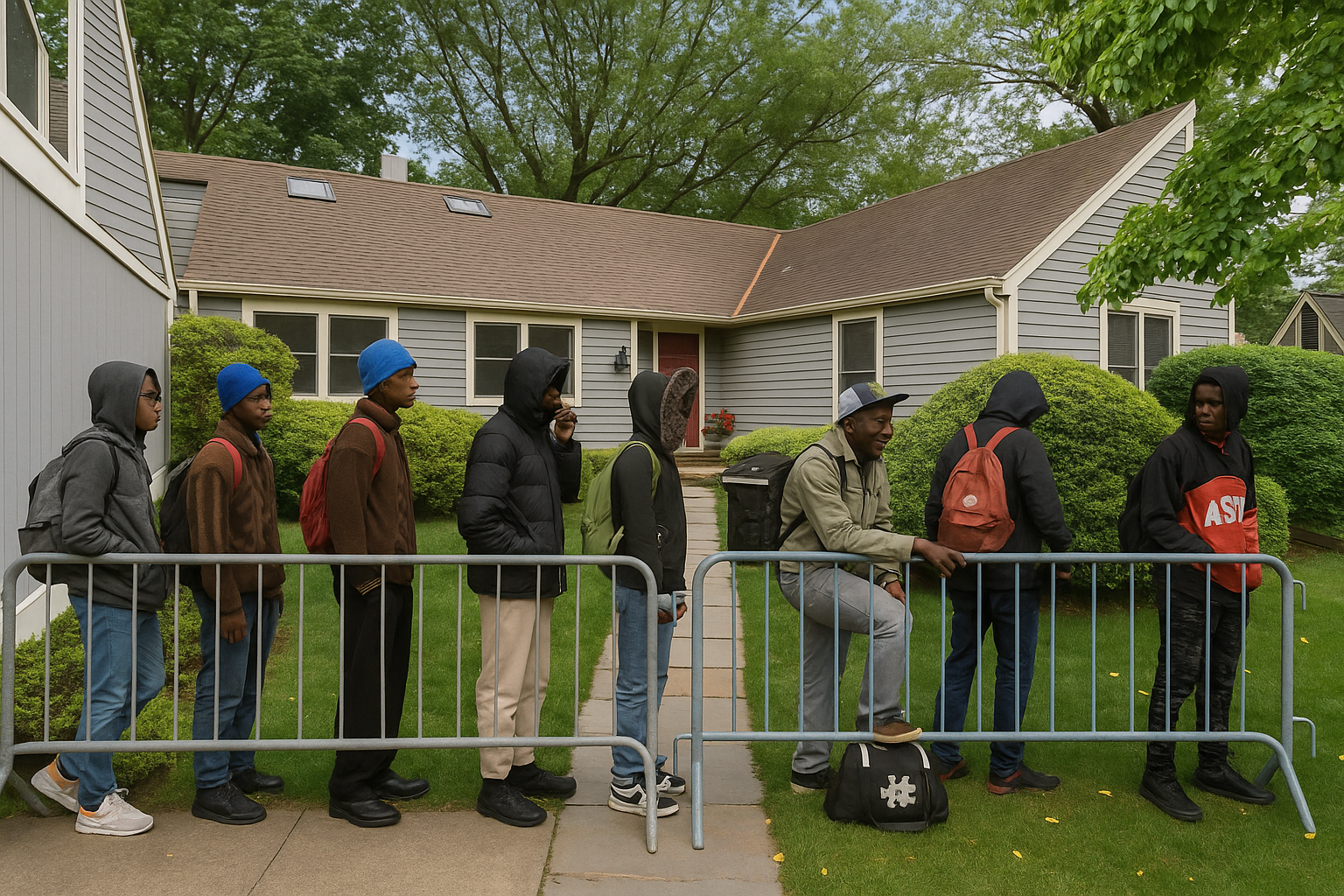
Sally Maloney’s listing for 622 W. Lyon Farm Drive, $1.850 million, is pending after just 18 days. As one of the very few 5-bedroom units in Lyon Farm, it’s my understanding that Greenwich Community Housing is purchasing it for use it as a temporary; no more than a year — okay, no more than two — migrant shelter, but of course, you’d have to ask Sally about that.

A busy day for closings

Windrose Way (artist’s impression)

6 Windrose Way, reported as pending yesterday, closed today at $16.175 million. Buyer’s agent Charles Paternina wrested an $800,000 discount from the sellers’ ask of $16.900 million. Hey, every penny counts. Buyers from Miami Beach

34 Turner drive

34 Turner Dive has also sold for full price, $10.950 million. Never on the MLS, worked out agent-to-agent. Scarsdale buyers.

10 Francine Drive, listed at $5.1 million, sold for $5.725. Zip code of buyer not disclosed. Possibly from Iran?

8 Cherry Blossom Lane, full price, $4.9 million. Manhattan (10013) buyers.