A full eleven days between listing and contract, but the blizzard probably slowed things up

(No, I don’t know why this picture is dated 2025, but I suppose readiness is all)

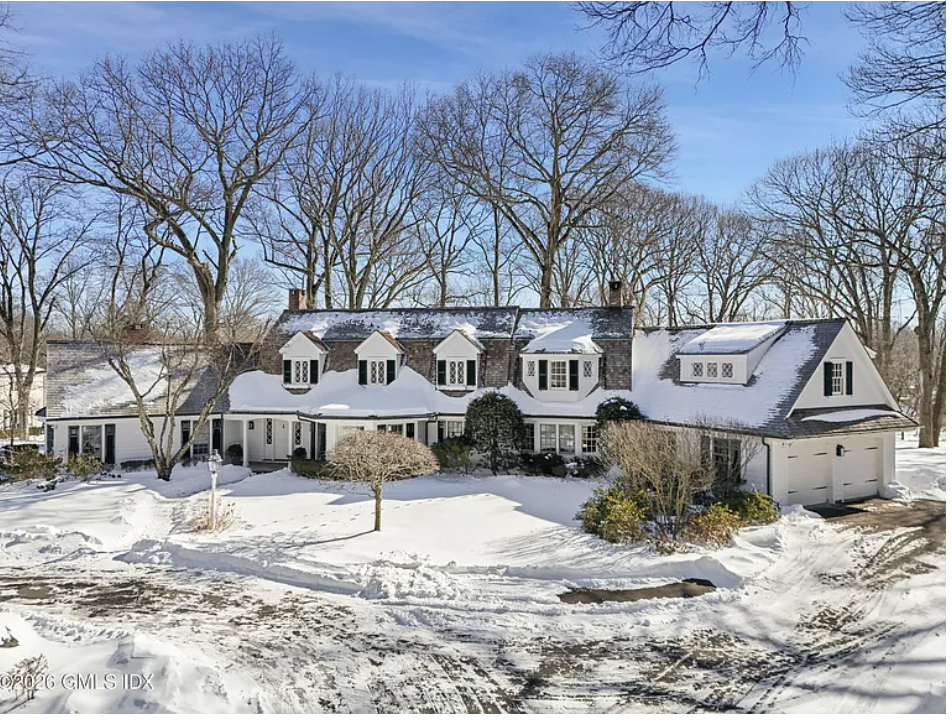
315 Stanwich Road reports executed contracts; listed at $7.995 million February 17th. The owners left the Pacific Palisades for the east coast during COVID (ahead of the wildfires, so smart move) and paid $6.150 million for the house in June, 2021. A pool’s been installed, and the dining room painted our now- mandatory gloss-grey (inexplicably left in 2010’s color, beige, by the previous owners), but even allowing for those expenses they should be making out alright here. Of course, if they’re merely relocating to Riverside, those newfound funds will be soon be dissipated covering that neighborhood’s skyrocketing prices, but there it is.

Taconic Road listing

395 Taconic Road, $1.395 million. It’s on just 0.63 of an acre in the 4-acre zone, so I doubt it can be expanded beyond its 1,680 sq. ft. (to give you a notion of the insanity of our FAR limits, ostensibly imposed to limit house sizes to an “appropriate” scale, this lot in the 1/2 acre - R-20 — zone would be considered oversized, and FAR would allow a house of 8,918 sq. ft.). Still, for a the right person or people, this could work.

As it did for the original owners, Grace and Frank Novak, for many years. Back in 2014, my friend, the late Jerry Dumas wrote a remembrance of them:

A shared life, in love and war

July 30, 2014

A few weeks ago Grace Novak died. She was 91, and lived just up the road with her husband, Frank, 88. The burial ceremony took place close to both our houses, at the small cemetery across Taconic Road from the old Stanwich Church. Grace, a U.S. Navy Wave, served in Washington during World War II, working at decoding Japanese messages. ("You didn't have to be an expert with the language," Frank once told me. "It was done with numbers.")

On Saturday morning in the sunny cemetery, there was a 21-gun salute for Grace. Then a bugler played "Taps." Frank, sitting in his chair, stared at the ground, saluting his wife, tears streaming down his face.

No onlooker stays dry-eyed when "Taps" is played.

Then Frank Novak went back up the road to his house, to start living alone.

Not long after, Frank came over to our house for wine and hamburgers. He told stories.

"We had great gardens. Grew tons of vegetables. We argued about the best way to do weeding. I used a hoe. Grace was always on her knees, digging. It took forever, but she always had to get out all the roots."

"One night I came home from work, saw dust on a table, and wrote with my finger: DUST ME. An hour later I came back to have a look.

She had written: SCREW YOU. Or words to that effect."

To back up a little:

Frank and Grace both grew up in Byram, which he continued to call East Port Chester, just a block apart.

They knew each other as kids, and went to New Lebanon School. Frank graduated from Greenwich High School in January 1944.

That same month he enlisted, and in May found himself in the Infantry, undergoing Basic in Camp Wheeler, Ga. He wound up lugging a bazooka in the anti-tank company, 272 Regiment, 69th Infantry -- the Fighting 69th.

In November 1944 a huge convoy crossed the Atlantic; one of the ships was the Queen Mary.

Frank's ship was a small one named the Santa Maria, of all things. It broke down and sat motionless, alone, for two days. The convoy moved on, the German subs too, presumably.

The crossing took 18 days.

Christmas 1944 -- the Battle of the Bulge had begun in Belgium. Frank and the Fighting 69th went over from England with all the others.

He was trucked to the front. It was a land of snow, ice, mud, forests, bombs, explosions, and German soldiers dressed as American MPs misdirecting traffic at crossroads.

The Germans had the best tanks, Tigers and Panthers, heavily armored, firing their feared 88 guns. Frank and his bazooka could only hope to get close enough to a tank so he could blast the treads, rendering it immobile. The heavy guns behind him could take it out.

Frank's other weapons were his .45 pistol, carbine and M-1 rifle. He never had trouble getting hold of a weapon or ammo -- he could get all he needed off dead American soldiers.

Meanwhile, Frank's brother, Stephen, a B-24 Liberator pilot, completed his 25 missions, then died in a plane crash, as an observer.

Grace's brother, Harold, a P-51 Mustang pilot, died three days before the war ended.

Grace and Frank got married when the war was over and he went into the advertising business: Benton and Bowles, Ted Bates, and then for 22 years, general manager and advertising director for Panasonic. For a long time he drove an hour and a half each way to his office in New Jersey hoping to get home each night in time to see their daughters, Nancie and Lisa.

In retirement Frank sang with the Holly Hill Tones (18 singers, two guitars) at schools and nursing homes, spent summers at their place in Vermont, steps from Lake Champlain, and each Memorial Day he placed American flags on veterans' graves in Stanwich Cemetery.

Recently, not long after our evening together, neighbors began to wonder about him.

Elissa Engelhardt saw that he hadn't picked up the newspapers for two days from the spot where she always carefully placed them.

She and Herbie and Missy Farquhar went into the house. Frank was on his bedroom floor, two fists resting on his chest.

So Frank is back beside Grace, where he was for so many years.

There was a 21-gun salute, and this time two soldiers, rather than Grace's two sailors, slowly and carefully folded the American flag. "Taps" was played again. Frank and Grace hadn't been separated very long.

Grace died on Memorial Day. Frank died on July 4, Independence Day.

One advantage a hot market offers sellers (besides increasing the odds of selling their house) is that there is immediate market price signalling

14 Pinecroft Road dropped its price today to $5.450 million, just seven days after hitting the market at $5.795. In a slow market, one might be tempted to wait a bit to see whether a buyer shows up (as was done with this same house back in 2007-2008, when it stayed on for months, dropping from $4.950 to $3.995 million — it never did sell), but currently, with buyers stacked up with nothing to buy, an overpricing is immediately exposed. Smart move.

(Very nice house, by the way, in a good location.)

I mean, really: have these people never heard of Zoom? Remote working?

“Paging Mr. Khamenei, please pick up the walkie-talkie waiting for you at Terminal X”

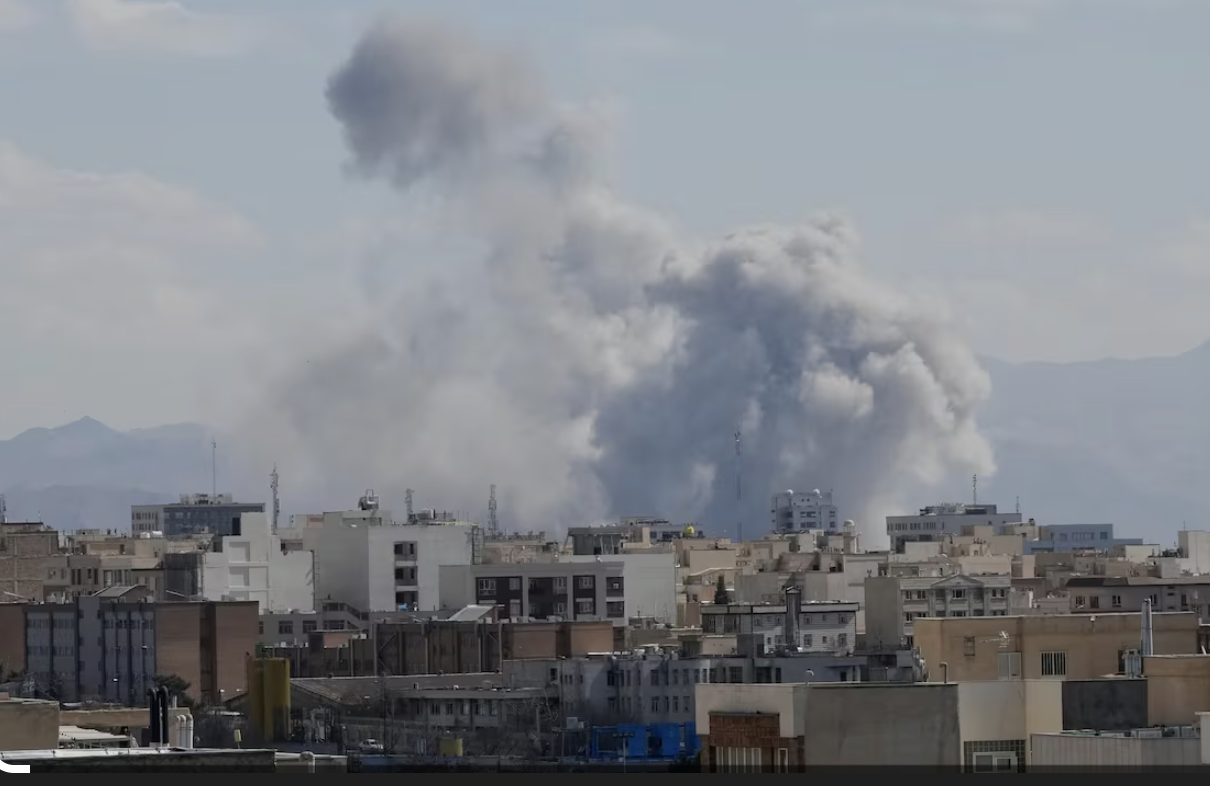
Israel strikes Iranian leadership meeting about Khamenei succession plan

(Update: I’m not sure whether this fellow was at this meeting or someplace else, but either way, we won’t miss him; nor did the Israelis)

Americans say they're willing to pay "no more than $10 month" to fight global warming*, yet they're already paying thousands because of regulatory costs; here’s another $4,000

Brace for THOUSANDS more in energy costs — unless Albany fixes NY’s insane climate law

NY Post Editorial:

Critics, including us, have been warning that New Yorkers’ energy costs are about to soar even higher, thanks to the state’s insane 2019 climate law.

Now, a state agency itself is confirming those warnings — and has even put a price tag on the pain: a whopping $4,100 a year extra per household by 2031.

That’s just for electricity, reports the New York State Energy Research and Development Agency; the bill for gas for home heating, as well as gasoline costs, are also set to shoot up. At the pump a gallon of gas is expected to go up an eye-watering $2.23.

Plus, businesses’ utility costs could rise 46%, and truck-delivery expenses over 60% — sending consumer prices through the roof.

Gov. Kathy Hochul seems to have recognized at least the political danger: As she runs for reelection on a promise of affordability, voters won’t find the extra hit particularly “affordable.”

So she appears set to push for changes or delays to the law — at least until after she’s safely reelected.

>>>>

Sometimes rule changes are needed to “fit the times,” argues Hochul Budget Director Blake Washington, as if “the times” have dramatically changed unpredictably since the law was passed. 

Truth is, opponents have been flagging its astronomical (and pointless) costs for years. 

Last year, even the left-leaning Progressive Policy Institute called it an “undeniable” failure that’s only succeeded in “driving up costs for families, constraining reliable supply” and imperiling “the political viability of the state’s climate agenda.”

The Climate Act was first championed by ex-Gov. Andrew Cuomo before Hochul doubled down on slashing gas emissions by 40% by 2030 with the goal of achieving 100% zero-carbon-emission electricity by 2040.

Yet fantasizing about an alternate reality didn’t bring it about: “There is a lack of market capacity to deliver the volume of renewable energy” for EVs, heat pumps, etc., to meet the requirements called for under the climate law, notes NYSERDA’s bombshell memo.

Hochul has already quietly pushed her new energy tax — the “cap and invest” program for reducing greenhouse gas emissions — past this fall’s election.

She’s also paused the state’s all-electric building mandate. And she’s sought new modular nuclear-power plants upstate.

Yet she’ll need the Legislature’s backing even just to delay the law’s mandates, and Senate Majority Leader Andrea Stewart Cousins, for one, is already on record opposing any effort to mess with them.

Unless Albany lawmakers get on board and head off the additional costs, voters would be justified in showing them the door come November.

They’d be justified, but they won’t; just like much of the rest of the country, they reelect the very people who are doing this, and then complain about inflation.

* From ten years ago, but still valid, as other, more recent polls show:

Americans willing to pay to fight climate change (but only a little)

CBS News September 15, 2016 / 4:29 PM EDT / AP

WASHINGTON Most Americans are willing to pay a little more each month to fight global warming - but only a tiny bit, according to a new poll. Still, environmental policy experts hail that as a hopeful sign.

Seventy-one percent want the federal government to do something about global warming, including 6 percent who think the government should act even though they are not sure that climate change is happening, according to a poll conducted by The Associated Press-NORC Center for Public Affairs Research and the Energy Policy Institute at the University of Chicago.

And those polled said they’d be willing to foot a little of that cost in higher electric bills.

If the cost of fighting climate change is only an additional $1 a month, 57 percent of Americans said they would support that. But as that fee goes up, support for it plummets. At $10 a month, 39 percent were in favor and 61 percent opposed. At $20 a month, the public is more than 2-to-1 against it. And only 1-in-5 would support $50 a month.

“I feel we need to make small sacrifices - and money is a small sacrifice - to make life better for future generations, “ said Sarah Griffin, a 63-year-old retired teacher in central Pennsylvania. “Surely I have enough money to spend on something that’s worthwhile.”

Greg Davis, a 27-year-old post-graduate student in Columbus, Ohio, agreed: “It’s far more important to protect the environment than to save money. I think that’s true for businesses as well as individuals.”

That a majority is willing to pay more is a new phenomenon, said Tom Dietz, professor of sociology and environmental science and policy at Michigan State University.

Dana Fisher, director of the Program for Society and the Environment at the University of Maryland, said it’s noteworthy that a majority was “willing to pay at all,” and added that the levels of support for $10 a month and $20 a month are significant.

But so was the opposition to higher costs.

James Osadzinski, 52 of Rockford, Illinois, said simply: “I have a set budget. I don’t have the money,” while for 26-year-old nurse Marina Shertzer of Pensacola, Florida, it doesn’t make sense because she doesn’t see climate change as a threat, but something cyclical and normal.

Of those polled, 77 percent said climate change is happening, 13 percent weren’t sure, and only 10 percent said it wasn’t happening.

New listing in (what I'd call) central Greenwich

7 Dearfield Lane, $2.950 million. Last time out in 2013-2014, it sold, eventually, for $1.940 million on an original ask of $2.495*, but these owners have removed all frightening objects from the household, and that in itself should ensure a better market reception.

original 2014 hazard zone

after exorcism

*An effort that was undoubtedly cursed by this unfortunate article in Greenwich Time:

While the iron is hot: Greenwich couple try to sell their home in a hurry

Story and photos by Anne W. Semmes Updated Oct 31, 2013 4:44 p.m.

What, at this point, does it matter?

Reuters Poll:

1 in 4 Americans back Trump’s Iran strikes, most say he’s too quick to use force: poll

Republicans mostly supports strikes, Democrats overwhelmingly oppose military action

Trump doesn’t seem to be impressed by how the media’s shaped public opinion, nor should he be.

"I think that the polling is very good, but I don’t care about polling. I have to do the right thing. I have to do the right thing. This should have been done a long time ago," Trump said in an interview Monday with the New York Post when asked about the new survey.

I thought PJMedia’s Scott Pinsker, who writes from a public relations perspective, offered a good take on this yesterday:

PRedictions, PRojections, PRaise, and PRedators: The PR Fallout of the War in Iran

“How this will play in Iran is unknown. (Either way, we’ll soon find out.)

But within the United States, the PR fallout of the Iran War is far easier to predict (or PRedict): If we win, the American people will approve; if it’s ANYTHING other than a win, there’ll be various degrees of blowback.

This is a purely outcome-based military mission: If Iran is flipped from an enemy into an ally — and American casualties are minimal — then this was a masterstroke in realpolitik. 

If so, Trump will be hailed as a visionary…

…which will eke him a few days of positive press, and then be mostly forgotten about by the midterms.

It’s a shame: Despite representing a seismic shift in geopolitics, the U.S. political benefit will be minimal. It’s highly unlikely that Maduro, the Ayatollah, or the collapse of Cuba will matter more in the November midterms than inflation, affordability, domestic issues, and the strength of the economy.

This was one of those gambles where the political downside was FAR greater than the political upside.

Of course, success in Iran will win Trump the love and support of Iranian Americans. We’re already seeing them march in the streets, weeping tears of joy — and thanking President Trump. Right now, they vote heavily Democratic: 52% are Democrats and only 8% Republicans (with 40% independent).

But there just aren’t a lot of ‘em. The Iranian American population is estimated at a little above half a million to maybe 2-ish million. (And about half live in California, which mutes their national reach.) Unless this flips the larger population of Arab Americans (3.7 million), that’s not enough voters to budge the needle.

Even if this war is a smashing success, by Nov. 2026, it’ll probably matter as much as President George H. W. Bush’s Gulf War victory did in 1992.

The Dems would have to retire their “TACO” taunt (for a few weeks, at least), but that’s about it. They’re on record opposing the Iran War, but they’ll pay a minimal PR price for their stance. It’s Maduro redux: Since this isn’t a huge deal to the American people, the Dems will side with their base.

From Joe Six Pack’s perspective, solving the Iranian problem is very nice, but that wasn’t his #1 priority. It’s not what animated him to vote in 2024, and it’s not what’ll drive him to the polls in 2026.

The midterms will still be about the economy. Period.

Now, if Iran’s new government does something that rewards the American taxpayers — cheap oil, military contracts, whatever — the Iran story and the economic story could fuse together. That’s the best-case PR scenario for the GOP: The victory in Iran becomes part of the overall “winning” narrative.

It’s the evidence that proves the theory.

Okay, but what if the Iran War is less than a smashing success? For example, what if we bash and batter Iran for a few weeks, but the mullahs manage to hold on and the regime survives?

Trump would still be able to claim victory: By definition, this was already regime change, because the “supreme leader” — who’d been in power since 1989 — was blown into bits.

Plus, Iran’s military will certainly be weakened. Too many craters over too many military bases already — and we’re just getting started. That alone fulfills the America First precept of advancing our national interests by weakening our enemies.

But that’s not how it’ll be spun.

See, it’s kind of like the Avengers, but for dumbass Republicans: Have you noticed that MAGA’s stupidest members are the ones most opposed to bombing Iran? Those super-geniuses, like Marjorie Taylor Greene, Nick Fuentes, Tucker Carlson, Candace Owens, Andrew Tate, and Thomas Massie, have all united against the president.

They have a microphone, too — and the mainstream media will gleefully amplify all their criticisms.

And we already know what their criticisms will be: AIPAC controls congress, Israel controls America, disloyal Jewish “neocons” control the White House, and this whole damn war was yet another example of the American government putting Israel First.

(Or maybe it was a distraction from the Epstein files, which something-something Israel-Mossad-Jews, too. Those nitwits love a conspiracy.)

If this happens, the PR fallout will be a fractured MAGA movement, with the 20% isolationist wing separating from the rest. And, with depressed GOP turnout, the 2026 midterms will produce a big Blue Wave that gives the Dems full control of the House by 30+ seats — and probably the Senate.

Losing 1 in 5 of our base in the midterms would be impossible to overcome, and there just aren’t enough Iranian Americans to offset the depressed numbers.

Third possibility: What if the war is a horrible mistake and ends in complete and total disaster?

Well, the supreme leader (who’s a lot like a regular leader, only with sour cream) is already dead, so that won’t happen. Plus, our Armed Forces are too frickin’ good to roll snake eyes. The part of this war we control directly — the number of bombs and missiles, and where they go — means we’ll 100% fulfill our objective of regime change at the top, plus degrading of Iranian’s military industrial complex.

So we’ve already passed that threshold. 

But what if Iran captures a downed U.S. pilot and parades him on TV?

What if, during the Biden years, Iran ordered sleeper cells to cross into our border, and they’re waiting for the green light to unleash a wave of terrorist attacks on U.S. cities?

That’s when things get dicey. And the ultimate PR fallout, I’m afraid, will depend on the gruesome specifics.

Sadly, we can’t predict what’s unpredictable — which is still the greatest danger of all.”