From their lips to God's ear
/
we’re doomed, i tell you, doomed!
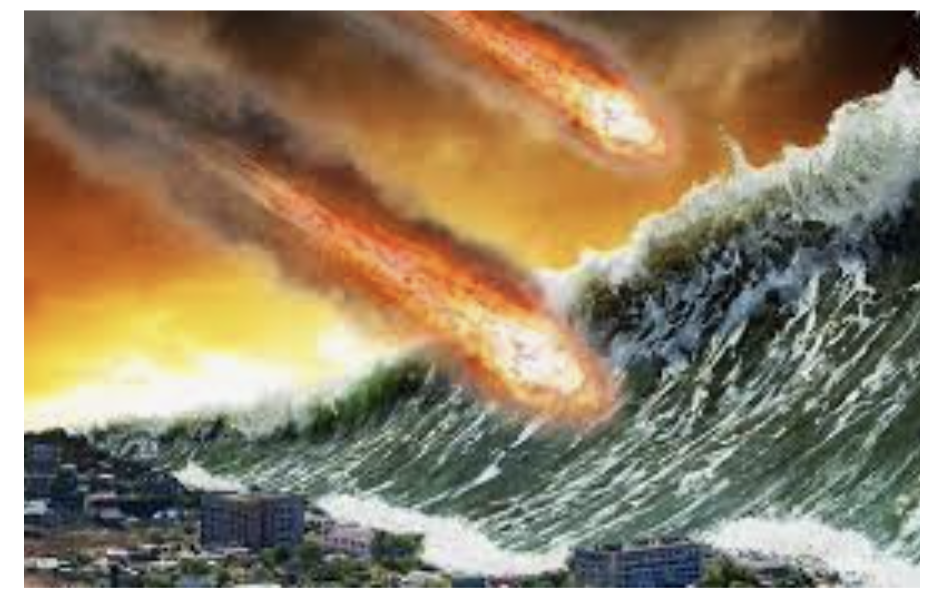
How a Category 5 hurricane could wipe out NYC for good.
It’s a chilling hypothetical, like something out of a “Twilight Zone” episode. But it could really happen, argues [author Stephen] Marche, who describes the devastation caused by an imaginary Category 5 hurricane called Muriel to explain his theory.
Over the last 40 years, “Category 5 hurricanes have increased by 300 percent globally,” he writes. And superstorms on the Eastern Seaboard are no longer a rarity.
“The one thing there is reasonable consensus on, at least for hurricane activity for the US, is overall an increase in the frequency and intensity of Category 4 or Category 5 hurricanes,” Peter Sousounis, the director of climate change research at AIR Worldwide, says in the book.
Uh-huh. And how serious, really, are these people? Do they really believe that the end of the world is nigh, or do they, like Obama of the Vineyard, and the Hamptons Celebrities howl and shriek, and continue life on the waterfront as before? Well, there’s this:
A plan by the de Blasio administration to completely demolish the city’s East River Park and raise the entire area on eight feet (and more than a million tons) of fill has been stalled by activists and residents, who claim the city didn’t consult them on the plans.
Fighting a boondoggle is a fine thing to do, but the Greens don’t oppose huge, wasteful government spending; in fact, they insist on it, but they want their part of the skim, and will block any plan that does’t include them, because they know there’s no actual crisis.
Of course, even among those who don’t share my belief that wiping out NYC would indeed be “for good”, there are voices of calm about the imminent doom posed by these fanciful storms coming our way: “The Myth That Hurricanes Are Getting Worse (Because of Climate Change)
A Closer Look at the Science
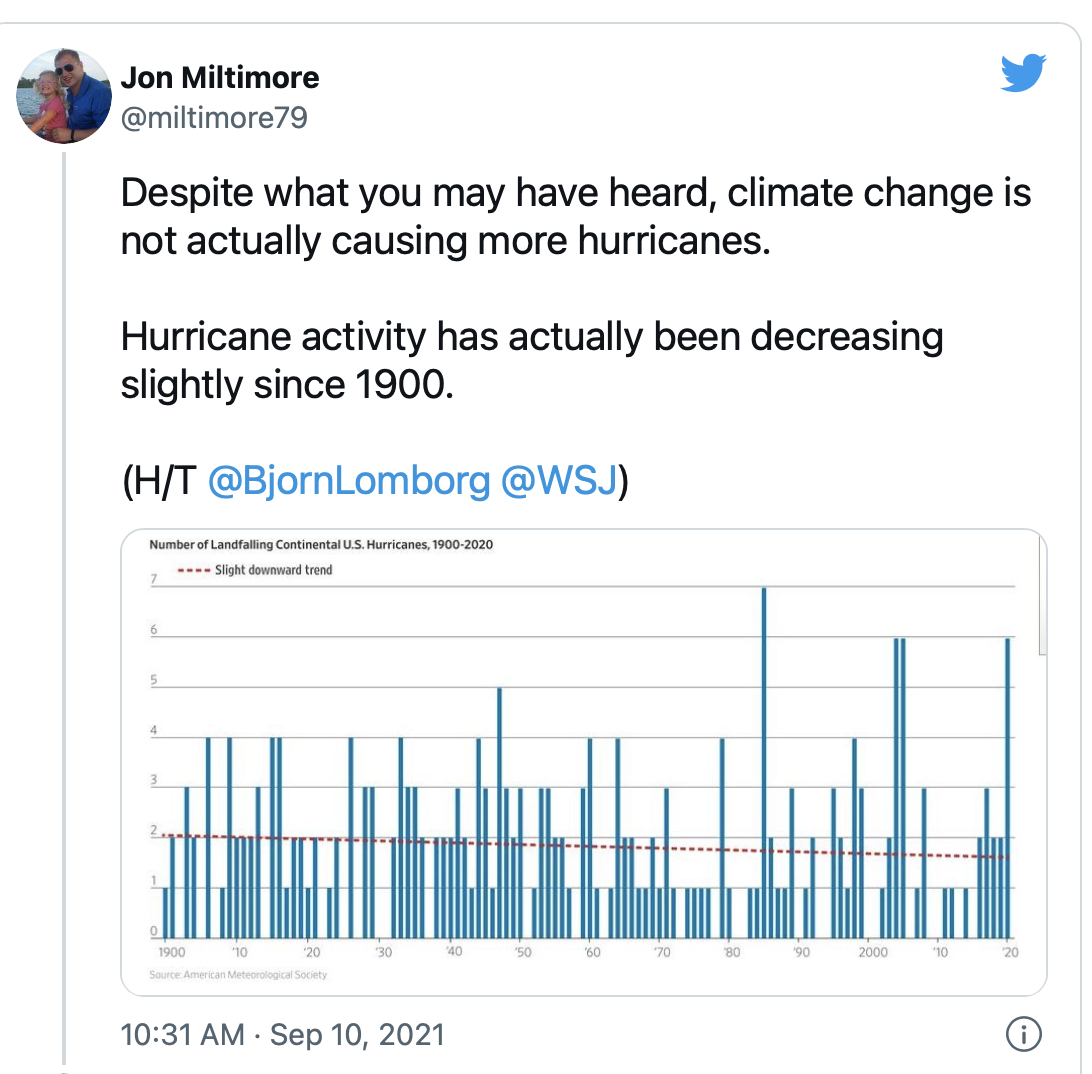
Before you take out a loan to build a storm shelter in your basement, it might be worthwhile to look at data from the American Meteorological Society recently published in the Wall Street Journal. The data show fewer hurricanes are landing on the continental US, not more.
“[D]espite what you may have heard, Atlantic hurricanes are not becoming more frequent,” explains Danish economist Bjorn Lomborg in the Journal. “In fact, the frequency of hurricanes making landfall in the continental U.S. has declined slightly since 1900.”
The WSJ is a respected publication, but it of course has a reputation for being right of center. So it’s important to note that Lomborg and the Journal are not out on a limb on this one. There is widespread consensus that hurricanes are not increasing in frequency.
“[A] new statistical analysis of historical records and satellite data suggests that there aren’t actually more Atlantic hurricanes now than there were roughly 150 years ago, researchers report July 13 in Nature Communications,” reported Science News.
The findings reported in Nature Communications were not an outlier. As The Economist reported in 2017 and the Washington Post reported in 2015, a plethora of research shows hurricanes are becoming less frequent, not more frequent.
That is only half of the story, however. While there is general agreement today that global warming is not causing more hurricanes, many scientists and media reports say storms are growing in intensity.
This claim, Lomborg argues, also is false.
“[No,] there aren’t more powerful hurricanes either. The frequency Category 3 and above hurricanes making landfall since 1900 is also trending slightly down,” Lomborg writes. “A July Nature paper finds that the increases in strong hurricanes you’ve heard so much about are ‘not part of a century-scale increase, but a recovery from a deep minimum in the 1960s–1980s.’”
Still, not everyone agrees with Lomborg and Nature. Some believe that the decline in the number of hurricanes is resulting in hurricanes that indeed are more powerful. But how much more?
Chris Landsea, tropical analysis forecast branch leader at the National Hurricane Center, said global warming likely added about 1 percent more power to Hurricane Michael, a Category 5 hurricane. That translated to 1 or 2 mph.
"That is a fairly small increase and most of the computer guidance by global warming models say maybe we could see 3 percent stronger by the end of the century," said Landsea, speaking during a session on hurricane history in 2019. "That's really not very much."
Why so Many Crises?
The actual science of global warming and hurricanes seems fairly clear. Hurricanes are not landing more often on the continental US, but less often. It’s unclear if they are becoming more powerful, but if hurricanes are growing in intensity, it’s not by very much.
These scientific revelations are rather bland, and they seem a stark contrast to claims that extreme weather poses an “existential crisis” to humanity and headlines of “turbocharged” storms.
A person could be forgiven for asking: What gives? What am I supposed to believe? Is a weather apocalypse truly upon us?
If an extreme weather apocalypse is indeed upon us, it is one of many crises we’re told we face. There is no shortage of catastrophes and epidemics, judging from politicians, intellectuals, and media reports. Mass shootings. The coronavirus. The opioid crisis. Forest fires. The list goes on.
While it’s true conflict and crises are common elements of human history, it seems that our modern state of affairs is virtually constant crises. Why?
In his book Crisis and Leviathan, the economist Robert Higgs discusses this phenomenon. Higgs argues that crises are essentially food for the leviathan, a metaphor for the state coined by the English philosopher Thomas Hobbes and derived from a Biblical sea monster.
Higgs observes that crises have served as the catalysts for the greatest expansions of state power in modern history. The New Deal was the spawn of the Great Depression. The War on Terror and the Patriot Act were the offspring of the 9/11 attacks. And then there is the Pandemic of 2020. Unlike in previous pandemics, public health officials leveraged the full power of the state to attempt to tame COVID-19.
In each crisis, Americans were told the emergency actions taken were not just necessary, but temporary. History, however, shows that once a crisis has passed, “the fattened leviathan continues to hold sway.”
Higgs’s thesis—that crises are the food that feeds the ravenous leviathan, slowly freeing it from the shackles designed to constrain it—calls to mind a meme popular on social media.
“If we let politicians break the law in an emergency,” it goes, “politicians will create an emergency so they can break the law.”
Another version of the meme would be this: Once crises are seen as a legitimate cause for extraconstitutional action, prepare yourself for an abundance of crises.