The more things change ...
/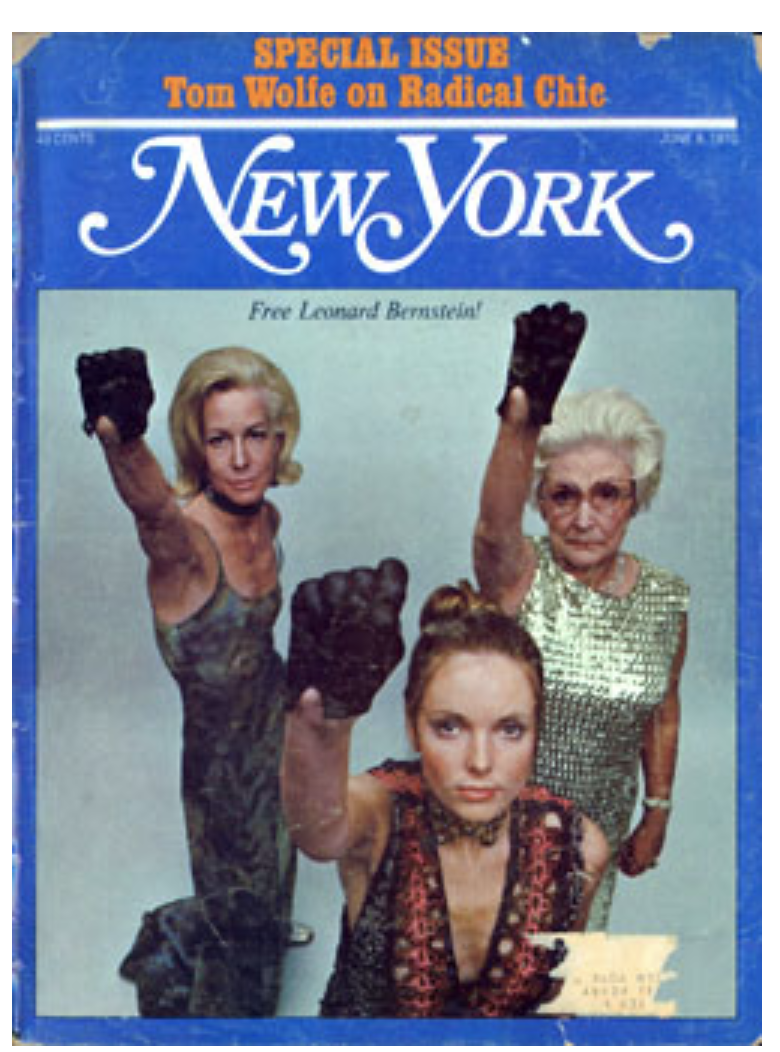
I just spent twenty minutes rereading, for the first time in decades Tom Wolf’s 1970 essay, “Radical Chic and Leonard Bernstein’ Party for the Black Panthers” — the party that gave rise to Bernstein’s infamous quote “I dig it absolutely”. Such a treat.
A few excerpts here; they’re lengthy, but not nearly as long as the essay itself, and you’ll be cheating yourself if you don’t read the whole thing.
First, the term radical chic’s history:
….. In fact, this sort of nostalgie de la boue, or romanticizing of primitive souls, was one of the things that brought Radical Chic to the fore in New York Society. Nostalgie de la boue is a 19th-century French term that means, literally, “nostalgia for the mud.” Within New York Society nostalgie de la boue was a great motif throughout the 1960s, from the moment two socialites, Susan Stein and Christina Paolozzi, discovered the Peppermint Lounge and the twist and two of the era’s first pet primitives, Joey Dee and Killer Joe Piro. Nostalgie de la boue tends to be a favorite motif whenever a great many new faces and a lot of new money enter Society. New arrivals have always had two ways of certifying their superiority over the hated “middle class.” They can take on the trappings of aristocracy, such as grand architecture, servants, parterre boxes and high protocol; and they can indulge in the gauche thrill of taking on certain styles of the lower orders. The two are by no means mutually exclusive; in fact, they are always used in combination. In England during the Regency period, a period much like our own—even to the point of the nation’s disastrous involvement in colonial wars during a period of mounting affluence—nostalgie de la boue was very much the rage. London socialites during the Regency adopted the flamboyant capes and wild driving styles of the coach drivers, the “bruiser” fashions and hair styles of the bare-knuckle prize fighters, the see-through, jutting-nipple fashions of the tavern girls, as well as a reckless new dance, the waltz. Such affectations were meant to convey the arrogant self-confidence of the aristocrat as opposed to the middle-class striver’s obsession with propriety and keeping up appearances. During the 1960s in New York nostalgie de la boue took the form of the vogue of rock music, the twist-frug genre of dances, Pop Art, Camp, the courting of pet primitives such as the Rolling Stones and José Torres, and innumerable dress fashions summed up in the recurrent image of the wealthy young man with his turtleneck jersey meeting his muttonchops at mid-jowl, à la the 1962 Sixth Avenue Automat bohemian, bidding good night to an aging doorman dressed in the mode of an 1870 Austrian army colonel.
At the same time Society in New York was going through another of those new-money upheavals that have made the social history of New York read like the political history of the Caribbean; which is to say, a revolution every 20 years, if not sooner. Aristocracies, in the European sense, are always based upon large hereditary landholdings. Early in the history of the United States, Jefferson’s crusade against primogeniture eliminated the possibility of a caste of hereditary land barons. The great landholders, such as the Carrolls, Livingstons and Schuylers, were soon upstaged by the federal bankers, such as the Biddles and Lenoxes. There followed wave after wave of new plutocrats with new sources of wealth: the international bankers, the real-estate speculators, the Civil War profiteers, railroad magnates, Wall Street operators, oil and steel trust manipulators, and so on. By the end of the Civil War, social life in New York was already The Great Barbecue, to borrow a term from Vernon L. Parrington, the literary historian. During the season of 1865-66 there were 600 Society balls given in New York, and a great wall of brownstone missions went up along Fifth Avenue.
In the early 1880s New York’s social parvenus—the people who were the Sculls, Paleys, Engelhards, Holzers, of their day—were the Vanderbilts, Rockefellers, Huntingtons and Goulds. They built the Metropolitan Opera House for the simple reason that New York’s prevailing temple of Culture, the Academy of Music, built just 29 years before at 14th Street and Irving Place, had only 18 fashionable proscenium boxes, and they were monopolized by families like the Lorillards, Traverses, Belmonts, Stebbinses, Gandys and Barlows. The status of the Goulds and Vanderbilts was revealed in the sort of press coverage the Met’s opening (October 22, 1883) received: “The Goulds and the Vanderbilts and people of that ilk perfumed the air with the odor of crisp greenbacks.” The Academy of Music is now a moviehouse showing double features, although it did enjoy one moment of eminence in 1964, when the Rolling Stones played there, live, with Murray the K as M.C.
Does this part sound familiar to Greenwich types? I think it does, yes:
By the 1960s yet another new industry had begun to dominate New York life, namely, communications—the media. At the same time the erstwhile “minorities” of the first quarter of the century had begun to come into their own. Jews, especially, but also many Catholics, were eminent in the media and in Culture. So, by 1965—as in 1935, as in 1926, as in 1883, as in 1866, as in 1820—New York had two Societies, “Old New York” and “New Society.” In every era, “Old New York” has taken a horrified look at “New Society” and expressed the devout conviction that a genuine aristocracy, good blood, good bone—themselves—was being defiled by a horde of rank climbers. This has been an all-time favorite number. In the 1960s this quaint belief was magnified by the fact that many members of “New Society,” for the first time, were not Protestant. The names and addresses of “Old New York” were to be found in the Social Register, which even 10 years ago was still confidently spoken of as the Stud Book and the Good Book. It was, and still is, almost exclusively a roster of Protestant families. Today, however, the Social Register’s annual shuffle, in which errant socialites, e.g., John Jacob Astor, are dropped from the Good Book, hardly even rates a yawn. The fact is that “Old New York”—except for those members who also figure in “New Society,” e.g., Nelson Rockefeller, John Hay Whitney, Mrs. Wyatt Cooper—is no longer good copy, and without publicity it has never been easy to rank as a fashionable person in New York City.
The black movement itself, of course, had taken on a much more electric and romantic cast. What a relief it was—socially—in New York—when the leadership seemed to shift from middle class to … funky! From A. Philip Randolph, Dr. Martin Luther King and James Farmer … to Stokely, Rap, LeRoi and Eldridge! This meant that the tricky business of the fashionable new politics could now be integrated with a tried and true social motif: Nostalgie de la boue. The upshot was Radical Chic.
Wolfe diverts briefly to Southampton party the summer before, thrown by the then 24-year-old NYC politico and Ponzi scheme operator Andy Stein on the seaside estate of his multi-millionaire father, Andrew Finkelstein. It reminds of the sort of party that might easily be held in Greenwich back then or even today — perhaps in Belle Haven?
From the beginning the afternoon was full of the delicious status contradictions and incongruities that provide much of the electricity for Radical Chic. Chavez himself was not there, but a contingent of grape workers was on hand, including Chavez’ first lieutenant, Andrew Imutan, and Imutan’s wife and three sons. The grape workers were all in work clothes, Levis, chinos, Sears balloon-seat twills, K-Mart sports shirts, and so forth. The socialites, meanwhile, arrived at the height of the 1969 summer season of bell-bottom silk pants suits, Pucci clings, Dunhill blazers and Turnbull & Asser neckerchiefs. A mariachi band played for the guests as they arrived. Marvelous! Everyone’s status radar was now so sensitive that the mariachi band seemed like a faux pas. After all, mariachi bands, with those Visit Mexico costumes on and those sad trumpets that keep struggling up to the top of the note but always fall off and then try to struggle back up again, are the prime white-tourist Mexicans. At a party for La Causa, the grape workers, the fighting chicanos—this was a little like bringing Ma Goldberg in to entertain the Stern Gang. But somehow it was … delicious to experience such weird status thrills . . .
When the fund-raising began, Andrew Imutan took a microphone up on the terrace above the lawn and asked everybody to shut their eyes and pretend they were a farm worker’s wife in the dusty plains of Delano, California, eating baloney sandwiches for breakfast at 3 a.m. before heading out into the fields … So they all stood there in their Pucci dresses, Gucci shoes, Capucci scarves, either imagining they were grape workers’ wives or wondering if the goddamned wind would ever stop. The wind had come up off the ocean and it was wrecking everybody’s hair. People were standing there with their hands pressed against their heads as if the place had been struck by a brain-piercing ray from the Purple Dimension. Andrew Stein’s hair was long, full, and at the outset had been especially well coifed in the Roger’s 58th Street French manner, and now it was … a wreck… . He kept one hand on his head the whole time, like the boy at the dike … “eating baloney sandwiches for breakfast at 3 a.m… .”
It’s all great fun, and it really does help locate today’s times in the rolling tide of history.