Accidentally on purpose?
/
This author thinks it’s no accident. He may be right, but either way, the greens pushing their agenda on America and Europe are undoubtedly pleased with the result.
Rare earth elements (REEs), comprising 17 (15 commercially relevant) chemical elements and soft heavy-metals like Thulium and Cerium, are vital in modern technologies from cell phones to windmill magnets. They are also used in glass properties and constitute 50% of digital camera lenses, and despite their name, these elements are abundant, yet economically exploitable deposits are uncommon.
Now on to the history:
Historically, in the California desert, Mountain Pass has been a rare earth elements mine since its discovery in 1949 by the Molybdenum Corporation of America, peaking in production from the mid-1960s to the 1980s, and representing US control of the market over this period.
So what went wrong?
However, challenges appeared in the form of environmental movements and regulatory pressures, leading companies to explore alternatives or relocate their industries to China. Conversely, China’s initial slower development in rare earth elements picked up during the mid-1970s, aligning with the closing down of some US mines, along with China flooding the market with low-priced REEs. …
In the 1990s, China emerged as a dominant force in rare earth production. Accounting for 85-95% of the global supply, and leveraging its abundant resources, China strategically utilized rare earths for technological innovation across sectors like space, defense, and energy. Deng Xiaoping’s vision outlined in 1992 aimed for China to lead the world in the rare earth industry, famously saying that, “The Middle East has oil, China has rare earth.” …
In 2010, China accounted for 95% of the world’s rare earth oxides….
Our government eventually began to wise up:
The arrival of the Trump administration further brought a realist frame to US foreign policy, as the administration was committed to not depending on Chinese markets for rare earth minerals. Trumps’ Executive Orders 13817 and 13953 expressed such concerns, pointing out at the time that the United States, the once world-leader, imported at much as 80% of its REEs from China. The Trump administration even considered imposing tariffs on Chinese REEs, but faced resistance due to potential economic and diplomatic consequences. Nevertheless, the U.S. sought alternative sources, forming partnerships with Australia, Canada, and Mexico. The Department of Defense allocated $30 million to support Lynas, an Australian rare earth company, aiming to establish refining facilities in Texas.
The problem is obvious enough that even the Democrats can see it:
The Biden administration continued these efforts, investing in rare-earth separation processes and committing $16 billion to the infrastructure plan. This bipartisan commitment reflects a shared goal of bolstering the American rare earths industry, acknowledging the strategic importance of securing a stable domestic supply chain.
But we are badly behind, and rare earths now represent a significant element of international rivalry and diplomacy.
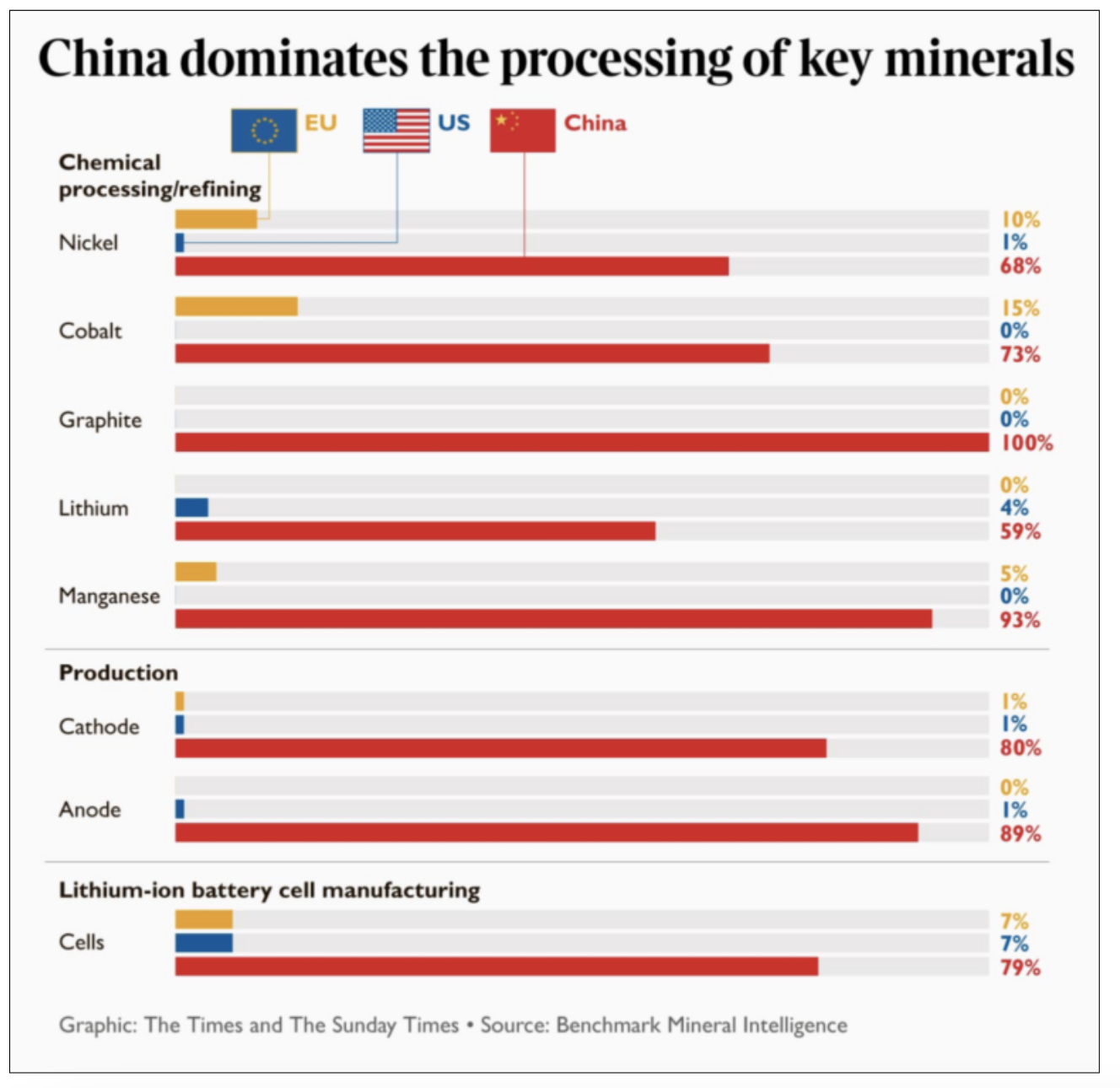
Unfortunately, it isn’t just rare earth elements. As we have pointed out many times, China dominates the production and/or processing of most of the world’s most critical materials. This applies especially to those that are needed in vast quantities to create “green” energy.
So the “green” push puts the American economy–our future–in the hands of the CCP. Somehow, I don’t think that is accidental.