Oh, just shut up
/
Twitchy: Like Peace and Quiet? Congrats, The Atlantic Says You're a Racist
Take a trip down memory lane with us. Back in 2017, the Left was all up in arms about noise pollution. The loud sounds of the city -- the places they want us all to live, because climate change -- were racist. No, really.
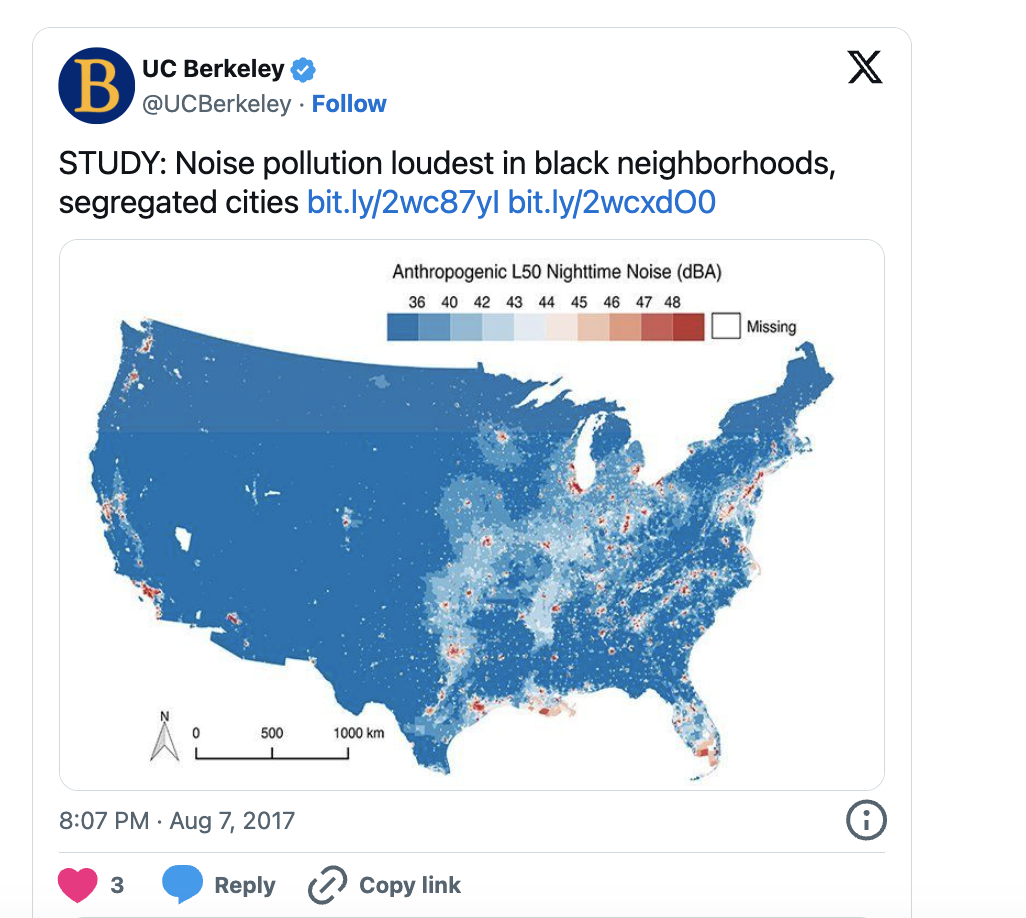
But because everything is racist, and logical consistency is anathema for the Left, silence is also racist.
Just ask the folks at The Atlantic:

Miss Gonzalez:
New york in the summer is a noisy place, especially if you don’t have money. The rich run off to the Hamptons or Maine. The bourgeoisie are safely shielded by the hum of their central air, their petite cousins by the roar of their window units. But for the broke—the have-littles and have-nots—summer means an open window, through which the clatter of the city becomes the soundtrack to life: motorcycles revving, buses braking, couples squabbling, children summoning one another out to play, and music. Ceaseless music.
I remember, the summer before I left for college, lying close to my bedroom box fan, taking it all in. Thanks to a partial scholarship (and a ton of loans), I was on my way to an Ivy League college [Brown —Ed]. I was counting down the days, eager to ditch the concrete sidewalks and my family’s cramped railroad apartment and to start living life on my own terms, against a backdrop of lush, manicured lawns and stately architecture.
I didn’t yet know that you don’t live on an Ivy League campus. You reside on one. Living is loud and messy, but residing? Residing is quiet business.
I first arrived on campus for the minority-student orientation. The welcome event had the feel of a block party, Blahzay Blahzay blasting on a boom box. (It was the ’90s.) We spent those first few nights convening in one another’s rooms, gossiping and dancing until late. We were learning to find some comfort in this new place, and with one another.
“Then the other students arrived—the white students.”
I just hadn’t counted on everything that followed being so quiet. The hush crept up on me at first. I would be hanging out with my friends from orientation when one of our new roommates would start ostentatiously readying themselves for bed at a surprisingly early hour. Hints would be taken, eyes would be rolled, and we’d call it a night.
“One day, when I accidentally [sic] sat down to study in the library’s Absolutely Quiet Room, fellow students Shhh-ed me into shame for putting on my Discman.”
I soon realized that silence was more than the absence of noise; it was an aesthetic to be revered. Yet it was an aesthetic at odds with who I was. Who a lot of us were.
Within a few weeks, the comfort that I and many of my fellow minority students had felt during those early cacophonous days had been eroded, one chastisement at a time. The passive-aggressive signals to wind our gatherings down were replaced by point-blank requests to make less noise, have less fun, do our living somewhere else, even though these rooms belonged to us, too. A boisterous conversation would lead to a classmate knocking on the door with a “Please quiet down.” A laugh that went a bit too loud or long in a computer cluster [emphasis added] would be met with an admonishment.
In those moments, I felt hot with shame and anger, yet unable to articulate why. It took me years to understand that, in demanding my friends and I quiet down, these students were implying that their comfort superseded our joy.
>>>
I loved the learning that I did in college—academic and cultural. And I managed to have a lot of fun, in the spaces that the students of color claimed as our own. We had our own dormitories, our own hangouts; we even co-opted a room in the computer center where we could work the way we preferred, with Víctor Manuelle or Selena playing in the background. Some white students resented that we self-segregated. What they didn’t understand was that we just wanted to be around people in places where nobody told us to shush.
When i moved back to Brooklyn after college, I found that the place had changed. Neighborhoods that had been Polish and Puerto Rican and Black [when did the Polacks replace the bog trotters as honorary blacks? Just askin’ — Ed] were suddenly peppered with people who looked better-suited to my college campus than to my working-class home turf. Many of them needed the affordable rents because they had opted into glamorous but poorly paying white-collar jobs [glamorous jobs like working as Lincoln Center ushers? MOMA ticket takers?] . Alas, these newcomers hadn’t moved here to live alongside us; they’d come to reside.
The first time it happened was the night before Thanksgiving. Three or four of us—all people of color—were eating takeout in my best friend’s studio apartment. [At what time of night?] The radio was playing, and we were debating, as we often did, who was the best rapper alive. There was a knock at the door and when we opened it, my friend’s neighbor, a 20-something woman new to Brooklyn, was standing there, exasperated. “Did your mothers not teach you the difference between inside voice and outside voice?”
>>>>
Attempts to regulate the sounds of the city (car horns, ice-cream-truck jingles) continued throughout the 20th century, but they took a turn for the personal in the ’90s. The city started going after boom boxes, car stereos, and nightclubs. These were certainly noisy, but were they nuisances? Not to the people who enjoyed them. [And their pleasure rules]
>>>>
I find many city noises nerve-racking and annoying: jackhammers doing street maintenance, the beeping of reversing trucks, cars honking for no good reason. Yet these noises account for a small minority of all noise complaints.
Nearly 60 percent of recent grievances center on what I’d consider lifestyle choices: music and parties and people talking loudly. But one person’s loud is another person’s expression of joy. As my grandmother used to say, “I’m not yelling, this is just how I tawk!”
All properly-woke universities have responded to complaints of self-centered individuals like Gonzalez by creating segregated dormitories and colored peoples study halls, where they may whoop, shout, and dance about with abandon, but rudeness and inconsiderateness of others is not restricted solely to “people of color” — cretinism comes in all shapes, sizes and race — so why not designate one dorm as a “Blutarsky House”, or several, depending upon demand, and let them have at it, while serious students get on with their work?
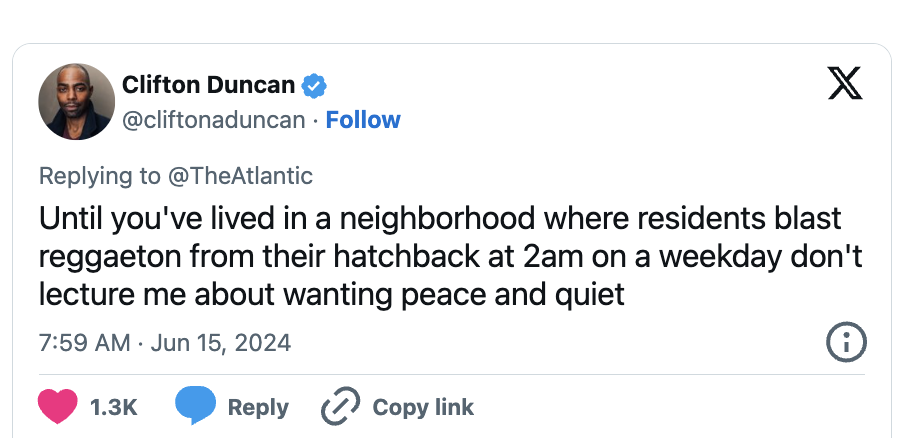
As for this privileged woman’s insistence that her “lifestyle choices”; her preference for drenching her neighborhood in noise, takes priority over the desires of others, this Atlantic reader offers a fitting riposte: