They have your kids, their minds, and your money
/
Public school districts coast to coast adopting radical curriculum from org named for 60s radical
Zinn Education Project boasts 176,000 teachers have downloaded more than 765,000 lessons for students from pre-K to grade 12
Public schools across the country are directing teachers to use curriculum resources from a nonprofit that teaches American history through the lens of racial and sexual oppression.
The Zinn Education Project (ZEP), named for the late radical 1960s professor Howard Zinn, pushes controversial resources and lesson plans to teachers for students as young as pre-K, all the way up to grade 12.
ZEP boasts that its curriculum has been adopted by more than 176,000 teachers, who have downloaded more than 765,000 lessons for their students, according to its website. The organization hosts a Teach Truth Day of Action annually, which is co-sponsored by the NEA, America's largest teachers union, and other organizations.
Zinn, who died in 2010, taught at Boston University from the early 1960s until his retirement in 1988. He was the author of "A People’s History of the United States," a book that teaches American history, beginning with Christopher Columbus' discovery of North America and into the 21st century, through a lens of racial and sexual oppression. The principles in his book serve as the benchmark for ZEP's lessons.
[FWIW: [From A People’s History of America introduction:
"The pretense is that there really is such a thing as ‘the United States, subject to conflicts and quarrels, but fundamentally a community of people with common interests. It is as if there really is a ‘national interest’ represented in the Constitution, in territorial expansion, in the laws passed by Congress, the decisions of the courts, the development of capitalism, the culture of education and the mass media.”
…. My viewpoint, in telling the history of the United States, is different: that we must not accept the memory of the states as our own. Nations are not communities and never have been. The history of any country, presented as the history of a family, conceals fierce conflicts of interest … between conquerors and conquered, masters and slaves, capitalists and workers, dominators and dominated in race and sex. And in such a world of conflict, a world of victims and executioners, it is the job of thinking people, as Albert Camus suggested, not to be on the side of the executioners.”
[Now back to your regularly scheduled programming — Ed]
In 2003, Zinn described himself as, "Something of an anarchist, something of a socialist. Maybe a democratic socialist."
New York City Public Schools, the largest school district in the country, encourages teachers to use ZEP resources to teach during Black History Month, Women’s History Month, Disability Pride Month and Pride Month.
"The Zinn Education Project also has compiled lesson ideas and relevant primary sources into a resource called 'Teaching with Seizing Freedom' that educators can use in their classrooms alongside the podcast," a Black History resources page on the school system's website says.
The "Teaching with Seizing Freedom" podcast is described by ZEP as "an ideal resource to introduce students to the imaginative, defiant ways that Black people sought and enacted freedom throughout U.S. history — and brings to life voices that are often muted in textbooks."
For Disability Pride Month, the school system directs teachers to ZEP resources that include an article titled, "10 Quick Ways to Analyze Children’s Books for Ableism."
In the Chicago Public Schools system, a page called "Equity Tools," alongside other social justice resources from other organizations, like "Implicit Bias and Structural Racialization" from the National Equity Project, ZEP is mentioned as a resource. The public school system links to the ZEP homepage.
Similarly, Portland Public Schools in Oregon directs teachers and students to ZEP for resources on Black History Month. The ZEP site has 328 webpages of resources for teaching Black History Month.
A summary on the ZEP page on Black History Month recommends a book called "The Real Ebonics Debate: Power, Language, and the Education of African-American Children." That book summary describes ebonics as "the distinctive language of many African-American children," and emphasizes urgency for teachers to learn to engage with discussions about ebonics.
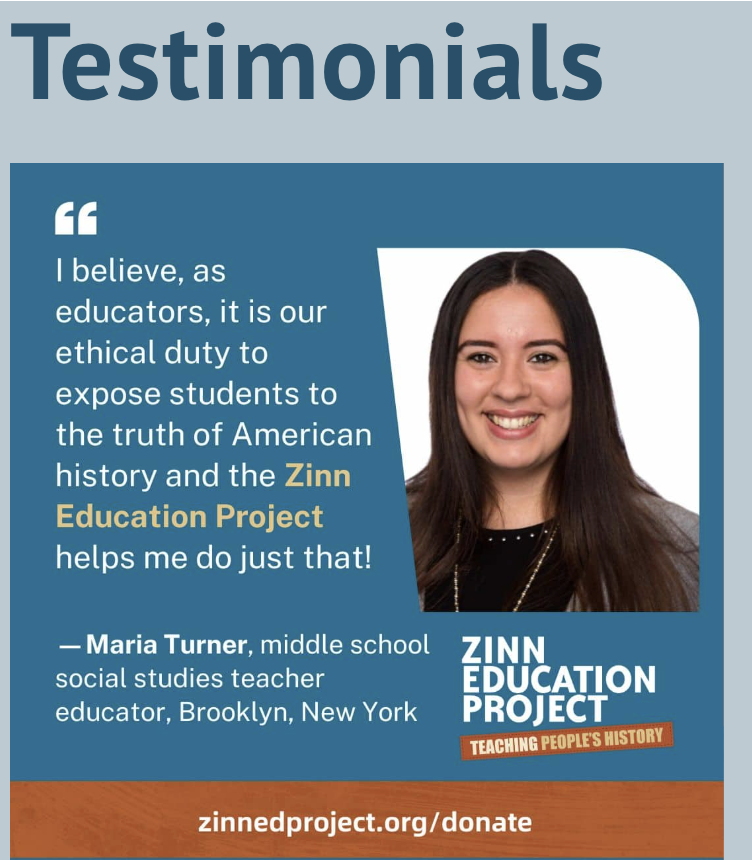
…. ZEP's website is full of colorful testimonials from teachers around the country, including Sarah Giddings, identified as a middle school social studies teacher from Mesa, Arizona. Giddings used ZEP resources to teach her students about climate change.
"The culminating activity involved having my students participate in a mock trial based on Bill Bigelow’s role play activity ‘Who’s to Blame for the Climate Crisis?'" Giddings' testimonial says. "By this point of our study, my students were emotionally and intellectually ‘invested’ and were genuinely curious as to what or who is responsible for the environmental crisis."
"I’ve used the Zinn Education Project’s materials since my first year teaching," says a testimonial from Corey Wincester, described as a high school history teacher from Evanston, Ill.
"Nine years later, my students can speak to the power of deconstructing the narratives of Christopher Columbus and Abraham Lincoln’s efforts that have replicated white supremacy and marginalization of people of color in historical discourse.
None of the school districts mentioned returned a request for comment.
Here’s the Zinn homepage. And lest you think this deconstruction of America is restricted to public schools, I offer this: Many years ago, I used to stop at the Putnam Avenue Starbucks for a 7:00 AM coffee to go. There was always a line at that time and, because of similar schedules, often the same people. Over months, I came to converse with many of the same people and struck up a casual aquaintance with several of them. One was a very nice younger man who, he told me, taught history at Rye Country Day, “and my favorite resource, the one I primarily teach from, is Howard Zinn’s ‘A People’s History f the United States” — these kids minds are just blown away.” I don’t think he meant that literally, but it was a powerful, and apt, metaphor.
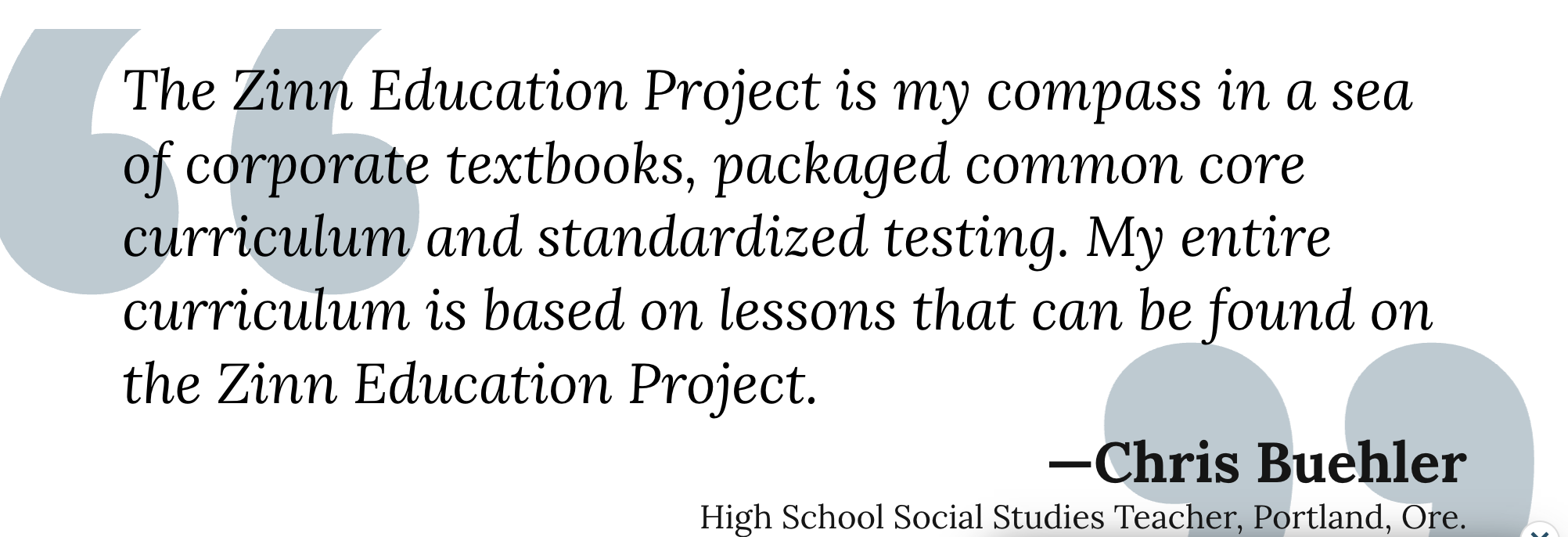
Further reading, if curious, on the scope of the penetration of Zinn and a critique of the work itself can be found in, of all places, an article published by the AFT in 2013: “Undue Certainty” I’m morally certain that, as much as the author softpedals his (scathing) analysis, the vast majority of Randi Weingarteners would like to see him hanged.