The Innocent's a Broad (Updated)
/
One final post on this subject and then I promise to Move On™, but I was reading the actual Vanity Fair profile of Susie Wiles (got through all of Part I, a quarter of the way through Part II) and was struck, again and again, at the horrendous vitriol spewed across its pages. It’s a typical example of how Vanity Fair has treated its political enemies in the past, so again, how could Wiles or the White House ever have considered this a good idea?
I thought I’d post two examples taken from just the first pages of the article because (a) I never could resist a bad pun* and (b) because you can get the full flavor of the entire piece from just these two paragraphs; them, and the picture we’ve thrown in for free.
At the same time, Trump has waged war on his political enemies; pardoned the January 6 rioters, firing nearly everyone involved in their investigation and prosecution; sued media companies into multimillion-dollar settlements; indicted multiple government officials he perceives as his foes; and pressured universities to toe his line. He’s redefined the way presidents behave—verbally abusing women, minorities, and almost anyone who offends him. Charlie Kirk’s assassination in September turbocharged Trump’s campaign of revenge and retribution. Critics have compared this moment to a Reichstag fire, a modern version of Hitler’s exploitation of the torching of Berlin’s parliament.
……
Then Trump issued pardons to almost everyone convicted in the bloody January 6, 2021, assault on the Capitol, in which nine people ultimately died and 150 were injured. Even rioters who’d beaten cops within an inch of their lives were set free. (Fourteen people convicted of seditious conspiracy had their sentences commuted.)
Trump WH: “Well, if we cooperate with Vanity Fair, at least we’ll get some of those Annie Liebowitz glamor shots.”
— Mark Hemingway (@Heminator) December 17, 2025
Vanity Fair: *laughs maniacally* https://t.co/sIs3Ib6q7B
UPDATE:
*It occured to me this morning that not all the readers of this blog, as well-read as they are, might get the reference. Here you are, if there are any such readers out there:
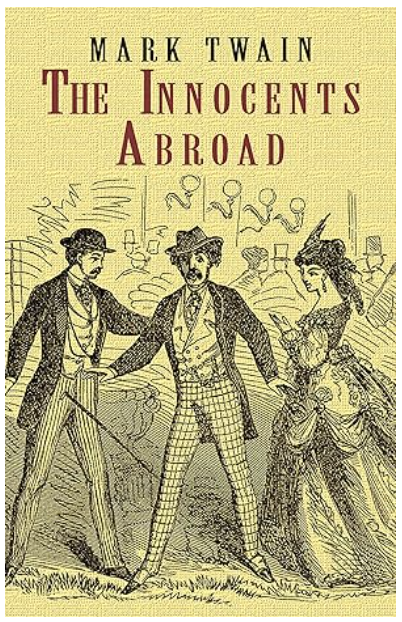
(It’s a fun read, BTW)
The Innocents Abroad, or The New Pilgrims' Progress, is Mark Twain's humorous 1869 travelogue chronicling his 1867 "Great Pleasure Excursion" with a group of American tourists through Europe and the Holy Land on the steamship Quaker City. The book satirizes both American tourism and European culture, contrasting the "New World" and "Old World" with sharp wit, and became one of the best-selling travel books of all time, launching Twain to international fame.
"The people of those foreign countries are very, very ignorant...in Paris they just simply opened their eyes and stared when we spoke to them in French! We never did succeed in making those idiots understand their own language."
Certainly not a work for those subject to fainting spells:
Debbie Klenzman Carlson
There are moments that I enjoyed Twain's humor and insightful descriptions of his experiences and his shipmates, however, I had a difficulty reading his racist comments about people of color who he continuously referred to as savages. Twain and his companions behave as a children on many excursions, poking fun of their guides, venturing off the ship during curfew, and running about stealing and breaking things with no respect for the property of others. The behavior of some of his shipmates is even worse: breaking off pieces of antiquity as souvenirs, firing guns as if they are vigilantes and pushing their pack animals to death. I have to admit, Twain's journal is long and when you finally reach the end, you feel as if you too have been on board this excursion and are thrilled to finally be home. I learned a lot about what it was like to travel in 1867 and what those countries were like at that time. All in all, I enjoyed the book, however, Mark Twain and I would probably not make good traveling companions.
Or ladies’ tea & book clubs:
2.0 out of 5 stars Our book club read this and almost unanimously disliked this book
Our book club read this and almost unanimously disliked this book. It was racist and elitist. Unlike some of his other books, this did not withstand the passing of time. So many other books, too little time. Don't waste yours!
Or the products of our modern education system:
2.0 out of 5 stars I didn't care for it.
…. Twain seems to be grouchy and critical about everything, and it gets a bit tiresome. Maybe it's because I'm Catholic and in this book Twain is rabidly anti-Catholic. He makes insults about all of the churches that have relics of the True Cross and then gets to Jerusalem and admits that he's not surprised they don't have the True Cross because he's seen bits and pieces all over Europe. Uh-huh.
He picks on his fellow Protestant travelers for wanting to observe the Lord's Day, making them travel longer on the succeeding days and then admits later how nice it is to get really tired sometimes because the rest that follows is so pleasant. (It even puts him in a temporary good mood.) That's the point. He doesn't complain later when they make equally long trips for other reasons.
He gripes and complains about the monks carrying candles and chanting in the Church of the Holy Sepulchre and how that ruins the ambiance for him and then admits later that this church the only place in Jerusalem he never gets tired of. I laughed right along with his sarcasms about guide books, but I felt he didn't add anything more insightful than the books and tourists he criticized. I didn't appreciate the prejudices or the jadedness with which he viewed most of Europe.