One of my favorite political pundits, David Strom, peers into the future and has some interesting observations
/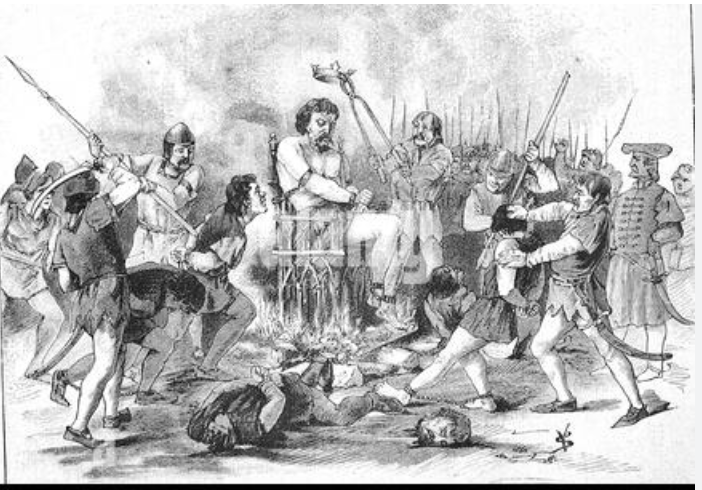
the peasants’ revolt and the execution of dozsa
The West Will Look Radically Different in 5-10 Years
It's hard to say exactly when the coming seismic shift in governance will come in the West, nor can we easily predict the contours of the structures that will be left after the cataclysm. As with earthquakes, you can be pretty sure that some fault will rupture, but the exact time, size of the rupture, and what will result are unpredictable.
But, looking around at the state of societies in the West, it's easy enough to see that the "Big One" is coming, and what follows will be dramatically reshaped from its current configuration.
….
First, the European Monetary Union as it exists today is done, and its demise was perfectly predictable from its inception. It all boils down to the fact that no one currency, or especially monetary policy, is appropriate to managing economies as diverse as Germany and Greece, Sweden and Bulgaria, France and Latvia. Their economies are not synchronized, and the political pressures are vastly different. When Germany has a youth unemployment rate of 6% and Spain has one of 26%, you can't square the circle.
Find more statistics at StatistaAnd that's before you get to any political differences, which the EU is currently trying to suppress using increasingly totalitarian means such as censorship, banning political parties, and dawn raids on dissenters.
You see the growing divergence between elite transnationalist opinion and "man on the street" anger everywhere, whether it is the backlash against mass migration or the inability of France to maintain a government. France has had five Prime Ministers in the last TWO years, and there seems to be no prospect that the structural problems that are plaguing the country can be fixed before an economic earthquake.
Germany is deindustrializing, and without Germany as the beating heart of the European economy, it is in for a rough ride. The countries of the EU are committed to keeping a losing war going—to the extent that European leaders are, increasingly, more committed to extending the war than many Ukrainians. The only reason why the US has been involved at all is our security commitment to NATO—the US has little at stake strategically in this war, unlike Taiwan, which is a vital adjunct to our economy. And Russia is not really a strategic competitor to the United States in the way that China is.
….
What can't go on forever won't. History shows that there is a "Wiley E. Coyote" effect—things go on longer than one expects, but the crash does come.
The technocrats know this, and their strategy is unfolding before our eyes: centralize power. The big threat to the EU project is that sovereign states will do what Britain did and leave, so they are suppressing dissent and working to centralize power in a federal system. Whether this project succeeds is unknowable, especially in the shorter term, but the farther out you look, the less likely it becomes. The US federal system (mostly) works due to a common culture and language, and Europe doesn't have anything like that.
…..
In short, Europe will soon look very different and far less stable, and it's likely that, politically, the countries will diverge quite a bit in how they address the crisis.
The security situation in the Far East, too, is highly difficult to predict. China's status as an economic juggernaut is at risk due to economic imbalances and a looming population crash, while the country is still rising as a military power with ambitions to change the regional power balance. Who knows how Xi will square that circle? He is rattling his sabers loudly, and the appeal to nationalism to maintain power will be strong, while the risk of a Taiwan war going badly is very high, especially since China's military power is entirely notional and untested. It certainly has the ability to impose high costs on its adversaries, but does it have the capacity to win an extended war, and would the costs be worth it either to the country or to Xi?
…..
We have entered an age of increasing political instability. Governments will fall, and policies will radically change. Either the technocrats or the nationalists will win in Europe, and I would bet on the latter.
Here in the United States, we have the same political tensions over similar issues as in Europe, but the balance of power between the two ideological camps leans a bit farther right, and there is a substantially larger ability to "sort" lefties and righties as is happening now. We have states that work, and states that don't. Florida and Texas on the one hand, California and Minnesota on the other. Socialists are winning in Blue cities, and conservatives are fleeing to friendlier climes.
The big question is, can the federal government start working again? Unlike most places in the world, we have vast swathes of our economy that still work well, and the US is the home of technological innovation and business development. The raw capacity for renewed influence and strength is enormous here; the big question is whether the government gets its act together in time.
A reckoning is coming. For all its flaws, the US is in the best position to survive the coming reshaping of the world, as long as we can beat back the socialist wave that is threatening to disrupt everything.