Lewiston, Maine: it's not just for Bates College kids anymore; Hail, Somalia!
/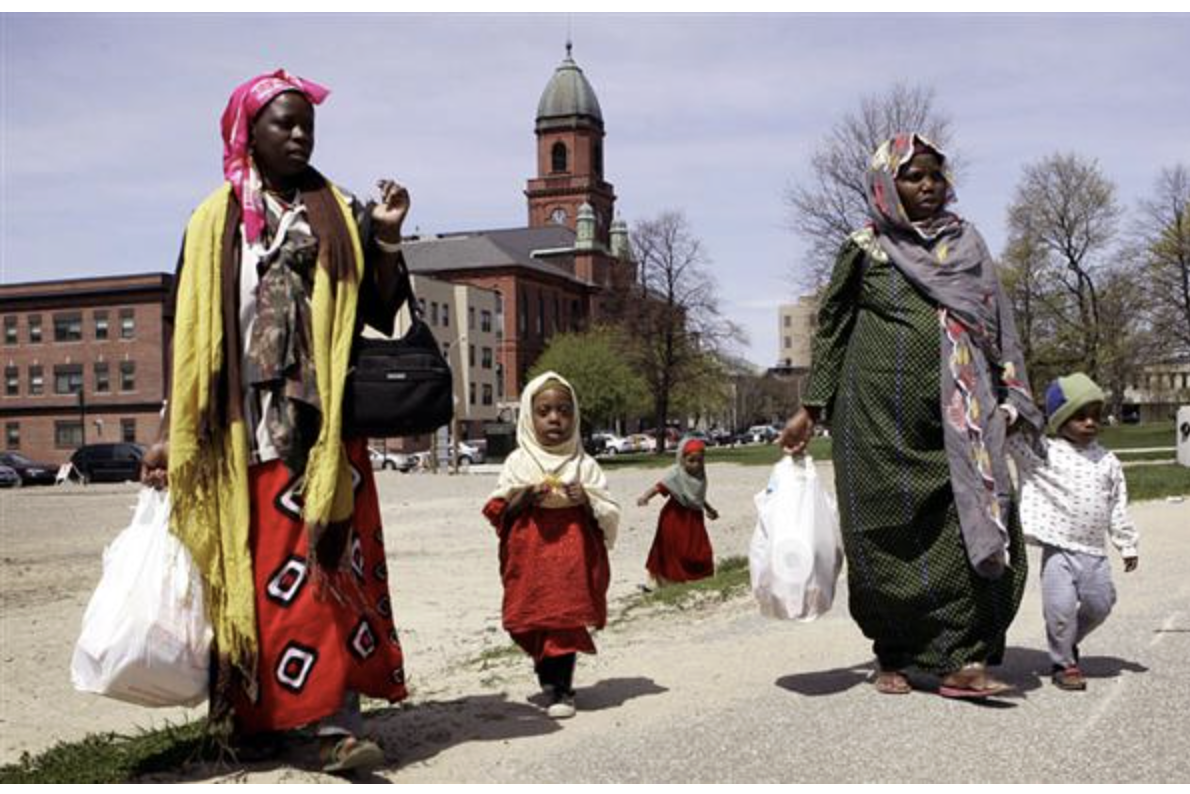
home from the food bank
To be fair, the twin cities of Lewiston-Auburn haven’t been garden spots since the textile mills moved south in the 50s, but they were coming back. Until, like those twin cities in the midwest we’re reading so much about thee days, the Bantus arrived, beginning in 2000 and in an increasing torrent since. From a city 95% white in 2000 (admittedly, many of them French Canadian and Irish white, but close enough, eh?) Somali/Bantus comprised 14% of the population by 2020, and an even higher percentage today.
The author of the article below takes a dim view of that transformation
What Happened to Lewiston, Maine? A Proud Mill City Now on the Brink as Leaders Stay Silent
Lewiston, Maine, once stood as a monument to American resilience, a booming mill city powered by the Androscoggin River, strengthened by generations of hardworking immigrant families, and anchored by institutions like Bates College and the Saints Peter and Paul Basilica.
Its French-Canadian heritage, its historic architecture, and its tightly woven working-class identity defined Maine’s second largest city for more than a century. Today, many residents look around and barely recognize the city they once knew. Crime and rampant drug abuse abound in Lewiston which, tragically, became the site of Maine’s first mass shooting just over two years ago.
….
Over the last two decades, the city underwent another dramatic demographic shift with the arrival of one of the nation’s largest Somali refugee populations. [Ed: Read, “The Great Somali Welfare Hunt”, American Conservative, November 18, 2002] This transformation reshaped Lewiston’s political structure, its schools, its social services, and its daily cultural landscape. Now with President Trump making clear his intent to remove Somali nationals who are unlawfully present in the United States, Lewiston has become an unexpected focal point in the national immigration debate.
A City in Visible Decline
A walk through downtown Lewiston makes clear how dramatically the community has changed. On thoroughfares such as Blake Street and Bartlett Street, gangs are visibly present, and teenage children have been seen carrying firearms. Open drug use occurs in daylight. Homelessness has surged.
Longtime residents and members of the Somali community increasingly avoid one another, exchanging cold stares, and engaging either in tense interactions, or no interaction at all.
The clearest symbol of the city’s decline is Kennedy Park, once a proud civic gathering space and now a site of persistent disorder. Families avoid the area. Police calls are routine. Nothing about the park reflects the thriving community it once served.
Shootings involving youths have become so routine that many are never reported in local news. Food pantry truck lines stretch down the block within steps of City Hall. The city feels less safe, less stable, and less hopeful than it has in generations.
The Iman Osman Scandal: A Breaking Point
If one event encapsulates the failure of local leadership, it is the rise and collapse of Iman Osman, a newly elected city councilor whose credibility collapsed under intense scrutiny.
Osman’s campaign for city council was shadowed by questions about his residency, including conflicting statements about addresses and documents that cast doubt on whether he lived in the district he claims to represent. Residents raised election-integrity concerns repeatedly, but city leaders brushed them aside.
Those concerns proved well-founded. Osman was indicted on Wednesday in an investigation involving firearms and narcotics, a development that shocked a city already grappling with rising youth violence and gun-related crime.
Despite this, the school committee avoided taking any position on the seriousness of the his residency, and the city council claimed it had no authority to act until Osman is sworn into office. The response left many residents outraged and reinforced the perception that those in power are more concerned with optics and appeasement than with protecting the community.
The Osman scandal has deepened cultural divisions, exposed the fragility of Lewiston’s political institutions, and amplified calls for accountability.
Where Is Maine’s Secretary of State and Governor?
The silence has not been limited to local leaders.
Maine Secretary of State Shenna Bellows, the state’s chief election official, [Ed. —the Soros candidate who ruled Trump ineligible for inclusion on the 2024 Republican primary ballot — a ruling that was rendered moot by the U.S. Supreme Court’s decision on a related case in March ‘24] has offered no statement and initiated no review regarding Osman’s residency, eligibility, or voter registration. Her refusal to engage is striking, especially given her history of intervening in high-profile election controversies.
Governor Janet Mills has remained equally quiet. She has not addressed the nonprofit controversies, the unanswered questions about victim-relief funds, the rise in youth violence, or the growing cultural tension in Lewiston. …
Related story: After the Lewiston mass shooting in 2023, 18 dead, 13 wounded, all white, private donors from Maine and around the country donated $6 million to a victims’ relief fund; $2 million of it was handed over to Somali welfare groups and disappeared, without an accounting.
And if you’re not exhausted or bored with this subject by now, here’s a 2009 puff-piece from Newsweek hailing the arrival of the “saviors of Lewiston”. It hasn’t aged well.
The Refugees Who Saved Lewiston
Barely a decade ago, Lewiston, Maine, was dying. The once bustling mill town's population had been shrinking since the 1970s; most jobs had vanished long before, and residents (those who hadn't already fled) called the decaying center of town "the combat zone." That was before a family of Somali refugees discovered Lewiston in 2001 and began spreading the word to immigrant friends and relatives that housing was cheap and it looked like a good place to build new lives and raise children in peace. Since then, the place has been transformed. Per capita income has soared, and crime rates have dropped. In 2004, Inc. magazine named Lewiston one of the best places to do business in America, and in 2007, it was named an "All-America City" by the National Civic League, the first time any town in Maine had received that honor in roughly 40 years. "No one could have dreamed this," says Chip Morrison, the local Chamber of Commerce president. "Not even me, and I'm an optimist."
Immigrants from Somalia may sound like improbable rescuers for a place like Lewiston. Maine is one of the whitest states in the country, second only to Vermont, and its old families have a reputation for distinct chilliness toward "outsiders." And many of the immigrants spoke no English at all when they arrived. But even beyond the obvious racial, cultural and religious differences between the Muslim newcomers and the locals, the town's image had become so negative that it was hard to imagine people choosing to move there. "Nothing could have rightfully prepared them," says Paul Badeau of the Lewiston-Auburn Economic Growth Council. "And nothing could have rightfully prepared us, either." It wasn't easy at first. Townspeople feared for the few jobs that remained in the area, and they warned that the strangers would overload local social services. In 2002, the then Mayor Laurier Raymond wrote an open letter to the Somali community begging them to stop encouraging friends and family to follow them to Maine.
But the Somalis kept coming, followed by Sudanese, Congolese and other Africans. By some estimates, 4,000 new immigrants have moved to Lewiston since 2001, and dozens are still arriving every month. Eight years ago, the town's adult-education center had only 76 students learning English as a second language. Now some 950 pass through every year. "This is just the teeniest little part of what has happened to the city," says the center's coordinator, Anne Kemper. "Everybody has had to scramble." Today, Somali women and children in donated winter parkas carefully navigate the snowbanks in the town's formerly [sic] crime-ridden low-income residential area.
The center of town still has pawnbrokers and bars, but now there are also shops with names like Mogadishu and Baracka, with signs advertising halal foods and selling headscarves and prepaid African phone cards. "Generally, refugees or migrants that come into a town give a new injection of energy," says Karen Jacobsen, director of the Forced Migration Program at Tufts University's Feinstein International Famine Center. "Somalis particularly. They have a very good network [with strong] trading links, and new economic activities they bring with them." Retailers sell clothes and spices imported from Africa; other entrepreneurs have launched restaurants and small businesses providing translation services, in-home care for the elderly and other social services. There's even a business consultant. "Increasingly, there's an acceptance that immigration is associated with good economic growth," says urban-studies specialist Richard Florida, director of the University of Toronto's Martin Prosperity Institute. "How is Maine going to grow? It's a big state with a sparse population. One of the ways to grow quickly is import people."
Commerce isn't all the Somalis are reshaping. Maine has America's highest median age and the lowest percentage of residents under 18. Throughout the 1990s, the state's population of 20- to 30-year-olds fell an average of 3,000 a year. Demographers predict that by 2030, the state will have only two workers for each retiree. "In many small Maine towns they're looking at having to close schools for lack of schoolchildren," says State Economist Catherine Reilly. "It will snowball. Right now we're seeing the difficulty of keeping some schools open; in 10 or 15 years that's going to be the difficulty of businesses finding workers." The same ominous trend is seen in other states with similarly homogenous demographics and low numbers of foreign-born residents—states like Montana, North Dakota and West Virginia. Reilly adds: "If you told a demographer just our racial composition, they would be able to guess that we're an old state with a low birthrate."
Lewiston's sudden jolt is reflected even in enrollment at local universities. Although University of Maine enrollment has dropped systemwide since 2002, the student population at its Lewiston campus jumped 16 percent between 2002 and 2007. And Andover College, which opened a campus in Lewiston in 2004, had to start expanding almost immediately to accommodate a boom in applications. Enrollment doubled in two years. The reason? "Young people didn't want to go to a place that's all white," says Morrison. Practically everyone in Lewiston credits the Somalis' discovery of their town with much of its newfound success. "It's been an absolute blessing in many ways," says Badeau. "Just to have an infusion of diversity, an infusion of culture and of youth. Cultural diversity was the missing piece." The question is whether the rest of Maine—and other states like it—can find their own missing pieces.
Source: Newsweek, Jan 23, 2009
Fun fact: the Somalis — Batus —were originally Tanzanians, until they were forcible captured by fellow-Africans hundreds of years ago and kept as slaves in Somalia. Reparations!
AI Overview
Yes, many Bantu people were enslaved, particularly during the Indian Ocean slave trade where they were captured from East Africa and forced into labor in places like Somalia, the Swahili Coast, and even the Americas, though Bantu origins for American slaves are more diverse; slavery was a complex system in Africa, involving internal capture and trade, and the term "Bantu" itself, as used in Somalia, could refer to "foreigner" or "slave," highlighting their marginalized status
.
Key Aspects of Bantu Enslavement:
** Somali Bantu:** Large numbers of Bantu people were taken to Somalia for plantation work, becoming a distinct, marginalized group (Mushunguli), with slavery legally abolished by Italians in the early 20th century, though discrimination continued.
Indian Ocean Trade: Afro-Arab traders captured Bantu peoples from the interior, transporting them to coastal areas and islands for labor, leading to Bantu influence and admixture in places like Madagascar.
Internal Slavery: Slavery existed within Bantu-speaking Africa long before European trade, often as a strategy for leaders to gain power, involving capturing outsiders for labor, a practice that intensified with global trade.
Transatlantic Trade: While many African slaves in the Americas came from West-Central Africa, Bantu-speaking regions in East-Central Africa also supplied captives for the Atlantic slave trade.
Social Status: Treatment of enslaved people varied greatly, from harsh labor to integration within families, but for many Bantu, slavery meant being outsiders, often despised, as seen in Somalia.