An interesting thought problem: what do we do when we run out of student who no longer learn?
/
We still have the borcherds, but who will replace them?
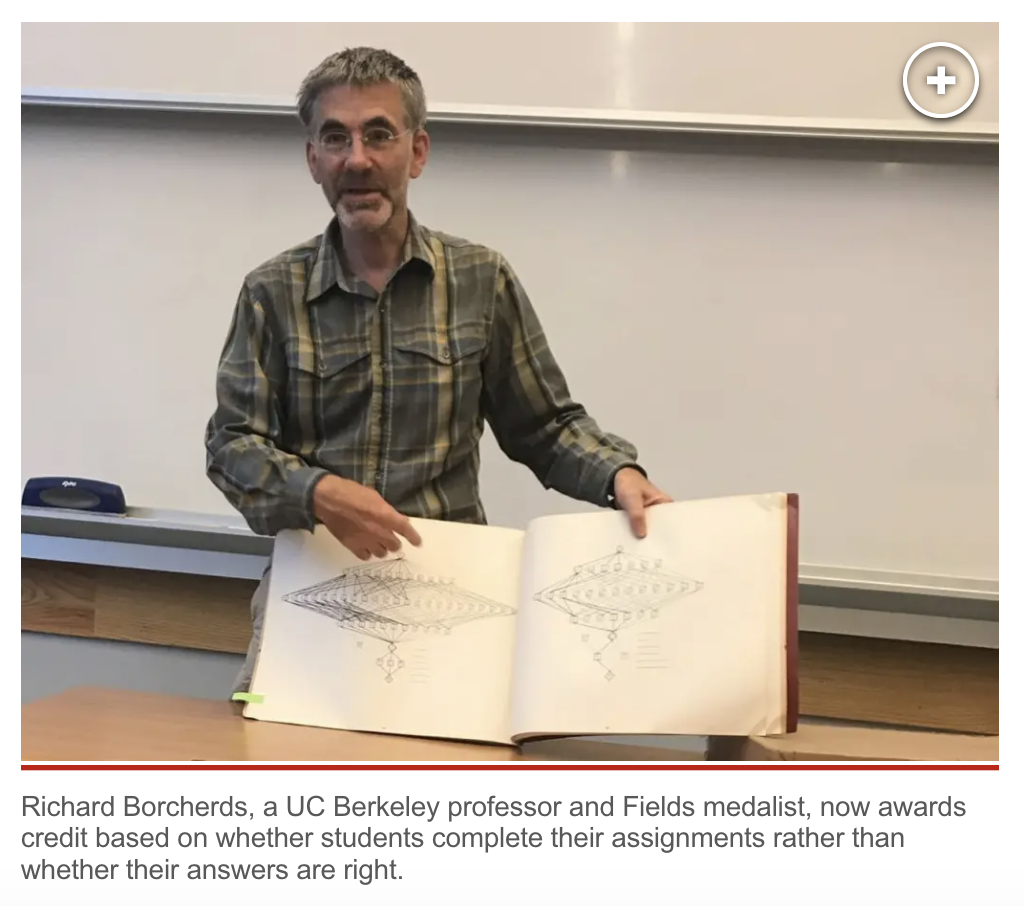
UC Berkeley professor refuses to grade his students’ homework after noticing worrying trend: ‘No point’
A UC Berkeley professor has stopped grading students’ homework for correctness after noticing artificial intelligence tools were helping them rack up top marks.
Richard Borcherds, a renowned mathematician who received the prestigious Fields Medal in 1998, said widespread student use of AI has undermined the value of traditional homework grading.
“Student use of AI for homework is now widespread,” Borcherds told The California Post. “Grading for correctness just adds a huge incentive for them to use AI for homework instead of doing it themselves, and penalizes students for honesty.”
Borcherds now awards credit based primarily on whether students complete their assignments rather than whether their answers are correct, acknowledging that he does not know of a better solution.
The professor said it has become increasingly difficult to distinguish work produced by artificial intelligence from work written by students themselves.
“There is no easy way to tell the difference between human and AI generated work,” he told The California Post. “Occasionally one could tell it is AI because AI made a few characteristic errors, but AI has now improved so much that it rarely makes obvious mistakes.”
His comments come as AI tools grow increasingly capable of tackling complex academic problems, raising questions about how universities will assess students’ work and prepare the next generation of mathematicians.
Borcherds’ concerns about the future of mathematics were also highlighted in an interview with the Daily Californian, UC Berkeley’s student newspaper.
“If AI continues to improve at present rate, then, in a few years, there’ll be nothing human mathematicians can do that AI can’t do better,” Borcherds told the paper.
The professor expressed uncertainty about whether aspiring mathematicians should still pursue the field, saying that just five years ago, mathematics appeared to offer relatively strong protection against the technological disruption now sweeping through other professions.
“I have no idea what to advise. I even asked ChatGPT this exact question, and even ChatGPT said it didn’t have any idea what was going to happen,” he told the student newspaper.
….
“There have been plenty of technical breakthroughs in the past — hand weaving was put out of business by looms, and horses were put out of business by motor cars, and so on,” Borcherds said. “This is the first time anything like this has happened in mathematics, though.”
With no better solution in sight, Borcherds told The California Post that he now bases grades mainly on in-person exams, where students are not allowed to use electronic devices.
Online exams, meanwhile, have become “a waste of time,” he said, because some students use AI to answer the questions.
Borcherds said he cannot tell which students are using AI but has noticed that average scores rise substantially on online exams.
….
And this final note
For Borcherds, however, the challenges of grading homework may pale in comparison with the wider consequences of artificial intelligence.
“If the worst effect of AI on society is that it is harder to assess homework then I will be very relieved,” he told The California Post.