The Best of the Wurst
/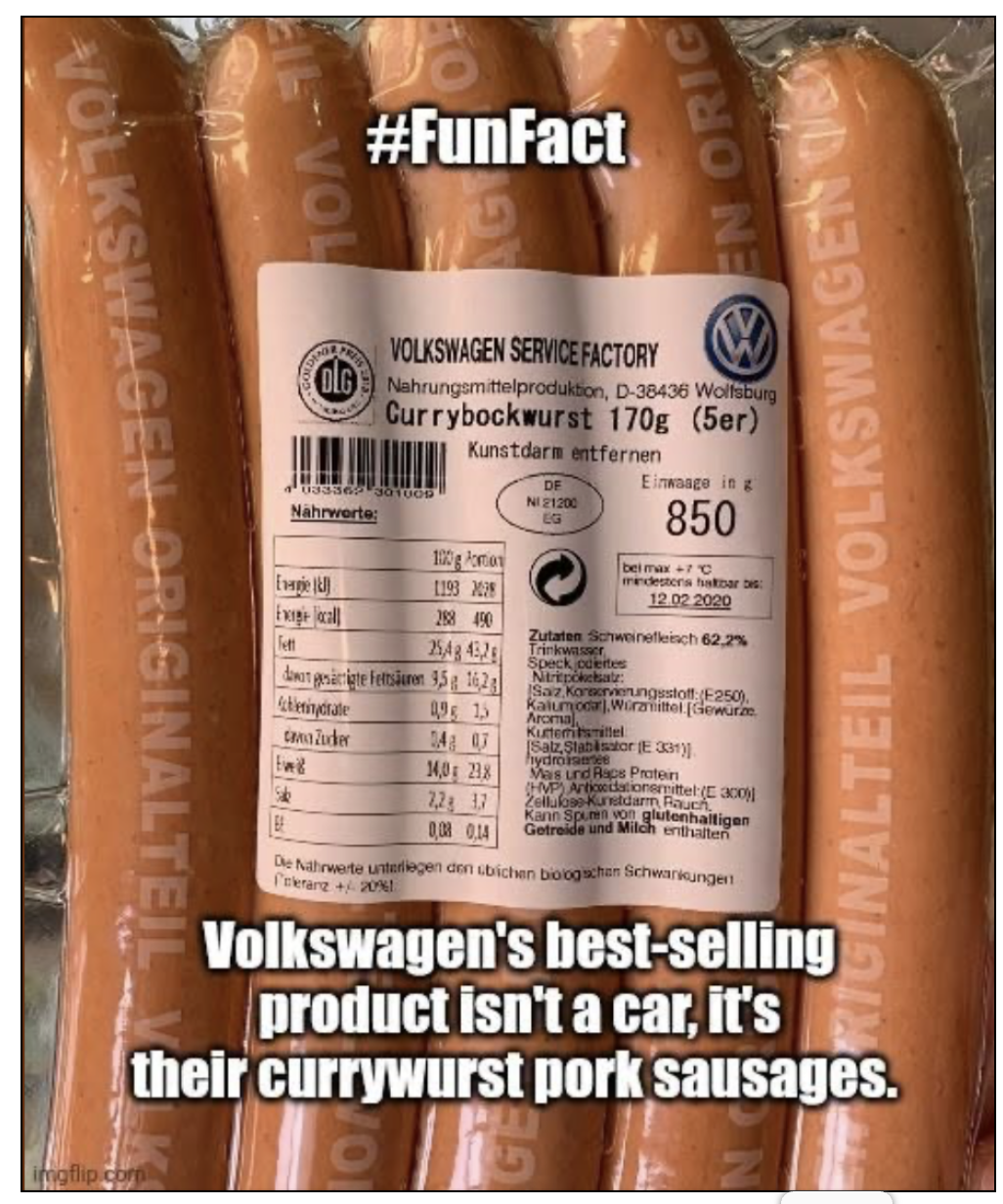
In an otherwise disappointing Week in Pictures today, I saw the above, posted with no further information. I had to ask, so I did: “Hey, Google: does Volkswagen really sell sausages?” Turns out that it does.
Yes, Volkswagen makes and sells its own currywurst sausages (currywurst) at its Wolfsburg plant in Germany. They have been produced since 1973 and even carry an official VW "original part" number: 199 398 500 A. [1, 2]
Key Details
Volume: Volkswagen sold about 8.5 million currywurst sausages in 2024—more than the 5.2 million VW-branded cars delivered that year. [1, 2]
Where They're Sold: Primarily in Germany and parts of Europe at VW factory cafeterias, select grocery stores, football stadiums, and some dealerships. [1, 2, 3]
Varieties: Alongside the traditional pork currybockwurst, VW also makes vegetarian and vegan versions, plus a companion spiced curry ketchup. [1, 2, 3]
U.S. Availability: They are not sold in U.S. grocery stores or dealerships due to meat import and freshness rules. [1, 2]
Volkswagen started making sausages out of pure logistical necessity to feed thousands of workers at its isolated flagship factory in Wolfsburg, Germany. [Google doesn’t mention the reason why the factory was so isolated: it was run using slave labor: Jews, captured Russian soldiers, and political prisoners, and you certainly don’t want those undesirables wandering around looking for snacks in the village, mixing with the civilian population and possibly polluting the fine german bloodline.]
When the Wolfsburg plant opened in 1938, it was built in a remote, rural area far away from established towns, restaurants, or grocery stores. To keep tens of thousands of assembly-line workers fed, VW had to build a completely self-sustaining food operation on-site—which originally included its own farm and an in-house butcher shop. [1, 2]
How It Evolved Into a Best-Seller
1973 – A Custom Factory Recipe: For decades, VW's butchers made standard meats for the employee canteens. In 1973, the culinary team created a signature currywurst specifically tailored for factory shifts—making it leaner than a traditional bratwurst (about 20% fat instead of 35%) so it would be filling and quick to serve without weighing workers down on the line. [1]
The Part Number: Because everything produced inside the Wolfsburg plant had to be tracked in the company's central inventory system, the sausage was assigned an official Volkswagen Originalteil (Original Part) number—199 398 500 A—alongside its own custom spiced ketchup (199 398 500 B). [1, 2]
Going Public: The sausage became so popular with employees and visitors—and even won gold awards from the German Agricultural Society—that VW expanded production. Today, a dedicated team of roughly 30 VW butchers produces thousands of sausages a day for German supermarkets, football stadiums, and dealerships that hand them out as thank-you gifts to car buyers. [1, 2, 3, 4]
This side story came up without prompting:
In August 2021, Volkswagen sparked a national culture war in Germany by removing meat—including its iconic currywurst—from the menu at one of its main headquarters cafeterias in Wolfsburg to promote sustainability.
While the change only applied to a single cafeteria within the massive complex (where roughly 30 other dining spots still served the pork sausage), the move immediately collided with German politics, blue-collar identity, and debates over climate policy. [1, 2, 3]
How the Controversy Unfolded
A Former Chancellor Intervenes: Former German Chancellor Gerhard Schröder—who previously governed VW’s home state of Lower Saxony and sat on the automaker's supervisory board—publicly blasted the decision on LinkedIn. Calling currywurst with fries the "power bar of the skilled production worker," he launched the viral hashtag #RettetdieCurrywurst ("Save the Currywurst") and declared that such a ban would never have happened on his watch. [1, 2, 3]
A Symbol of Bigger Political Fights: The uproar happened just weeks before Germany's 2021 federal election. Conservative and populist commentators seized on the menu change as an example of "woke" corporate overreach and climate-driven lecturing—echoing a famous 2013 backlash against the German Green Party when it proposed a weekly meat-free "Veggie Day" in public canteens. [1, 2]
The Outcome: After two years of worker pushback and a follow-up employee survey, Volkswagen quietly reversed the policy in August 2023, bringing the traditional pork currywurst back to the central canteen alongside its plant-based alternatives. [1, 2]
So now you know.