The earth is doomed, Chapter 4,312 (stay tuned! Next week, Chapter 4,313)
/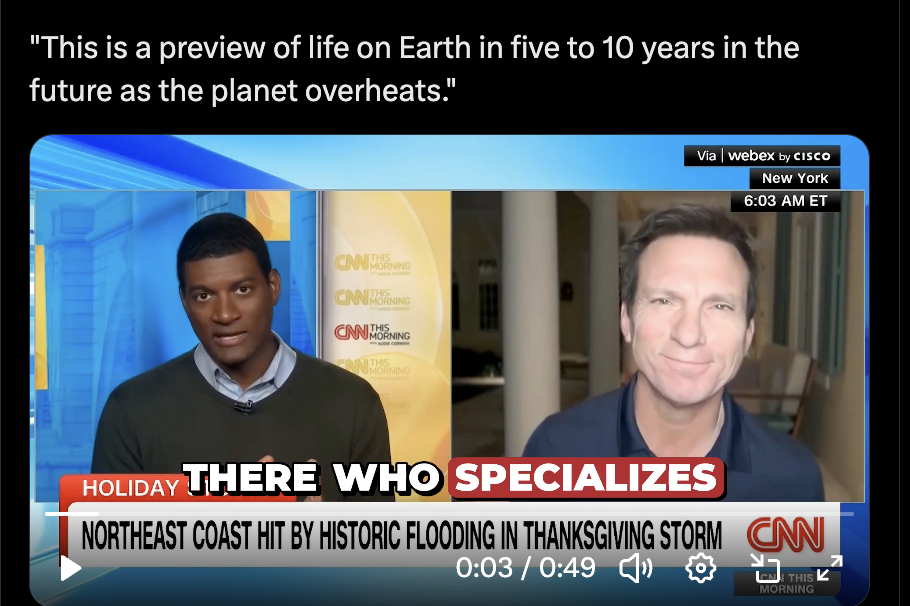
CNN's chief climate correspondent on the Thanksgiving storm: "This is a preview of life on Earth in five to 10 years in the future as the planet overheats." https://t.co/YrD9d4rJ5g
— Townhall.com (@townhallcom) November 27, 2026
Where have we heard this before?
18 Spectacularly Wrong Predictions Were Made Around the Time of the First Earth Day in 1970, Expect More This Year
Apr 21, 2022 — Mark J. Perry
Tomorrow is Earth Day 2022 and marks the 52nd anniversary of Earth Day, so it’s time for my annual CD post on the spectacularly wrong predictions that were made around the time of the first Earth Day in 1970…..
In the May 2000 issue of Reason Magazine, award-winning science correspondent Ronald Bailey wrote an excellent article titled “Earth Day, Then and Now: The planet’s future has never looked better. Here’s why” to provide some historical perspective on the 30th anniversary of Earth Day. In that article, Bailey noted that around the time of the first Earth Day in 1970, and in the years following, there was a “torrent of apocalyptic predictions” and many of those predictions were featured in his Reason article. Well, it’s now the 51st anniversary of Earth Day, and a good time to ask the question again that Bailey asked 21 years ago: How accurate were the predictions made around the time of the first Earth Day in 1970? The answer: “The prophets of doom were not simply wrong, but spectacularly wrong,” according to Bailey. Here are 18 examples of the spectacularly wrong predictions made around 1970 when the “green holy day” (aka Earth Day) started:
1. Harvard biologist George Wald estimated that “civilization will end within 15 or 30 years [by 1985 or 2000] unless immediate action is taken against problems facing mankind.”
2. “We are in an environmental crisis that threatens the survival of this nation, and of the world as a suitable place of human habitation,” wrote Washington University biologist Barry Commoner in the Earth Day issue of the scholarly journal Environment.
3. The day after the first Earth Day, the New York Times editorial page warned, “Man must stop pollution and conserve his resources, not merely to enhance existence but to save the race from intolerable deterioration and possible extinction.”
4. “Population will inevitably and completely outstrip whatever small increases in food supplies we make,” Paul Ehrlich confidently declared in the April 1970 issue of Mademoiselle. “The death rate will increase until at least 100-200 million people per year will be starving to death during the next ten years [by 1980].”
5. “Most of the people who are going to die in the greatest cataclysm in the history of man have already been born,” wrote Paul Ehrlich in a 1969 essay titled “Eco-Catastrophe! “By…[1975] some experts feel that food shortages will have escalated the present level of world hunger and starvation into famines of unbelievable proportions. Other experts, more optimistic, think the ultimate food-population collision will not occur until the decade of the 1980s.”
6. Ehrlich sketched out his most alarmist scenario for the 1970 Earth Day issue of The Progressive, assuring readers that between 1980 and 1989, some 4 billion people, including 65 million Americans, would perish in the “Great Die-Off.”
7. “It is already too late to avoid mass starvation,” declared Denis Hayes, the chief organizer for Earth Day, in the Spring 1970 issue of The Living Wilderness.
8. Peter Gunter, a North Texas State University professor, wrote in 1970, “Demographers agree almost unanimously on the following grim timetable: by 1975 widespread famines will begin in India; these will spread by 1990 to include all of India, Pakistan, China, and the Near East, Africa. By the year 2000, or conceivably sooner, South and Central America will exist under famine conditions….By the year 2000, thirty years from now, the entire world, with the exception of Western Europe, North America, and Australia, will be in famine.”
Note: The prediction of famine in South America is partly true, but only in Venezuela and only because of socialism, not for environmental reasons.
9. In January 1970, Life reported, “Scientists have solid experimental and theoretical evidence to support…the following predictions: In a decade, urban dwellers will have to wear gas masks to survive air pollution…by 1985 air pollution will have reduced the amount of sunlight reaching earth by one half….”
10. Ecologist Kenneth Watt told Time that, “At the present rate of nitrogen buildup, it’s only a matter of time before light will be filtered out of the atmosphere and none of our land will be usable.”
11. Barry Commoner predicted that decaying organic pollutants would use up all of the oxygen in America’s rivers, causing freshwater fish to suffocate.
12. Paul Ehrlich chimed in, predicting in 1970 that “air pollution…is certainly going to take hundreds of thousands of lives in the next few years alone.” Ehrlich sketched a scenario in which 200,000 Americans would die in 1973 during “smog disasters” in New York and Los Angeles.
13. Paul Ehrlich warned in the May 1970 issue of Audubon that DDT and other chlorinated hydrocarbons “may have substantially reduced the life expectancy of people born since 1945.” Ehrlich warned that Americans born since 1946…now had a life expectancy of only 49 years, and he predicted that if current patterns continued this expectancy would reach 42 years by 1980 when it might level out. (Note: According to the most recent CDC report, life expectancy in the US is 78.6 years).
14. Ecologist Kenneth Watt declared, “By the year 2000 if present trends continue, we will be using up crude oil at such a rate…that there won’t be any more crude oil. You’ll drive up to the pump and say, `Fill ‘er up, buddy,’ and he’ll say,`I am very sorry, there isn’t any.’”
Note: Global oil production last year at about 95M barrels per day (bpd) was double the global oil output of 48M bpd around the time of the first Earth Day in 1970.
15. Harrison Brown, a scientist at the National Academy of Sciences, published a chart in Scientific American that looked at metal reserves and estimated that humanity would totally run out of copper shortly after 2000. Lead, zinc, tin, gold, and silver would be gone before 1990.
16. Sen. Gaylord Nelson wrote in Look, “Dr. S. Dillon Ripley, secretary of the Smithsonian Institute, believes that in 25 years, somewhere between 75 and 80 percent of all the species of living animals will be extinct.”
17. In 1975, Paul Ehrlich predicted that “since more than nine-tenths of the original tropical rainforests will be removed in most areas within the next 30 years or so [by 2005], it is expected that half of the organisms in these areas will vanish with it.”
18. Kenneth Watt warned about a pending Ice Age in a speech. “The world has been chilling sharply for about twenty years,” he declared. “If present trends continue, the world will be about four degrees colder for the global mean temperature in 1990, but eleven degrees colder in the year 2000. This is about twice what it would take to put us into an Ice Age.”
MP: Let’s keep those spectacularly wrong predictions from the first Earth Day 1970 in mind when we’re bombarded again this year with dire predictions of “gloom and doom” and “existential threats” due to climate change. And let’s think about the question posed by Ronald Bailey in 2000: What will Earth look like when Earth Day 60 rolls around in 2030? Bailey predicts a much cleaner, and much richer future world, with less hunger and malnutrition, less poverty, longer life expectancy, and lower mineral and metal prices. But he makes one final prediction about Earth Day 2030: “There will be a disproportionately influential group of doomsters predicting that the future – and the present – never looked so bleak.” In other words, the hype, hysteria, and spectacularly wrong apocalyptic predictions will continue, promoted by virtue-signaling “environmental grievance hustlers” like AOC, who said several years ago that we have “only 12 years left to stop the worst impacts of climate change.”
But wait, there’s more!
Google AI:
Predictions of "Tipping Points" and Deadlines
The Year 2000 Deadline (1989). Noel Brown, then-director of the New York office of the United Nations Environment Programme (UNEP), told the Associated Press that governments had a "10-year window of opportunity to solve the greenhouse effect". He stated that entire nations could be wiped off the face of the Earth by rising sea levels if the global-warming trend was not reversed by the year 2000. [1]
The 10-Year Tipping Point (2006). While promoting his documentary An Inconvenient Truth, former U.S. Vice President Al Gore stated that humanity had only 10 years left to take drastic measures before the planet reached a "point of no return" regarding global warming. [1]
The "100 Months" Countdown (2008). The New Economics Foundation, a British think tank, launched a campaign declaring that the world had just 100 months (ending in December 2016) to stabilize greenhouse gas concentrations before reaching an irreversible tipping point. Prince Charles (now King Charles III) echoed similar timelines in 2009, stating the world had "just 96 months to save the world" from irretrievable ecosystem collapse. [1, 2]
The "500 Days" Warning (2014). During a joint appearance with U.S. Secretary of State John Kerry, French Foreign Minister Laurent Fabius stated that the world had "500 days to avoid climate chaos" ahead of the 2015 Paris Climate Conference. [1, 2]
The 12-Year Warning (2018–2019). Following a 2018 report by the Intergovernmental Panel on Climate Change (IPCC) detailing the impacts of 1.5°C of warming by 2030, several politicians and activists framed 2030 as a hard deadline for human survival. Notably, U.S. Representative Alexandria Ocasio-Cortez stated in January 2019 that "the world is gonna end in 12 years if we don't address climate change," though she later clarified the remark was meant to underscore the urgency of cutting emissions rather than a literal apocalypse. [1]
Specific Sea-Level Rise and Ice-Melt Predictions
The Maldives Underwater by 2018 (1988). Agence France-Presse reported that Maldivian officials warned a gradual rise in average sea level would completely cover the 1,196 islands of the Maldives within the next 30 years (by 2018).
New York’s West Side Highway Underwater (1988). During an interview with author Bob Reiss, NASA scientist James Hansen was asked what New York City would look like in 20 or 40 years if carbon dioxide levels doubled. Hansen speculated that Manhattan's West Side Highway would be underwater. Reiss later misquoted the timeframe as 20 years (2008) in a magazine interview before clarifying that his book recorded the timeframe as 40 years (2028).
Ice-Free Arctic Summers by 2013–2016 (2007–2012). In his 2007 Nobel Peace Prize acceptance speech and a 2009 speech in Copenhagen, Al Gore cited research by scientist Wieslaw Maslowski suggesting there was a 75% chance the entire north polar ice cap could be completely ice-free during summer months within five to seven years (by 2013–2016). Similarly, Cambridge ocean physicist Peter Wadhams predicted in 2012 that the final collapse of summer Arctic sea ice would occur by 2015 or 2016. While summer sea ice has declined significantly over the satellite record, the Arctic has not become ice-free.
5 to 9 Meters of Sea-Level Rise by 2100 (2016). In a 2016 paper, James Hansen and his co-authors argued that a 2°C rise in global temperatures could trigger nonlinear ice-sheet disintegration, leading to multi-meter sea-level rise—potentially 5 to 9 meters (16 to 30 feet)—within the next 50 to 150 years. By contrast, mainstream consensus projections from the IPCC generally estimate a global mean sea-level rise of roughly 0.3 to 1 meter (1 to 3 feet) by 2100, depending on future emissions. [1, 2, 3, 4, 5, 6, 7, 8, 9, 10, 11, 12]
When examining these statements, historians and climate scientists point out two main distinctions:
Policy Deadlines vs. Physical Collapse: Many "tipping point" dates (such as 2000, 2016, or 2030) were intended by policymakers to describe the window of time required to prevent locking in long-term warming, rather than the exact date physical destruction would occur. [1]
Media Amplification of Outliers: Extreme projections—such as an ice-free Arctic by 2013 or multi-meter sea-level rise within a single century—often originated from single outlier studies or linear extrapolations rather than the broader scientific consensus, which historically projected slower, multi-century timelines for major ice-sheet collapse. [1, 2]
Cato Institute
The Global Warming Apocalypses That Didn't Happen
April 21, 2014 — On July 5, 1989, Noel Brown, then the director of the New York office of the United Nations Environment Program, warned of a “10-y...
Skeptical Science
Examining Hansen's prediction about the West Side Highway
Hansen was speculating on changes that might happen if CO2 doubled. Climate Myth: Hansen predicted the West Side Highway would be ...
Quora
In 1988, famous NASA climate scientist James Hansen ...
April 21, 2021 — Hansen Prediction Misconception: The widely circulated claim that James Hansen predicted the Riverside Expressway would be underwa...
Alarmist Claim #5: May 2013, President Obama claimed the climate is warming faster than anybody anticipated five or 10 years ago.” FACT: Nature reported “For ...Read more
Celebrating 50 years of Failed Climate Predictions
May 5, 2023 — On June 30, 1989, the Associated Press squeezed decimation into a tight, 11-year window, with an ominous article, “Rising Seas Could Obliterate ...Read more