More hot air seeping from the seat of their pants
/
As is its wont, Greenwich Free Press has collected a few press releases, this time on the wind power boondoggle off the CT RI shore, and reprinted it as news Here are some excerpts; — note that what is not is not mentioned, what is being lied about, is that the amount of actual electricity produced by the propeller beanies will actually be less than half the number Lamont, Himes, and Blumenthal (Chris Murphy being unavailable to join in the celebration) cite, so the “less expensive” electricity will in fact be as much as twice what they’re claiming. When your electric bill continues to soar, you can thank them appropriately.
Do you remember the time when journalists were perceived to be hard bitten, skeptics, questioning everything they were told? When editors were said to instruct their reporters, “If your mother says she loves you, check it out”? Those days are long gone, if they ever existed at all.
Greenwich Free Press, November 6, 2026:
Revolution Wind Offshore Wind Project Reaches Full Commercial Operation
…. Located approximately 15 nautical miles southeast of Point Judith, Rhode Island, the project will provide enough electricity to the New England grid to power 350,000 homes, equivalent to about 2.5% of the region’s electricity supply.
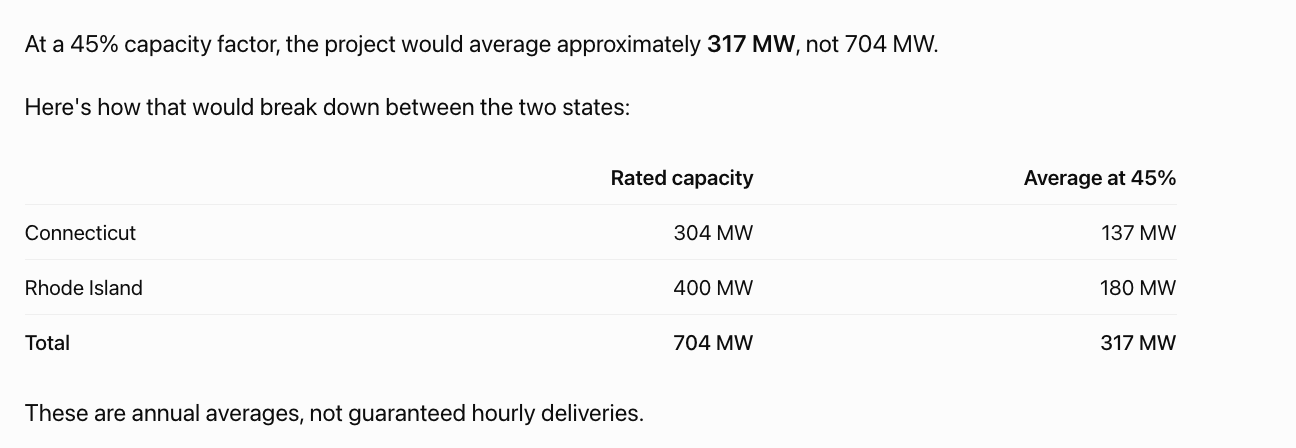
Connecticut will purchase 304 MW of the final output from Revolution Wind with the remaining 400 MW to be delivered to Rhode Island. Connecticut’s share will meet about 5% of the state’s overall electricity demand.
“This project being fully operational is a significant milestone for Connecticut and a welcome addition to our energy mix,” Governor Lamont said. “Revolution Wind will help to lower utility costs for families and businesses, improve the reliability of our grid, and provide clean electricity that will power 350,000 homes. ….
…. Congressman Jim Himes (CT-04) released the following statement:
“The completion of Revolution Wind is an important step towards bringing down rising energy costs across the Connecticut. This project will power 350,000 homes and, beginning in 2028, save customers $500 million annually.

Oh, really? Let’s ask ChatGTP the question none of these morons and liars and the editor of Greenwich Free Press think or dare to ask:
Q. I read that the "Revolution Wind Project" off shore of CT will 704 MW of power to CT and RI - is that a theoretical number, as in "potential", ar an accurate number of what will be delivered?
A. The 704 megawatts (MW) quoted for the Revolution Wind Project is its rated generating capacity, NOT the amount of electricity it will continuously deliver to Connecticut and Rhode Island.
It's a measure of how much power the wind farm can generate under favorable wind conditions, not a guarantee of actual production.
This distinction is important because wind farms produce varying amounts of electricity depending on wind speeds, turbine availability, maintenance, and other factors.
The more meaningful number is the project's capacity factor — the percentage of its theoretical maximum output that it actually generates over time.
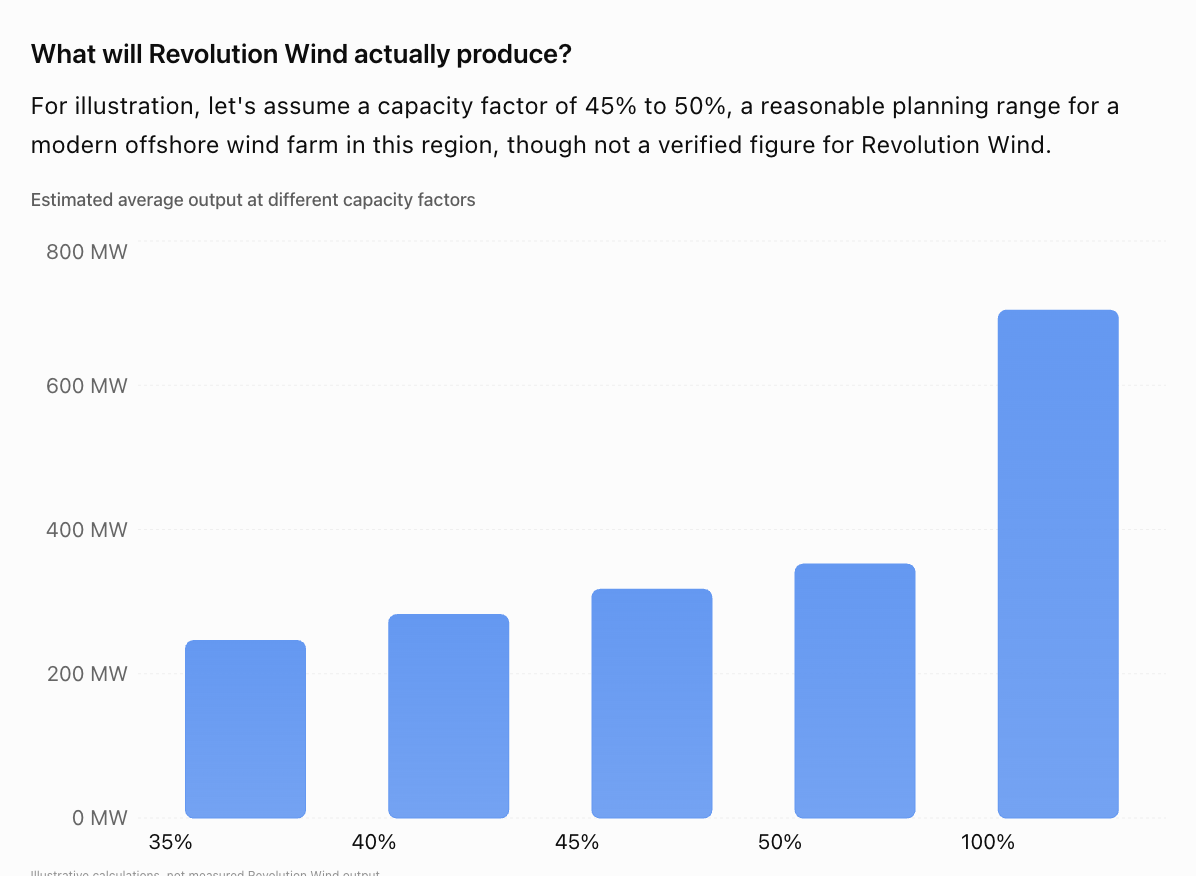
What will Revolution Wind actually produce?
For illustration, let's assume a capacity factor of 45% to 50%, a reasonable planning range for a modern offshore wind farm in this region, though not a verified figure for Revolution Wind.
What do we know about its actual performance?
Interestingly, Revolution Wind officially reached full operational status on November 5, 2026, just three days ago.
That means we don't yet have a full year of operating data to establish its actual annual capacity factor.
However, a nearby offshore project, South Fork Wind, reportedly achieved a 46.4% net capacity factor during its first full year. That provides a useful comparison, although it doesn't guarantee Revolution Wind will perform identically.
One other important distinction
Even when Revolution Wind averages 317 MW, it could produce very little electricity during periods of weak wind. At other times, it could approach its full 704 MW capacity.
This means the grid must have other resources available to meet demand when wind production falls.
Bottom line: The advertised 704 MW is a legitimate engineering rating, but it would be misleading to interpret it as 704 MW of electricity delivered around the clock.
And there's a related question worth investigating: How much are Connecticut ratepayers paying per megawatt-hour for Revolution Wind's actual electricity production, and how does that compare with natural gas generation? That's where the capacity factor, contract terms, and economics become particularly interesting.
Okay, let’s Chat about that:
Connecticut ratepayers have a contracted price of $99 per megawatt-hour (MWh) for Revolution Wind electricity and its renewable energy credits. That's 9.9 cents per kilowatt-hour, before transmission, distribution, and other retail electricity charges.
The important distinction is that $99/MWh is the contracted price for electricity actually generated, not a guaranteed payment for the wind farm's theoretical maximum capacity.
Revolution Wind reached full commercial operation in October 2026, according to a November 5 report by the CT Mirror. However, developer Ørsted has not publicly disclosed detailed actual production figures in that report.
Revolution Wind versus natural gas
Using that benchmark, Revolution Wind's contract price is:
2.39 times as high, or approximately 139% more expensive.
$57.53 more per MWh than the 2024 wholesale average.
This comparison is useful but imperfect: the wholesale average includes electricity from natural gas, nuclear, hydro, wind, and other sources, while the wind contract also includes renewable energy credits. [Meaning i’s even more expensive than these figures show — ED]
More recent comparison: 2025 actual market prices
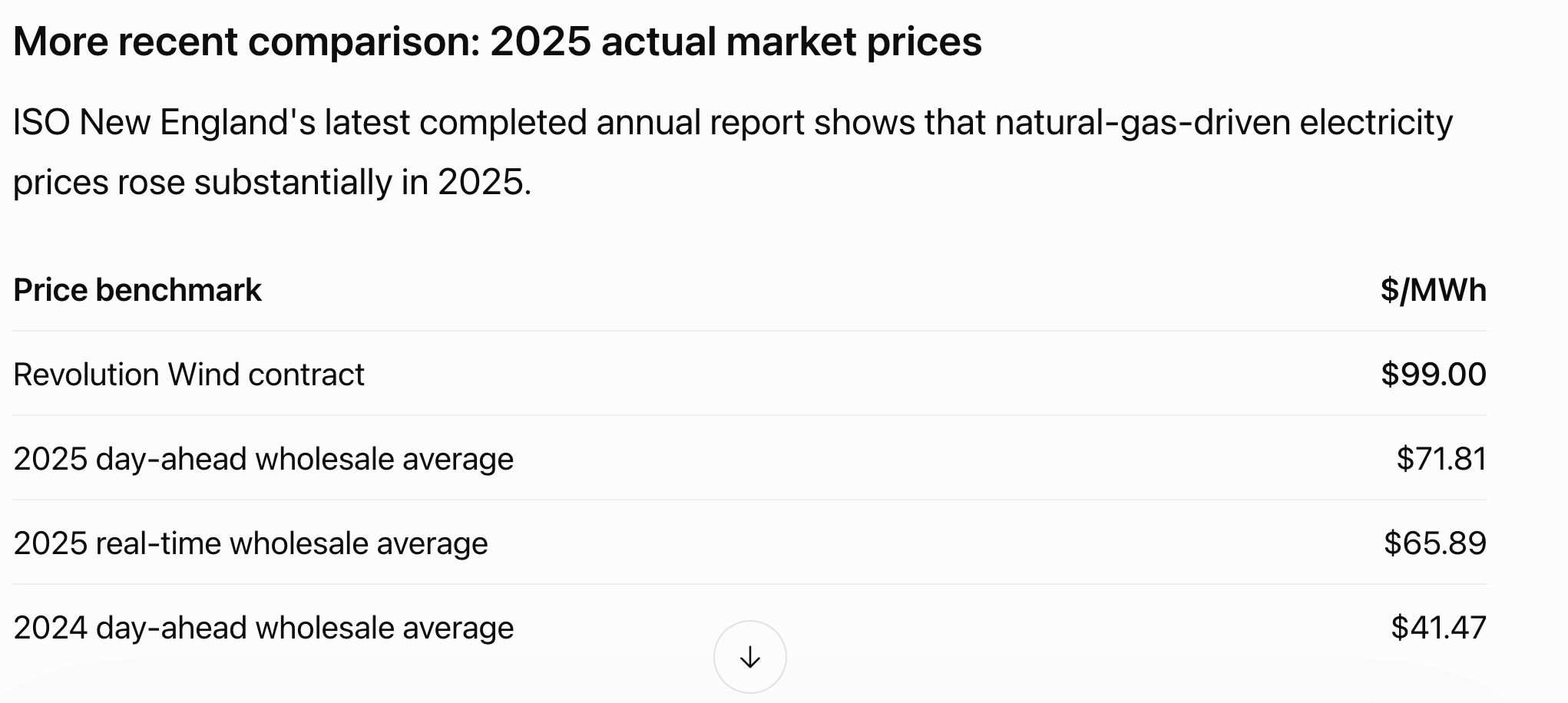
ISO New England's latest completed annual report shows that natural-gas-driven electricity prices rose substantially in 2025.
Against the more recent 2025 day-ahead market price, Revolution Wind's contract was 38% more expensive, rather than 139% more expensive using 2024 prices.
For a direct natural gas generation comparison, the U.S. Energy Information Administration reports that Connecticut power plants paid an average of $6.21 per million BTU for natural gas in 2025. At an illustrative combined-cycle heat rate of 7.5 million BTU/MWh, that translates into approximately $46.58/MWh in fuel costs alone, excluding plant operating expenses and capital recovery.
What ratepayers actually pay
There is another important accounting distinction.
Connecticut's contract is structured so that electricity and renewable energy credits are sold into the market. Ratepayers cover the difference when their combined market value is below $99/MWh, but receive a credit when it exceeds $99/MWh.
For example, if the combined market value were $70/MWh, the additional contract settlement would be approximately $29/MWh. That is not an additional $99 charge on top of the market electricity price.
DEEP projects that the contract could ultimately save Connecticut ratepayers $150–$200 million over 20 years, but that is a forecast, not a measured result.
Bottom line: Connecticut's contracted Revolution Wind price is $99/MWh, versus approximately $66–$72/MWh in New England's 2025 wholesale energy markets. Natural gas generation can be cheaper, particularly when fuel prices are low, but it is subject to substantial price volatility.
What is not yet established from the public information I found is Revolution Wind's actual cumulative MWh delivered since startup, together with the actual monthly net settlement paid by Connecticut ratepayers. Those figures would be needed to calculate the realized cost to ratepayers per MWh rather than relying on the contract price and historical market comparisons.