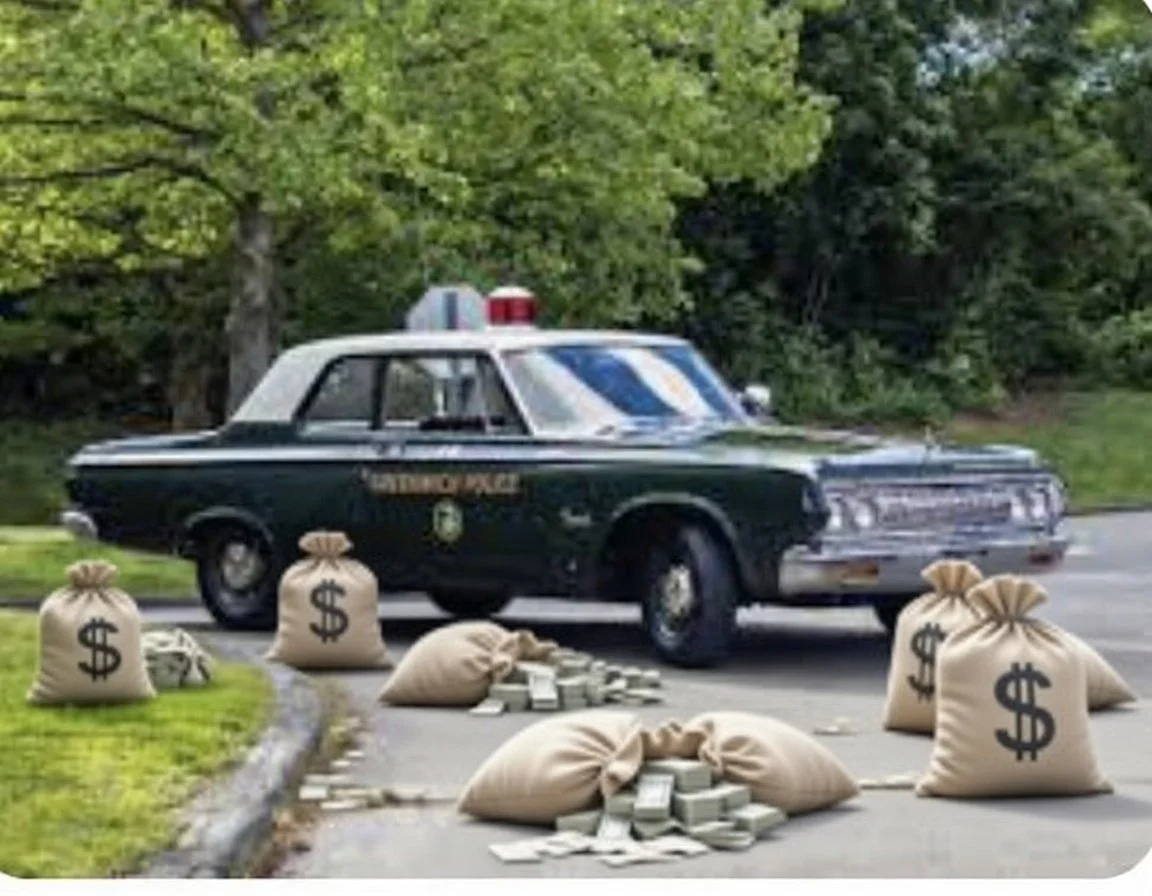
Laughing all the way to the bank?
/
Greenwich Police Facebook Post: 7,225 Speed Camera Violations in January
**** Monthly Stats for January****
For the month of January 2026 there were a total of 7,225 School Speed Camera Violations. The 7,225 violations were reviewed by Blue Lines Solutions and our Traffic Section and have been mailed out. Currently, there are still 9,537 pending violations for review that may increase the total number of violations for the month.
The speed cameras are located in school zones, which is curious, because in December Chief Jim “BLM” Heavey told the BOE that speeding around Eagle Hill School and North Street School had dropped 90%. By my math, if January’s numbers represent a 90% drop, that would mean that December saw 72,250 violations, with another 95,370 “under review”. I call bullshit.
Here’s an AI summary of this cash cow program:
In Greenwich, CT, school zone speed cameras issue a warning for the first 30 days after installation, and potentially for a driver's first-ever violation, with no fines initially assessed. After this, violations incur a $50 fine for the first offense and $75 for subsequent offenses.
Key Details for Greenwich Speed Cameras:
Warning Period: A 30-day grace period occurs for new,, or newly installed cameras, during which only warning notices are mailed.
Initial Violation: After the warning period, the first offense is a $50 fine.
Subsequent Violations: Each offense after the first is $75.
Locations: Cameras are installed in specific school zones, including near North Street School, Eagle Hill School, Brunswick Lower School, and Greenwich Academy.
Process: Cameras capture vehicles speeding 10+ mph over the limit, with citations mailed to the registered owner.
Following the 30-day warning period for the initial set of cameras, full enforcement began, with many cameras now active.
The fee for the first violation is $50 and subsequent ones are $75.
7,250 violations @$50 equals a monthly potential of $361,250 (ignoring the 30 day grace period following installation, but not including second-offense fines of $75). Multiply by twelve and we reach $4,335,000. At $75 per ticket, we’ll have the high school swimming pool paid for in no time.
I’m in complete agreement that speeding cars in general and in school zones in particular are a danger, and should be curtailed, but this process seems skewed against residents: a robot takes a picture and sends it off to some third party that “reviews” it and sends out a ticket while pocketing a tidy fee for itself. Who does one appeal a ticket to? Blue Line Solutions, down in Chattanooga? The soon-to-be-established For What It’s Worth hotline? Inquiring minds want to know.
An AI-generated summary of the contract between Greenwich and Blue Line:
The Town of Greenwich, CT, has contracted with Blue Line Solutions to install, maintain, and monitor speed cameras in designated school zones. While specific revenue-split percentages are not finalized in public reports as of early 2026, the contract aligns with Connecticut state law (Public Act No. 23-116), which dictates that vendor fees cannot be directly contingent on the volume of tickets issued.
Contractual Terms and Revenue Structure
Vendor: Blue Line Solutions was chosen to provide the technology, construction, infrastructure, and maintenance for the Automatic Traffic Enforcement Safety Device (ATESD) program.
Scope: The program covers eight school zones, including Greenwich High School, Central Middle School, and others, with cameras designed to record speed violations.
Fine Structure: Tickets are civil violations, not criminal, with fines set at $50 for the first offense and $75 for subsequent offenses.
Payment Model: Connecticut law prohibits "ghost tickets" or revenue-sharing models where vendors take a percentage of every fine. Instead, towns generally pay vendors a set, non-contingent fee for services. While some CT towns have paid roughly $13.50 per citation and $6 per warning for similar services, the specific per-ticket cost for Greenwich's contract with Blue Line Solutions is not explicitly detailed in the provided search results.
Revenue Allocation: Fines collected go toward paying the vendor's contractual fees, with remaining funds required to be used for traffic-related safety improvements, according to state law.