“The Navy: Nothing but rum, buggery and the lash” — Winston Churchill
/David Strom has the latest on the current state of the British Navy:
Humiliating: HMS Dragon Delayed Because Shipyard Works Only 9-5
This should come as no surprise, American military commentators have been reporting on the hollowing-out of the British forces, especially its navy, for decades, but only now, when they’re actually needed, has that neutered status been exposed so publicly They have one carrier, out of two remaining, that’s still operable, and it’s in the shipyard being attended to. The admirals boasted of a demonstration last summer that saw the carrier’s full complement of 24 jet fighters aboard; for 24 hours, delivered with the help of allies; they’re been operating with just six, and don’t enough people to fly or maintain even those.
Here are excerpts from a British pro-Naval publication: its editors are far kinder to the service than those American commentators, but they’re harsh enough. “This is not Winston Churchill we’re dealing with”, Trump observed last week, and that’s true; fortunately for the Britain’s proud naval tradition, there’s still plenty of buggery and booze to go round.
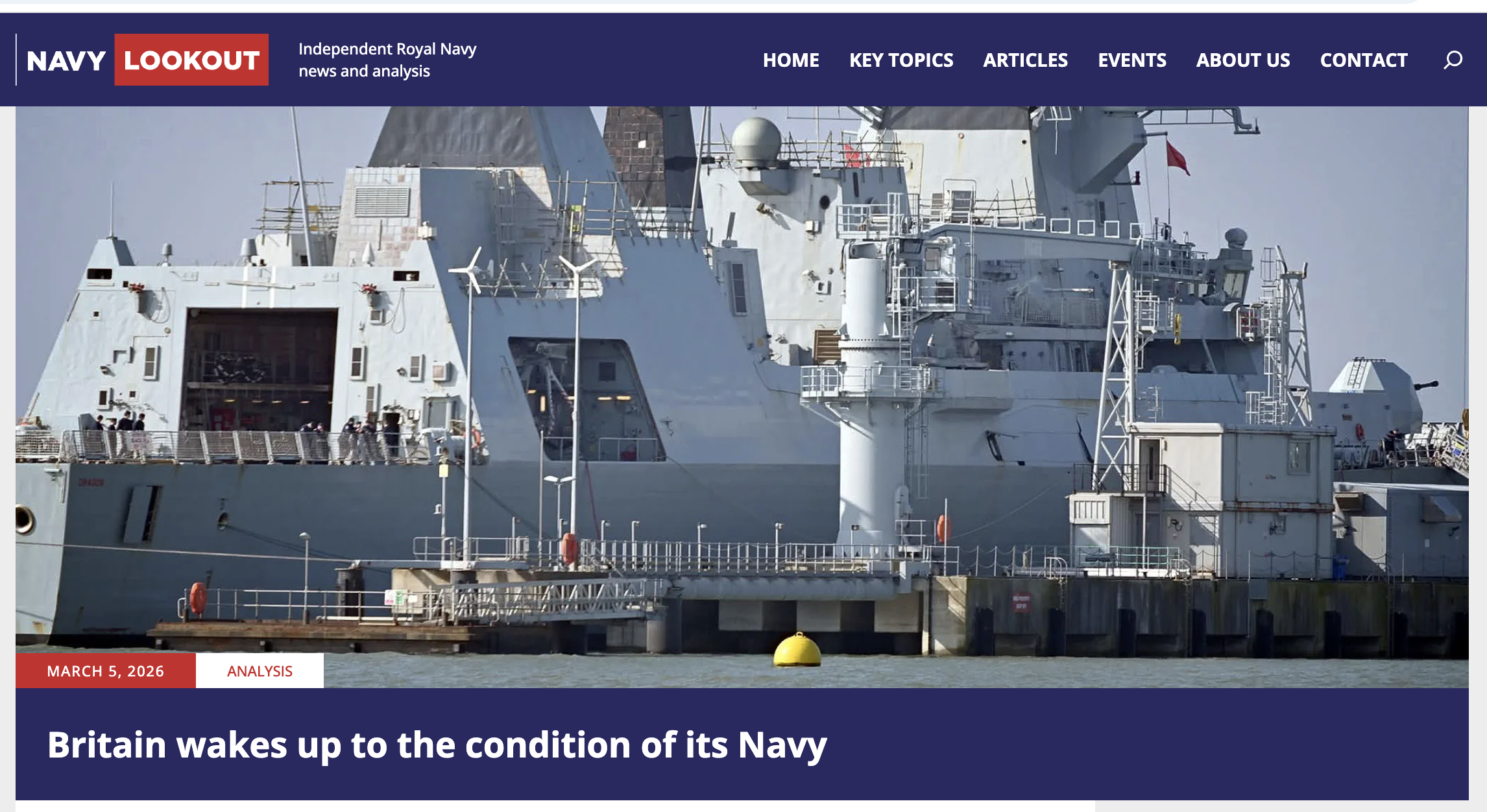
https://www.navylookout.com/hms-prince-of-wales-placed-on-five-days-notice-to-sail-in-response-to-middle-east-crisis/
For years, warnings about the declining strength of the Royal Navy have been largely ignored. The crisis in the Middle East has placed the size and readiness of the RN in the spotlight, with various politicians and sections of the mainstream media describing Britain’s naval position as “weak”, “embarrassing” and “a disgrace”. Here we consider those claims, how it came to this, and a roadmap for change.
For years, the steady contraction of the RN has occurred largely out of public sight. Fleet numbers fell gradually, older vessels were retired and replacement programmes stretched across decades. While this erosion was obvious to those following naval policy closely, it remained on the fringes of the national conversation.
Events over the past few weeks have changed that. The confused reaction to rising tensions in the Middle East, combined with the difficulty of rapidly deploying a single destroyer, has forced a much broader debate about the true state of Britain’s maritime power. Even traditionally defence-sceptical media outlets have begun asking why a leading naval nation struggles to field ships at short notice.
Aspects of the criticism have been exaggerated or poorly informed. The RN continues to operate globally, supports NATO commitments, maintains the nuclear deterrent and contributes to coalition operations around the world, at least on a sporadic basis. Nevertheless, the uncomfortable reality is that the central criticism is largely justified: the Navy is simply too small and its readiness levels are not high enough.
The RN is caught in a perfect storm of underfunding and the impacts of poor decisions made in the past. The Navy is not just hollowed out, but is now actually incapable of performing many of the routine tasks it was managing until quite recently. This breakdown is not the result of losses in combat or even the pressure of high-tempo operations, but has been caused by long-term under-resourcing and mismanagement. This is a fleet expected to be ready for too many missions with too few ships.
Thirty years of hurt
The present situation did not emerge overnight. It is the cumulative result of three decades of shrinking force structure, repeated delays to shipbuilding programmes and a strategic assumption that a large-scale maritime clash was unlikely or the delusion that major conflict was always “10 years away”.
During the Cold War, the RN maintained far larger surface forces. 12 Type 42 destroyers were eventually replaced by just 6 Type 45 destroyers; the decision to build half of the planned 12 can be traced to the costs of the war in Iraq. The legacy of the Cold War ‘peace dividend’, followed by the prioritisation of counter-insurgency operations in Iraq and Afghanistan were disastrous for the Navy. Although there was a period of more optimism around 2015 with the arrival of the aircraft carriers and much-delayed orders for new frigates, the hollowing out continued.
The latest crisis has hit at a particularly low point for the RN. 13 frigates are in the shipbuilding pipeline, but the 30-year-old Type 23s are falling apart, well before replacements are ready. The ‘frigate gap’ will leave the escort fleet under severe pressure for the rest of the decade. The Type 45 destroyers, currently being placed most prominently in the public view, are in the middle of an upgrade programme, which should start to show some availability benefits in the next year or two.
Strategy without resolve
Britain now has a political class whose instincts in an international crisis are to consult the lawyers before consulting military leaders or strategic thinkers. ….
As naval assets have become fewer in number (and typically more expensive), British leaders have become more reluctant to take risks with their deployment. This caution can feed a cycle in which fewer ships lead to greater hesitation about using them. In the case of RAF Akrotiri, it has long been known that the site was highly vulnerable, but despite being the largest overseas airbase with great strategic value, little was done to harden defences. This parsimony, along with the rushed dispatch of a destroyer, encapsulates how hesitation and over-caution are likely to worsen outcomes in the long run. For military planners, political flip-flopping and indecision multiply their problems. ….
Media interest in the state of the Navy is likely to move on quickly, while it takes many years to build and sustain a fleet. This government could seize the opportunity to instruct the Treasury to stop stalling on the Defence Investment Plan and convert vague promises to increase funding in the future into an immediate uplift. ….
This regeneration must begin with a genuine “people first” approach, repairing recruitment and retention to ensure the Navy has the personnel on which operational success ultimately depends. That should be followed by a clear signal to industry that a steady and predictable drumbeat of procurement can be expected over the coming decades.
Beyond the vessels already on order, renewal must include 12 SSN-AUKUS submarines, 6 Multi-Role Support Ships (MRSS), the Future Air Dominance System (FADS) / Type 83 destroyers, development of hybrid aircraft carriers and the Type 32 frigates. These programmes must also be accompanied by deeper ammunition stockpiles and far greater investment in uncrewed systems to add mass and resilience to the fleet.
Related Article
Type 45 destroyer to be sent to the eastern Mediterranean
>>>>
Wide open
RAF Akrotiri, a Sovereign Base Area in southern Cyprus, was hit by a Shahed-type drone just after midnight Monday and remains vulnerable. Like the majority of UK defence installations, Akrotiri is wide open to missile and drone attack unless fast jets can scramble fast enough to attempt interception. There are minimal ground-based air defences (GBAD) and no hardened Aircraft Shelters (HAS). It is believed the ORCUS counter-UAS system is deployed at the base, but this is an electronic jamming-based system intended to defend against small, low, and slow drone threats, not the large Shahed-type attack drones in their terminal phase. Deploying one of the Army’s Sky Sabre batteries to Cyprus would seem to be a very sensible step that could also be put in place quickly.
Iranian attacks are most likely to come from its Hezbollah proxies in Lebanon. The island is also in range of Shahed drones or missiles fired from Iran, although they must travel 1,200km through Iraqi and Syrian airspace. There is pressure from Cypriot leaders for the UK to do more to defend them. Greece has already announced the deployment of two Hellenic Navy warships to help protect Cyprus, including their brand new frigate HS Kimon, as well as deploying F-16 jets to Andreas Papandreou Air Base on the island. France has announced it will also send a frigate to the eastern Mediterranean, and Germany is considering doing the same.
Juggling act
All part of the naval life, but the ship’s company and support teams in Portsmouth have had to move quickly to prepare the ship to sail at short notice. HMS Dragon was earmarked to become the flagship of Standing NATO Maritime Group One, but her maintenance period has been expedited and she is being taken out of dry dock and will begin loading munitions today. Dragon is expected to sail early next week. She completed FOST in December but has not been to sea since and will need to conduct a brief workup while in transit.
>>>>
The Royal Navy simply does not have enough ships to sustain vessels on deployment overseas, ready to respond to emergencies as it used to. Instead, it is reduced to prioritising its handful of available ships to assign to the most urgent mission at the expense of other tasks. This situation is not of the RN’s making and is the clear result of successive governments underfunding defence. The crippling in-year budget rounds and small spending increases that barely cover the cost of inflation have all contributed to the precipitous decline.
Defence In Paralysis
Now delayed for 8 months and counting, failure to publish the Defence Investment Plan (DIP) is causing near paralysis across an organisation that was already grossly under-resourced for the long list of tasks it is required to be ready for.
Despite defence of the nation being the first duty of government, the current Chancellor believes the MoD is just another department that should wait in the queue while she funds other, more politically popular priorities. The argument that defence should have no more money until it can reduce waste and improve efficiency appears superficially reasonable. Unfortunately, this is no time to play politics and is wildly out of step with the urgent need to be ready to ‘fight tonight’ in an increasingly dangerous world. We cannot defend ourselves using apologies for historical mismanagement; what matters is the current and future force. The UK needs to recover its hard power and quickly; this cannot be done on the cheap or without a significant increase in funding.
Bonus Material:
Eric Florack, PJ Media:
Google tells me that the Royal Navy is down to just 63 ships, yet employs more than 100 admirals at the rank of one-star and above.
FWIW: I looked up what the comparable numbers are for the U.S. Navy:
AI Overview
As of early 2025/2026, the U.S. Navy has approximately 295–296 deployable battle-force ships. The total number of one-star-and-above (flag) officers is generally capped around 216 active-duty personnel, though the total number of admirals (including reserves and staff) often ranges between 200–300.
Ship Count: The fleet includes 11 aircraft carriers, over 100 surface combatants (cruisers/destroyers), and roughly 68 submarines, with plans to grow to 381 manned vessels by 2045.
Admirals: The ranks include Rear Admiral (lower half - one star), Rear Admiral (upper half - two stars), Vice Admiral (three stars), and Admiral (four stars). The number of 4-star officers is strictly limited by law.