Surrender: gradually, then suddenly.
/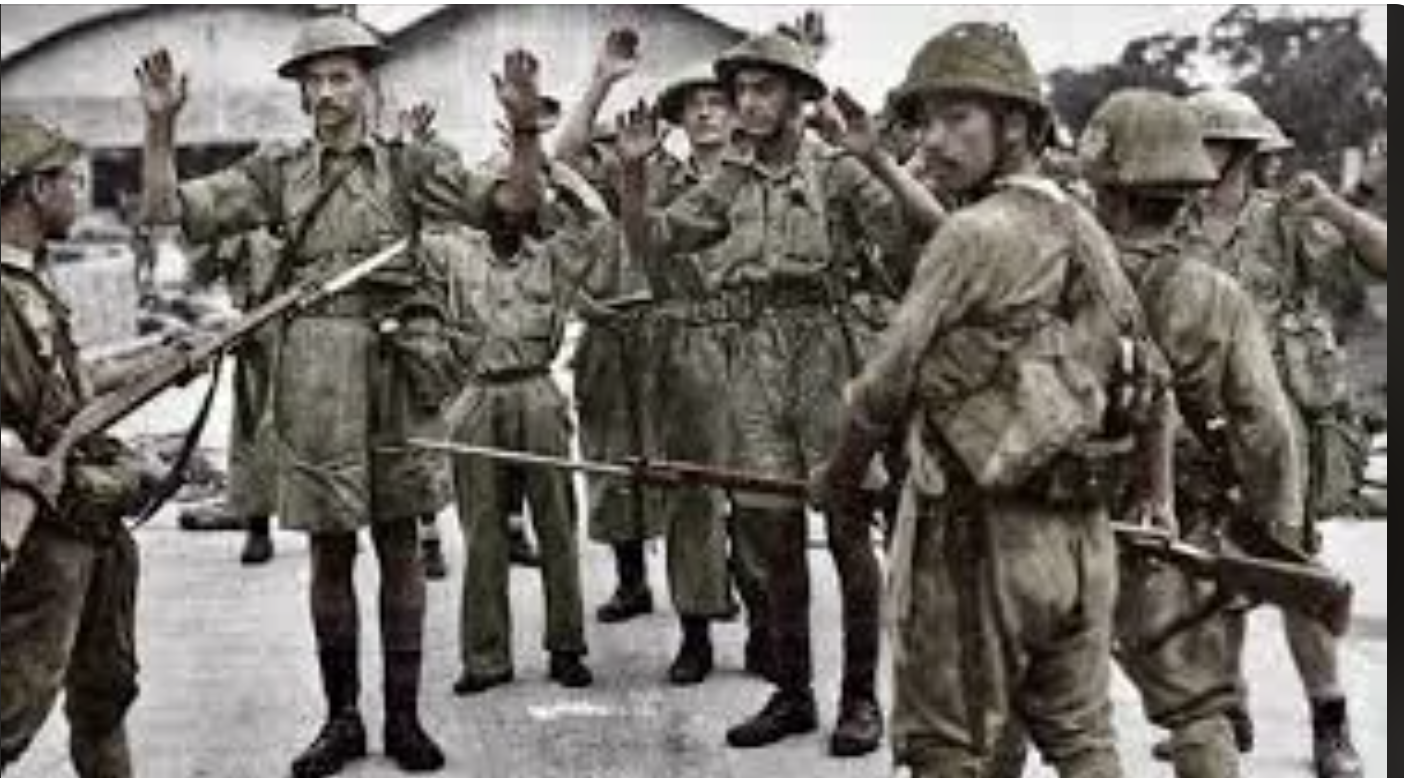
singapore was just a warm-up exercise
Britain and western Europe have opened their borders of the Third World, destroyed their cultures and their energy infrastructures, and are now incapable of defending themselves even if they had the willpower to do so.
British General Admits [Again] That It Can't Deploy a Division Abroad
How pathetic is the British Army?
How about this: it cannot actually deploy a heavy (armored) division to Europe if required.
It has no navy, it’s sole aircraft carrier has no planes, it’s air force is a weak joke, and the country has no willingness to do anything about those deficiencies. In fact, it’s joined its disarming friends, Germany, France and Spain in denying the United States’s to use their otherwise-unused bases and airfields, and even, in France’s and Spain’s case, fly through their airspace.
I read an article yesterday (somehere — can’t lay my hands on it now) by a European writer warning that the United States was withdrawing from Europe and creating it’s own sphere of interest — if it served our interests to go somewhere or do someting, we would; otherwise, the Europeans and the island lime eaters will be left to defend themselves as they see it and are capable of doing. That does indeed seem to be the case, and it’s a move long overdue.
Just in case you missed it - this is the Deputy Chief of the Defence Staff failing to confirm that the British Army could deploy 1000 troops to the continent of Europe. pic.twitter.com/GnyvLfiJjY
— Mike Martin MP 🔸 (@ThreshedThought) April 10, 2026
This is hardly new news. A 2015 review of Britain’s military preparedness noted the country's inability to meet its basic NATO obligation to defend its allies; in 2026, the country still cannot deploy a fighting force. It’s in even worse shape, if possible, than it was in 2021, when the weakling still claimed it’d be capable of sending … something abroad to fight, if necessary:
8th January 2021
British Army heavy division comes up light
An ongoing House of Commons Defence Committee inquiry into British armoured-vehicle programmes has made the British Army’s shortfall in modern armour evident. The army’s war-fighting division, which it previously aimed to field by 2025, will be smaller, less ‘heavy’ and have less armour than set out in the 2015 Strategic Defence and Security Review.
The British Army will be capable of fielding a war-fighting division by 2025. However, it will be smaller, less ‘heavy’ and have less modern armour than originally planned. The shortfall in armour is the result of procurement problems compounded by inadequate funding: the outcome is that the army will deliver considerably less near-term capability than was the goal.
Just how short the British Army will fall of the divisional target established by the 2015 Strategic Defence and Security Review (SDSR) has been made apparent during an ongoing House of Commons Defence Committee inquiry into British armoured-vehicle programmes. During hearings, the Ministry of Defence (MoD) acknowledged it would not meet the aim of the 2015 SDSR. Rather than being able to field a division with three brigades – two armoured infantry brigades and a strike brigade – the division would only consist of two: a single armoured infantry brigade and an ‘interim manoeuvre support brigade’, the latter with some new Ajax vehicles and infantry travelling in Boxer and Foxhound armoured personnel carriers (APCs).
Missing the goal
The MoD said it was unable to meet the 2015 SDSR target because its budget ‘did not fully resource the army to achieve this output within this timeframe’. More simply put, it did not have enough money to fund what it said it was going to do. Development delays to the new Ajax medium armoured fighting vehicle and a very slow delivery rate for new Boxer APCs have further compounded the issue. There are also indications that the stockpiles of spares and ammunition needed to deploy more than one armoured infantry brigade have not been funded.
The army currently has one single heavy division: the 3rd Division. It is declared to NATO, but could also be employed on other missions, including with the United States. It is made up of three armoured infantry brigades, each with a single regiment (battalion sized) of Challenger 2 tanks and two armoured infantry battalions with Warrior infantry fighting vehicles (IFVs). Three armoured cavalry regiments are currently equipped with Scimitar light-armoured reconnaissance vehicles. The Scimitars are obsolescent, while the Challenger tanks and Warrior IFVs have undergone only limited upgrades and are approaching obsolescence by the army’s admission. Both require improvements to their firepower, including new guns, ammunition and turrets. Research and development work has been funded, but the Warrior upgrade has been greatly delayed. The MoD, army and the companies involved say some of the delay with Ajax and Warrior has resulted from weaknesses in managing the programmes. Both the Warrior and Challenger programmes are yet to receive ‘main gate’ approval – they must do so if they are to be fully funded. And even if approval is forthcoming, it is unlikely that the first modernised vehicles will enter service before 2025.
Further modernisation aims for the 3rd Division were set out in the 2015 SDSR. Two ‘strike brigades’ were to be formed to complement the retention of two of the three armoured infantry brigades. The new formations would include two mechanised infantry battalions equipped with new wheeled APCs (Boxer). An armoured cavalry regiment optimised for reconnaissance and a medium-armour regiment would both be equipped with the Ajax family of tracked scout vehicle, replacing the Scimitar. Ajax has been funded, with the first unit receiving its vehicles in 2020, albeit with production difficulties delaying delivery of the scout variant. Boxer is on contract, with the first vehicles to be delivered in 2023. However, delivery will be slow − spread over a decade. Although the United Kingdom’s Defence Secretary Ben Wallace has tasked the army with examining options to accelerate delivery of Boxer, there is no evidence that extra funds are being allocated to achieve this.
Five years on, Britain still can’t send a single armored brigade, let alone a division, onto a battlefield.