Hey, buddy, can you spare a gold bar or two? Or 300?
/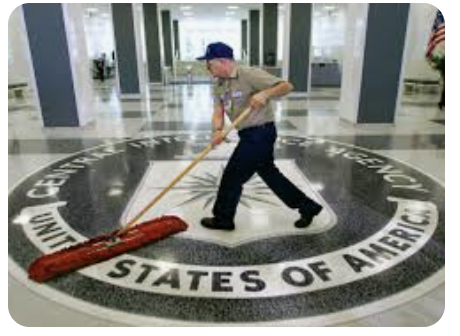
Under the rug?
As I mentioned in a comment to a reader earlier, when I adopted a nine-year-old cat two years ago, it took over a month, while the cat ladies running the shelter interviewed me for 45 minutes and pored over my application, then conducted three phone interviews with references I’d supplied, friends who vouched for my reputation as one who rarely, if ever, set cats on fire or tied firecrackers to their tails, and, finally, a video tour of my entire house to make sure there were no hidden cat perils in the premises.
That was for an old cat: the intelligence experts at the CIA are apparently far more lackadaisical when it comes to vetting their own job applicants.
The story first broke two days ago:
Former CIA official arrested after feds find $40M worth of gold bars stashed at his home: report
Yesterday saw more details revealed :
WASHINGTON — A wannabe spy convinced the CIA to give him $40 million in gold bars by claiming it was for “work-related expenses” — and it was just the latest in a lengthy career full of increasingly brazen lies, according to federal prosecutors.
David Rush made a series of requests to the agency to obtain “a significant quantity” of foreign currency and hundreds of gold bars between November and March, according to a federal affidavit.
Astonishingly, Rush received what he asked for, according to the court documents, and the agency was later unable to locate any record of Rush explaining the work-related purpose for the enormous sums.
In three separate employment applications to join the CIA, he allegedly falsely claimed to have degrees from Clemson University in South Carolina and Rensselaer Polytechnic Institute in Upstate New York — as well as an evaluation certification from the US Naval Test Pilot School.
None of these claims were accurate, according to the affidavit, nor was an undated assertion in one of the applications that he had attained a master’s degree in computing technology from the Naval Postgraduate School.
But the subterfuge apparently worked for decades, and Rush achieved his dream of working for the CIA, where he allegedly continued exaggerating his accomplishments for advancement and financial gain.
Rush enlisted in the Navy in 1997, was honorably discharged in 2015 and after that, he never enlisted in any other branch of the US military, the court documents state.
Following his Navy discharge, Rush allegedly falsified active status as a captain to pocket $77,000 in unearned military leave while drawing an inflated executive salary.
He also claimed he received a mathematics degree from Clemson University and an electrical engineering master’s degree from Rensselaer Polytechnic Institute, but registrars found no record of him.
Rush additionally alleged to have certifications from the US Air Force and Naval Test Pilot schools, but FAA and military files reveal he lacked a pilot’s license, serving instead as an IT technician, among other roles.
And today, its reported that something might just be wrong here:
Why ex-CIA officer David Rush’s $40M gold bar case could point to ‘large-scale cover-up’ — as expert reveals painstaking vetting process
Ex-CIA officer David Rush’s alleged years-long scheme that netted him $40 million in gold bars and a top-secret security clearance has those in the Clandestine Service community questioning how he slipped through the fastidious vetting process — and who else may be flying under the radar.
Former CIA staff operations officer Tracy Walder was baffled over the stunning allegations against Rush and believes they could point to a much more troubling issue within the agency.
“This would have been a large-scale lying cover-up. There would have had to be a lot of other co-conspirators,” Walder told The Post.
“They are going to go back at least 10 years in terms of people you know, people you are friends with. He would have had to ask all those people to lie for him. Or did he lie to them?”
The FBI raided Rush’s Virginia home May 18 as part of an investigation into whether he lied about his military and academic background, and found 303 1-kilogram gold bars worth over $40 million, $2 million in US currency and 35 luxury watches, “many of which” were Rolexes.
According to an affidavit, Rush obtained the gold bars by making a series of requests between last November and March of this year, claiming he needed the bullion for “work-related expenses.”
Walder surmised Rush may have forged documents, or maybe “it’s a lazy or incompetent background investigator” who missed the red flags across his three separate applications to the agency before he was finally hired in 2009.
Walden said CIA candidates must endure a lengthy, invasive vetting process in order to get hired.
“They don’t just verify your college. They came to my sorority house. They talked to my sorority sisters. They came to my parents’ house. They went to the friends of the friends of my parents,” she said.
As for the king’s ransom in gold bars Rush accumulated, she said sometimes the agency receives requests for currency or gold, but never without accounting for every penny.
“It’s not unusual to need money to meet with assets overseas. You have to have a way to pay them and you don’t just run a credit card. They’re essentially committing treason, so you’re going to pay them in whatever currency they want,” she said.
“But I cannot think of an asset that needs $40 million in gold bars,” she added.
“There is a whole process that we go through to get that money. I don’t just walk into the logistics office and say, ‘Excuse me, I need $100,000 tomorrow.’ There is a form I have to fill out. It’s not a bank vault you walk into. It doesn’t work like that.”
She said even if Rush lied and said his asset was someone ultra-high-profile like Russian President Vladimir Putin, “the CIA would know who has what asset and who is working with what asset and if they are real or not.”
But she said even if an agent asks for $10, “you still have to fill out that form and be accountable for it. It’s not a free-for-all.”
She said even after the pre-hiring vetting, CIA employees are subject to rigorous scrutiny of their credit and finances.
Walder said when she was just getting started in her career and money was tight and she was living in a rough neighborhood, her parents helped her out with $75 a month to park her car in a garage. Eventually, the agency flagged even that pittance.
“It’s annoying … I remember being flagged about that,” she said, recalling the agency peppered her with questions about the money: “Where did you get this? Why did you get it? What was it for?”
She eventually had to give them her parents’ banking information to prove where the $75 was coming from.
My bold prediction: either we never hear of this story again — given the CIA’s record so far, that wouldn’t totally surprise me — or more heads will roll, and steel doors clang. Stay tuned.