Tall Ships, balloons, and puppy dogs will dock in Greenwich Harbor this Sunday
/
She’ll be in Greenwich, but her captain insists, “I’d rather be in Holland, wooden shoe?”
Historic Dutch Tall Ship to Anchor Greenwich Historical Society Celebration of America’s 250th
Greenwich Historical Society will host a major community celebration of
America’s 250th anniversary during a signature weekend of events culminating on June 28, 2026, with Sunday at the Park with George, bringing together history, culture, music, education, and civic pride for one of Connecticut’s signature America’s 250th celebrations.The celebration will center on the arrival of the historic Dutch tall ship Oosterschelde in Greenwich Harbor at Delamar Greenwich Harbor and a free public festival at Roger Sherman Baldwin Park on Sunday, June 28, from 10:00am to 4:00pm.
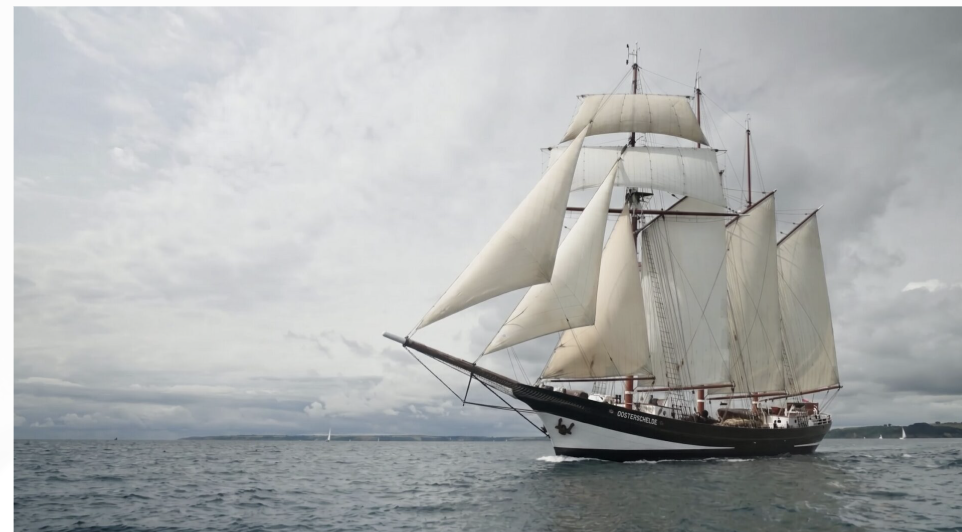
The Oosterschelde, the largest restored Dutch sailing ship in operation and one of the world’s most celebrated historic tall ships, will dock in Greenwich Harbor as part of its international voyage. The vessel will serve as the centerpiece of the celebration and will be open for free public tours throughout the day.
That sounds like fun, but the Greenwich Historical Society press release reprinted in Greenwich Free Press offers no explanation of why the Oosterschelde is considered “historic”, which is annoying to anyone with a spark of curiosity about old sailing ships. I initially guessed that its fame might be attributable to Old Greenwich’s Daphne Lamsvelt-Pol’s great-grandmother having used it to smuggle tulip bulbs, chocolate, and stinky cheese to these shores long ago, but checking with ChatGPD, I learned that was not the case — there are additional reasons:
The adjective "historic" is not just travel-brochure puffery in this case. The Oosterschelde is genuinely one of the most significant surviving Dutch sailing ships.
Here are the main reasons.
She is the last of her kind
Built in 1917 in Rotterdam as a three-masted topsail schooner, the Oosterschelde is the last surviving original Dutch three-masted topsail schooner. Around the time of the First World War, hundreds of similar sailing cargo vessels worked the North Sea and Baltic trades, but virtually all were scrapped, converted beyond recognition, or lost. She is the sole authentic survivor of that once-common fleet.
She was a real working cargo ship
Unlike many "tall ships" built specifically for sail training or as replicas, the Oosterschelde spent more than seventy years earning her living. She carried everyday cargoes including:
clay
timber
stone
potatoes
straw
herring
even bananas
In other words, she represents the last generation of commercial sailing ships that coexisted with steam and diesel vessels.
She had several lives
Her career mirrors much of 20th-century northern European maritime history.
1917–1939: Dutch cargo schooner Oosterschelde.
1939: Sold to Danish owners and renamed Fuglen II.
During the Second World War she struck a magnetic sea mine but survived after being towed to safety.
1954: Sold to Sweden, renamed Sylvan, and rebuilt as a modern motor coaster with much of her sailing rig removed.
1988: Returned to the Netherlands after her working life ended.
That sequence explains why her survival is rather remarkable: most vessels that underwent such extensive conversions were eventually broken up.
She was restored instead of scrapped
From 1988 to 1992 she underwent what was then the largest ship restoration ever attempted in the Netherlands. The work aimed not merely to make her look old, but to recreate her original 1917 appearance using historical plans, photographs, surviving fittings and advice from former sailors. Princess Margriet recommissioned her in 1992.
She still sails the world
Unlike many historic ships that become museum exhibits, the Oosterschelde remains an active ocean-going vessel. Since her restoration she has:
circumnavigated the globe more than once,
visited more than 50 countries,
sailed to Antarctica, South Georgia and the Arctic,
rounded Cape Horn under sail,
and recently completed the ambitious DARWIN200 voyage, retracing much of Charles Darwin's voyage aboard HMS Beagle while supporting science and youth education.
That's an unusual combination: a ship that is both an authentic artifact from the age of commercial sail and a fully operational ocean voyager.
So if your local paper simply calls her "historic," it's understating things a little. She's not just old—she's effectively the last surviving representative of an entire class of Dutch merchant sailing ships, preserved in working order rather than as a static museum piece.
If you have the chance to go aboard, one thing to notice is the rigging. A topsail schooner like Oosterschelde combines fore-and-aft sails with square topsails on the foremast, a rig that gave merchant captains a useful compromise between speed, cargo capacity, and a crew small enough to be economical. It's a type of vessel that was once a familiar sight in the North Sea but has almost completely disappeared.
Update:
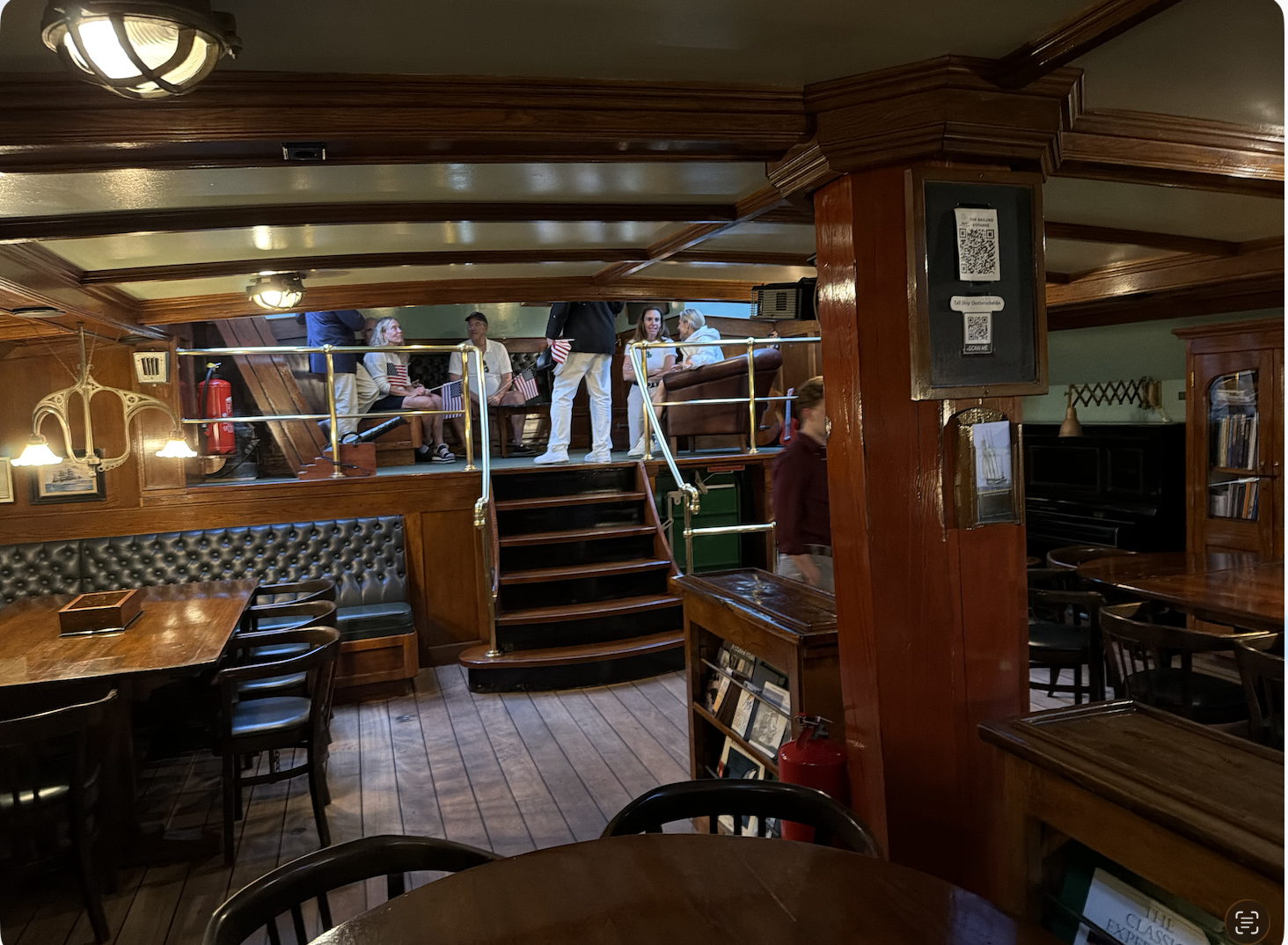
As it turns out, Oooosterschelde (not “Oystershell” as spelled by an illiterate drunken Dutchman, as one might assume) is already in port. Gideon was there last night moonlighting as a canape server — chocolate chip Gouda and jalapeno spread and hardtack – and snuck a photo with his Minox spy camera.
Bonus material:
Back when Holland was a fierce trading rival of England and a world-power, it generated the same jokes we tell, or used to tell, about Poles, blondes, and rednecks, and similar to those told by Swedes/Finns and Norwegians about the other (the Irish are in a seperate class; everyone tells jokes about them, and deservedly so).
I know a number of the slurs, but I asked ChatGPD for a compilation, and it obliged. Brush up on them, then visit the Oosterschelde and try them out on her crew; they’ll be delighted, surely.
Expression/Original meaning
Dutch courage Courage inspired by alcohol.
Dutch treat / Dutch date Everyone pays for themselves.
Dutch uncle Someone who scolds or lectures sternly.
Dutch comfort Comfort that isn't comforting ("Things could be worse.").
Dutch bargain A bargain sealed while drunk.
Dutch concert A noisy chorus in which everyone sings a different tune (or snores!).
Dutch feast A party where the host gets drunk before the guests.
Dutch gold/Dutch metal Brass or other cheap metal.
Dutch leave Leaving without saying goodbye ("French leave" is the more common version).
Dutch reckoning An inflated or dishonest bill.
Dutch widow A prostitute (now obsolete).[Who says? — ED]
Dutch nightingale A frog.
Dutch defense A sham or inadequate defense.
Dutch auction Originally, an auction where the asking price starts high and is lowered until someone accepts. Unlike most of the others, this term lost its derogatory flavor and is still standard.
Double Dutch Gibberish; incomprehensible speech.
I'm a Dutchman if..."I'll be damned if..."—expressing disbelief.
To talk like a Dutch uncle To admonish bluntly. [I’d define it as “a mean son of a bitch”, but Chat is so discrete — Ed]
There were also colorful but now almost forgotten ones:
Dutch headache — a hangover.
Dutch cap — a type of contraceptive pessary (medical usage).
Dutch cheese — a person's head (slang).
Dutchman — in printing and carpentry, a patch inserted to hide a flaw (this one is still used technically, without any obvious ethnic slur intended).
Interestingly, the English weren't the only ones who played this game. Many European languages pinned undesirable traits on neighboring peoples:
French leave (English) = leaving without permission.
English leave (French: filer à l'anglaise) means exactly the same thing.
In German, a Polnische Wirtschaft ("Polish economy") meant disorder or mismanagement.
In several languages, diseases acquired national labels: "French disease," "Spanish disease," "Neapolitan disease," etc., depending on who was doing the blaming.