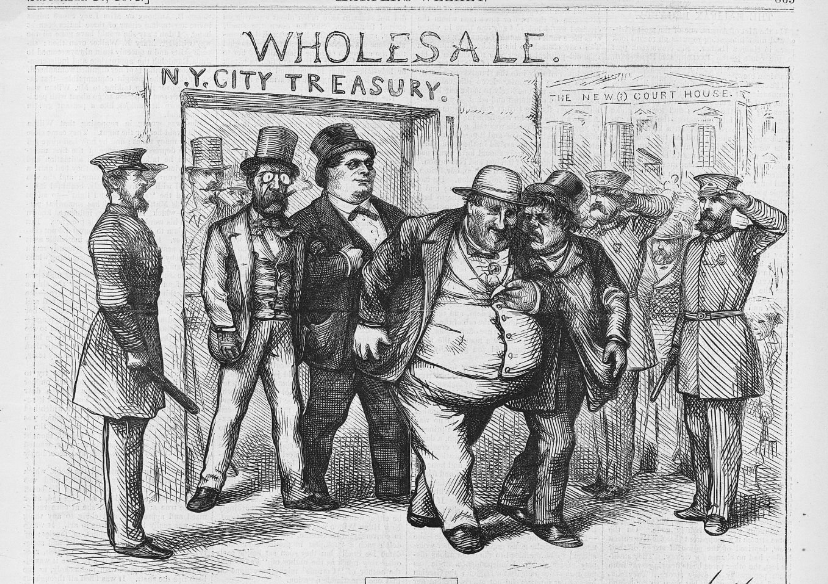
"People's" Housing" and "People's Rutabaga Emporiums" – Tammany Hall returns to New York
/
Update, but I’ll put it here on top, to set the stage:
DON SURBER: Why They Try Communism. “Communism is not about economics. It is about power.”
Mamdani officials scramble to ease concerns about public supermarkets — but local business leaders aren’t buying it
The Mamdani administration is scrambling to ease concerns about its plans to open government-owned supermarkets — but recent talks have instead raised even greater alarms among local business owners, The Post has learned.
New York City bodega owners came to City Hall last week for a “roundtable discussion” at the invitation of Julie Su, deputy mayor for economic justice — only to get barraged with “intrusive” questions about their businesses, a source close to the situation said.
[“Deputy mayor for economic justice” says it all. — Ed]
Ahead of the meeting last Monday — attended by reps from city agencies and trade groups for the city’s 13,000 bodegas — Su asked the group in a questionnaire, “What items are sold the most at your stores?” and “Where is your profit margin the greatest?” sources said.
There are some 13,000 bodegas in New York City, who were represented at a meeting on Monday with city officials.c.moulton – stock.adobe.com
The bodega reps declined to answer, according to sources.
“They wanted us to share proprietary information with them but they don’t answer our questions and that’s why there is distrust,” said a bodega rep who did not want to be identified.
Business owners gripe that city officials are only now seeking their input — and seemingly as an afterthought — after sparking alarms in April with a surprise plan to build a public grocery store in East Harlem at La Marqueta. That store will cost a whopping $30 million to build – and threatens the livelihood of more than a dozen existing stores nearby.
The city insists its socialist-inspired vision for at least one public supermarket in each of the city’s five boroughs – the first of which will open in Hunts Point in the Bronx next year – will not directly compete with existing stores nearby.
“We met with bodega owners so they could help us plan and ensure that we take into account their challenges and their role as a part of the food ecosystem,” Su said in a statement to The Post.
“One of the questions we wanted to understand is whether there are key products bodegas sell and rely on that we should not sell. That’s how serious we are about not undercutting them.”
Grocers and bodega owners, however, are struggling to make sense of such claims.
“Mamdani’s plan to subsidize the grocery stores with taxpayer funds so they can offer rock-bottom prices on essential items threatens grocers who operate on 2% to 3% profit margins. They say they have been forced to raise prices as costs from fuel, tariffs and property taxes have soared.”
….
So far, the Mamdani administration’s promises sound like empty campaign slogans, say industry executives. Meanwhile, it’s provoking alarms with nosy questions that have also included, “What is the main thing people come into your store for? What else do they buy while there?”
“It seems like a clumsy, one-sided fishing expedition,” a food policy expert who did not want to be identified told The Post.
“I would be put off if my local government asked me questions about my profits and margins,” the source who does business with the city said. “It’s none of their business.”
Of course, like all socialist projects, it’s about graft and loot passed on to cronies, not “the People”. This particular 9,000 sq. ft vegetable stall will cost $3,000 sq. ft. vs the typical $900 sq. ft. a Trader Joe’s or other commercial supermarket spends: $30 million vs $2.7 million: plenty of money to pass around to political friends.
Mamdani’s $30M city-owned grocery store will cost 4 times the normal price to build — and lose $300K a year in perpetuity: experts
Mayor Zohran Mamdani’s $30 million city‑owned East Harlem grocery store is going to cost taxpayers roughly four times what rival markets spend on construction, industry sources told The Post — and will likely run at a loss in perpetuity.
At $30 million, Mamdani’s 9,000-square-foot East Harlem grocery store [built on city-owned land] would cost more than $3,000 per square foot to construct.
But when it comes to building a new Whole Foods or a Trader Joe’s from the ground up, the costs are much lower, according to a real estate broker who works with prominent grocery chains. Those costs would run at about $800 per square foot, or $7.2 million, for a 9,000-square-foot location.
As for Mamdani’s $30 million shop, according to a grocery store consultant with knowledge of New York development, “no supermarket operator would pay that number.”
“Over $3,000 psf?” the broker emailed. “Someone is making extra vacation money!”
What’s more, the market would have to bring in a whopping $137,000 in daily sales (equivalent to $50 million a year) — which would convert to a roughly $13,000 daily profit — to recoup the $30 million outlay in six years.
That’s an astonishing annual sum, especially because the top five city supermarkets — often with larger footprints — roughly earned between $16 million to $27 million in annual sales in 2025, according to Food Trade News.
The ranking of the top 20 city markets overall for annual sales included familiar names. Key Food notched about $11 million per store, Krasdale scored about $9.4 million per location, ASG Stores — with brands like Associated — also did about $11 million per store. Fine Fare brought in $6.5 million per locale, and Food Bazaar averaged about $20 million per store.
The store will likely lose at least $300,000 a year, possibly in perpetuity, despite the store being rent-free, according to the consultant, a cost that will have to be borne by the taxpayer.
The La Marqueta store wouldn’t open until 2029, with other municipal grocery store sites selected and opened sooner, officials said.
It wasn’t immediately clear why it would require so many years for the store to open. Typically, upon taking possession of a space, it would take six to 12 months to construct a grocery store, the firm partner said.
The store will likely lose at least $300,000 a year, possibly in perpetuity, despite the store being rent-free, according to the consultant, a cost that will have to be borne by the taxpayer.
The La Marqueta store wouldn’t open until 2029, with other municipal grocery store sites selected and opened sooner, officials said.
“It wasn’t immediately clear [and never will be — Ed] why it would require so many years for the store to open. Typically, upon taking possession of a space, it would take six to 12 months to construct a grocery store, the firm partner said.”