And there was (not) a great wailing and gnashing of teeth. Bishop Berkeley and ICE in the forest (Updated)
/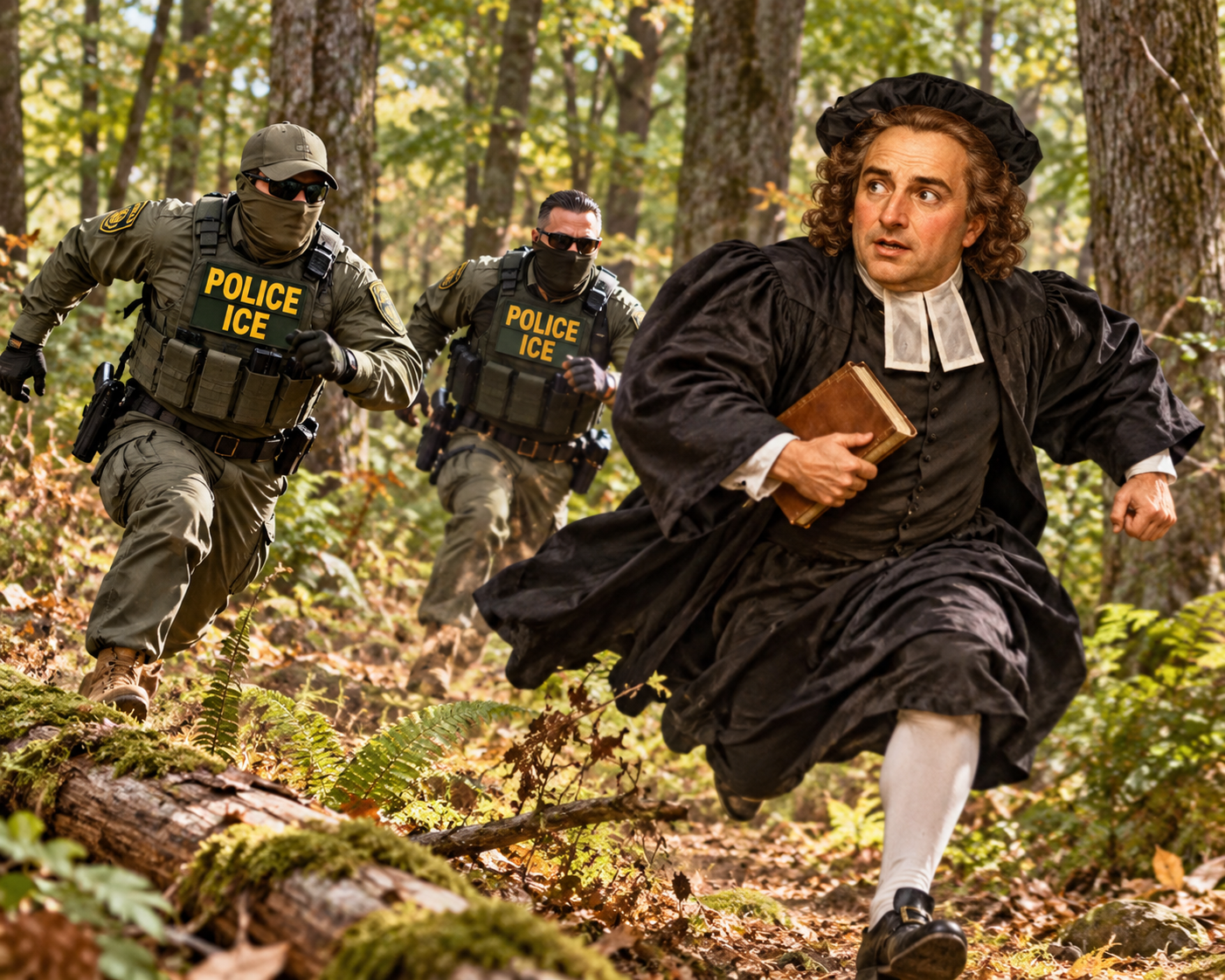
if he falls and the NYT doesn’t report it, will he have made a sound?
ICE Tactics Deflate Media and Activist Outrage and Boost Arrest Numbers
Deportations officers have changed how they arrest illegal migrants, successfully expanding detention numbers while deflating media outrage and nullifying activist protests, the New York Times complains.
Starting in June, the numbers of illegals arrested and detained for deportation proceedings soared to close to 50,000 arrests per month — with August even exceeding that number — however, the violent protests seen last year were oddly absent from the media during the summer surge. It wasn’t because supporters of illegals tired of the pursuit, but because Immigration and Customs Enforcement (ICE) made an important and effective change in its deployment policies in pursuit of fulfilling the president’s 2024 election mandate to implement mass deportations.
The change in tactics gave lower priority to the fixed bases in big cities that were giving left-wingers tempting targets for mounting protests, instead sending ICE officers out into the wider countryside to confront illegals.
ICE officers turned up in small towns, at suburban construction sites, truck stops, laundromats, outside airports, hospitals, near schools, and more. They raided both small and large businesses and fanned out to nearly every state, from desert towns in Arizona, the plains of Wyoming, and throughout the south, the New York Times recently reported.
David Bier, director of immigration studies at the Cato Institute, said that the Department of Homeland Security (DHS) deployed several new tactics that gave the left fewer opportunities to grandstand.
“This gradual rise everywhere all at once, through a lot of means, is enabling the operation to fly under the radar,” he told the Times.
The shift made for fewer raucous headlines in the news media, but still very quietly allowed the Department of Homeland Security to pump up its deportation numbers. DHS added in a statement, “This is promises made and promises kept in action. The results speak for themselves.”
ICE also made much greater use of its cooperative agreements with local law enforcement agencies all across the country instead of launching high profile named operations in deep blue cities where extremist, pro-illegal migrant groups are primarily located.
Arrest numbers soared in states that had not yet seen large-scale operations, including Oregon, Montana, Hawaii, New Mexico, Vermont, and New Jersey.
In June, DHS highlighted the fact that deportation flights had reached a record high.
“DEPORTATION FLIGHTS AT A RECORD HIGH,” DHS wrote in a post on X, replying to a post in which the Washington Examiner shared that nearly 900,000 illegal aliens have been deported since the start of the Trump administration in January 2025.
“Our message is clear: LEAVE NOW or we will find you, arrest you, and deport you,” {DHS posted] on X.
ICE reported that 49,000 illegals were taken into custody in June, and in August they took in a record of almost 51,000.
UPDATE:
Comments received from several puzzled readers have made me realize that not as many people as I had assumed know of Bishop Berkeley and the famous conundrum attributed to him, so here’s ChatGTP to explain all:
George Berkeley (1685–1753), usually pronounced “Barkley,” was an Irish philosopher and Anglican clergyman who eventually became Bishop of Cloyne. He is best remembered for defending immaterialism (or subjective idealism): the startling view that material objects do not exist independently of minds. What we call a tree, a rock, or a table consists of ideas or perceptions. Berkeley summarized the central thought with the Latin phrase esse est percipi—“to be is to be perceived.”
The tree in the forest
Berkeley almost certainly never asked the familiar question:
“If a tree falls in a forest and no one is there to hear it, does it make a sound?”
But the question captures a genuine problem raised by his philosophy. If the sensible world consists of things as perceived, what happens to the tree when no human being is perceiving it?
Berkeley’s answer is often missed in modern versions of the puzzle: God is always perceiving it. Objects therefore do not blink in and out of existence as people enter and leave rooms. Their continued existence is secured because they remain ideas in the infinite mind of God.
The “tree falls in the forest” formulation arose much later. It turns Berkeley's metaphysical problem into a somewhat different question about the meaning of “sound”: is sound the physical vibration of air, or the auditory experience produced in a hearer? Berkeley's concern was broader—whether it makes sense to speak of a material world existing completely independently of perception.
Samuel Johnson and the rock
Berkeley's philosophy famously irritated people who thought it contradicted common sense. The best-known response came from Samuel Johnson. James Boswell records that in 1763 he and Johnson were discussing Berkeley's claim that matter did not exist independently of perception. Boswell remarked that although the doctrine seemed obviously wrong, it was difficult to refute.
Johnson responded by striking his foot forcefully against a large stone and declaring:
“I refute it thus.”
It's a wonderful gesture, but philosophically it doesn't actually refute Berkeley. Berkeley did not claim that rocks are imaginary, that you can walk through walls, or that kicking a stone won't hurt. He fully accepted the solidity and resistance Johnson experienced. His claim was about what that experience ultimately consists in. Johnson's painful encounter with the rock was therefore exactly the sort of sensory experience Berkeley expected him to have.
That is part of what makes the anecdote so enduring. Johnson thought the rock demonstrated the undeniable reality of matter; Berkeley could simply reply that Johnson had demonstrated the undeniable reality of his perception of a rock.
So the tree and the rock neatly bracket Berkeley's philosophy. The tree asks, What becomes of the world when nobody perceives it? Berkeley answers, God perceives it. Johnson's rock asks, How can you possibly deny that this solid thing is real? Berkeley's answer would essentially be, I don't deny that it's real—I deny your account of what its reality consists in.