Proving that state governments are even more efficient than our federal rulers

Rotary small businessman of the year

Rotary small businessman of the year

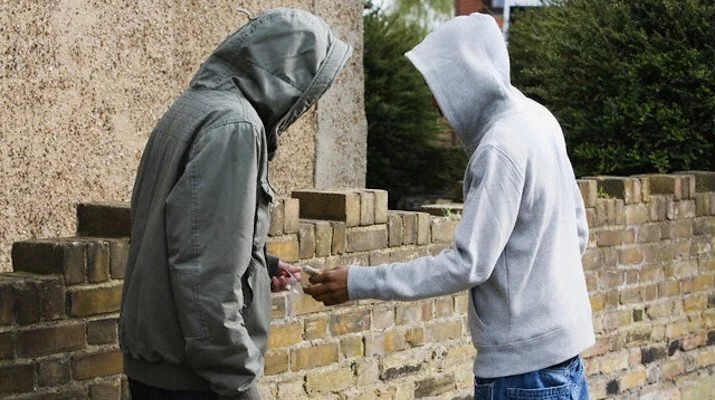
Milton Friedman once said that if you put the federal government in charge of the Sarah Desert there’d be a shortage of sand in five years. In Illinois, they’ve run out of pot just five days after legalizing it.

It seems that while the stores that sell the weed are privately owned, the state was slow in approving cultivation centers to grow it. And after just five days, legal pot dispensaries were running out of product because the cultivation centers didn't have enough to send.

The state’s 21 cultivation centers simply don’t have enough product to supply the few dozen dispensaries, many of which have been forced to set buying limits and even shut down sales to recreational customers in the wake of legalization.

Could it be that the problem with finding cultivation centers is that the state is looking for "social equity applicants"?

Other applicants will have an opportunity to apply for licenses in an upcoming phase of the implementation process, with priority going to “social equity applicants” – generally, applicants from communities “disproportionately impacted” by the war on drugs, or individuals with previous arrests or convictions for minor marijuana violations.

There are no large-scale marijuana cultivation centers in the state because they haven't got around to licensing any yet. And then, there are those pesky "social equity" rules that take precedence.

A spokesman for the Illinois Department of Agriculture, the agency that oversees the state’s grow facilities, said Gov. J.B. Pritzker’s administration is “taking a deliberative and incremental approach to cannabis legalization” in order to stage a successful rollout and make way for social equity applicants who have pot-related records or live in areas that have borne the brunt of drug war-era enforcement policies.

Those individuals are getting a leg up in the process of awarding craft grow permits, as well as for permits for new dispensaries and other pot-related businesses.

Why not just set racial quotas rather than going through this farce of finding stoners willing to get up off their couches, turn off their TVs, and start a business?

What they're hoping is that some of the gang-bangers and criminals who sold pot on the street will clean up their act and pay the state for the privilege of going straight. If that sounds sort of crazy, it is.

A listing dies in New Canaan

Fall of the House of usher

Fall of the House of usher

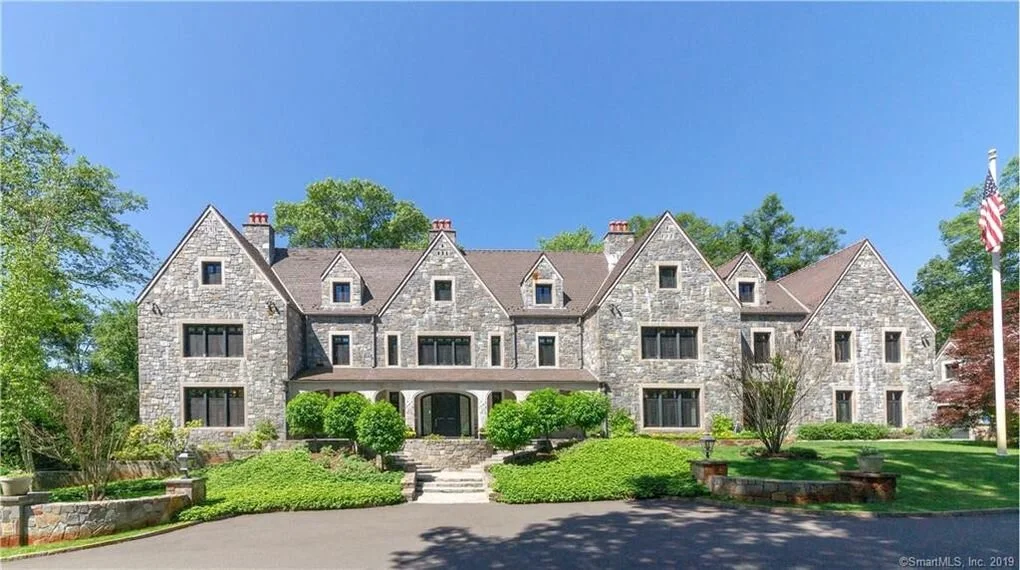
New Canaan’s market makes Greenwich’s look almost healthy. 64 Wydendown Road, 11,400 square feet on 5 acres, was offered new in 2007 for $12.9 million. Finding no buyers, it disappeared in 2008, only reemerging in 2017 at $9.950. Now, two years on, it’s been marked down as a short sale and asks $3.995.

They probably won’t get that, either

UPDATE: I was going to suggest that a short sale was unlikely here because the borrower usually has to show he has no assets, and the scion of IBM’s Arthur Watson seemed an unusual candidate for that status, but the tax records show $3 million-plus in federal tax liens, $6 million-plus in mortgage debt, and an active foreclosure going on. Interesting.

Nah, it couldn't be

Are those petroleum based fibres she’s wearing?

Are those petroleum based fibres she’s wearing?

Over at PJ Media, Charlie Martin discusses “St. Greta of Stockholm”’s severe disabilities, and then makes this observation:

So, this is what we're being asked to believe: that an autistic kid with OCD who often can't speak on her own has:

  • organized a worldwide movement

  • given TED talks, spoken to the UN General Assembly, and been named Person of the Year by Time magazine

  • managed to get a ride on a multimillion-dollar racing yacht so she wouldn't have to fly (and bragged on how she wasn't releasing CO2 on the trip, although it required seven plane tickets for the crew for the boat)

There's a bucolic barnyard term for that — actually, several, depending on your choice of equine, bovine, or galline.

This isn't a neurologically atypical high school kid arranging this: there are adults, and probably a lot of adults, using her as a front. Some of them are surely her parents, but while they've been reasonably successful in music and the arts, I don't think they have the money that's obviously behind this.

Frankly, that's a tragedy. Instead of getting the treatment she needs, she's become a climate-change muppet.

The editors of FWIW regret their error

Screen Shot 2020-01-06 at 9.59.00 AM.png

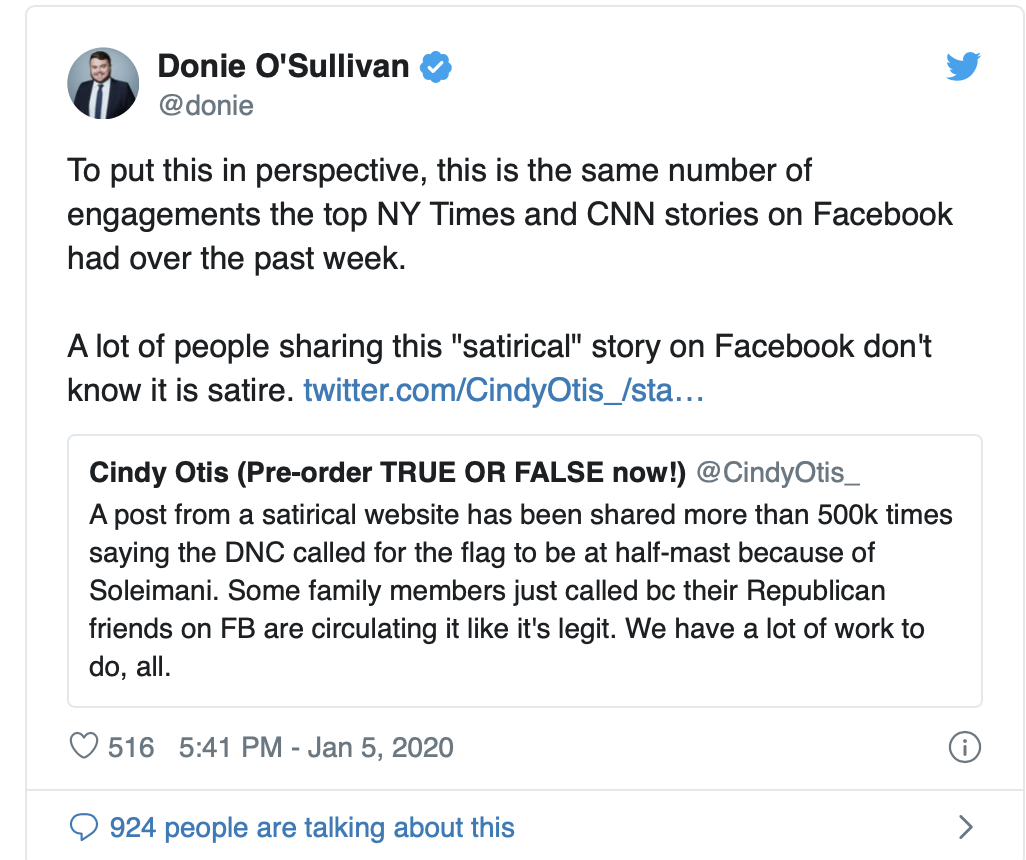
The Babylon Bee’s article reporting on the DNC’s request, linked to here January 3 by FWIW, has been exposed as fake news. Apparently, the Bee has abandoned straight news in favor of emulating the former paper of record, the New York Times. Who knew?

500,000 shares on Face Book, another 70,000 retweets; serious reporters like CNN’s Donie O’Sullivan are outraged.

Screen Shot 2020-01-06 at 10.46.25 AM.png
Screen Shot 2020-01-06 at 10.03.49 AM.png

Geegaws and gimcracks in the desert

Yesterday’s Post headline, “Dead Ringer”. Nicely done.

Yesterday’s Post headline, “Dead Ringer”. Nicely done.

The NY Post took a picture of the late, lamented Mr. Soleimani’s ring down to the city’s Diamond District and the experts were unimpressed.

Dealers believe the distinctive ring worn by Soleimani is either a red carnelian stone — believed by some Middle East Muslims as able to bestow “blessings”– or possibly an inexpensive ruby that would cost a few hundred bucks.

“From the photo, it looks like it’s a carnelian stone — it’s not a ruby; it comes from Africa,” said Maykel Rieth, a professional cutter for R Gems Inc on West 48th Street.

“The ring is made out of silver,” he continued.

“It could be white gold, but it looks like silver — and whoever made a stone like this is not going to put it in gold because it’s not an expensive piece.”

Another jeweler, from Paillon Jewelry, agreed it was a silver band, and said that gives away that the piece is cheap.

….

Whatever its cash worth, the stone still significant within the Islamic faith, particularly among the Shia sect, according to Freddy, 33,  who works at Taste of Persia Pizzeria and hails from Libya.

“That’s a religious ring. That little rock that you see inside is a type of blessing,” Freddy said. He asked his last name not be used.

“Back in the day, the messengers used to carry those type of rings with that stone or rock inside,” he said. “It’s a blessing for them to carry on their journey, so for you to carry that type of ring you’re associated with that type of religion.”

….

Rieth guessed that even with the intricate engravings on the band, the ring would be easy to replicate — probably at the cost of $400 to $500.

“Anybody can manufacturer that ring,” he said. “If you show me a better picture, I can copy it.”

FWIW’s New Mexico correspondent, who follows goings-on in the Shia sect, notes that “the beaming” Jewish merchant “was no doubt delighted to assist the Post’s reporters with their gruesome assignment”.

Exactly so.

Hospital mad cash cow's days are numbered; maybe

From health care provider to piggy bank

From health care provider to piggy bank

Connecticut’s been milking the hospitals to balance its budget; now that’s supposedly going to end. Full Greenwich Time article at the link, but here are excerpts:

For good or ill, state officials relied on aggressive increases in hospital taxes to keep Connecticut’s finances in balance during an extremely sluggish recovery from the last recession. Between 2013 and this year, hospitals pumped more than $1 billion into the state’s coffers, funds that otherwise might be raised by income tax hikes, municipal aid reductions, program cuts or all of the above.

Lawmakers and Gov. Dannel P. Malloy created the hospital levy in 2011 as a tax in name only. The industry paid $350 million to the state, which responded by redistributing all of those funds, plus another $50 million, back to hospitals.

Connecticut didn’t lose out because these supplemental payments helped the state to leverage hundreds of millions of dollars annually in federal Medicaid reimbursements — a back-and-forth arrangement encouraged by Washington and employed by most states.

But as Connecticut’s recovery from the last recession plodded along far slower than officials anticipated, Malloy and lawmakers gradually increased the tax, scaled back the supplemental payments — and forfeited huge federal dollars in the process.

Hospitals, who paid a total of nearly $2 billion more than they received between 2013 and 2019 collectively, sued four years ago on grounds that this system abused the process allowed under Medicaid.

Facing an industry claiming roughly $4 billion in damages, Connecticut agreed to pay $1.8 billion to hospitals over the next seven years — with just over half being covered by federal Medicaid reimbursement payments.

And while that deal also came with a pledge to modestly trim hospital tax rates — and avoid any hikes — through 2026, lawmakers were happy to remove a multi-billion-dollar risk. “I think that was enough, alone, for most people” to back the deal, Fonfara said.

“But the discipline part, cleaning up our finances, I don’t know if people are realizing we’re going to have to bite the bullet,” he added.

The war and bullet-biting Fonfara and Walker fear is possible despite overwhelming bipartisan support for the settlement, largely because there’s little-to-no agreement on what Connecticut can tap as an alternative cash cow.

Many of Walker’s fellow Democrats in the House and Senate majorities are wary of further cuts in spending on social services and local aid.

If there’s no other acceptable alternative, progressive Democrats say the answer should center on raising income taxes on Connecticut’s wealthiest residents. Though the state’s largest revenue engine is fairly progressive at the lower end — households earning less than $35,000 per year usually have no tax liability — that progressiveness flattens out quickly.

Many middle-class and rich households all pay an effective tax rate that ranges between 5 percent and 6.5 percent. [The highest earners, singles making more than $500,000 per year and couples topping $1 million, pay 6.99 percent.]

But while hospitals were forced to adjust over the past decade, Fonfara said, it will be state government’s turn to make even harder choices in the years to come.

And though there’s no consensus on what to do if or when the reserves run dry, the Hartford lawmaker said he’s optimistic legislators will turn to a more sustainable solution the next time one is needed.

“I think we’ve learned the hard way when we’re not disciplined how much it hurts us,” he said. “That’s what people are fed up with.”

Using history as a guide, it’s a fair guess that we’ll see those higher taxes on the middle class and the rich, and no fiscal discipline.

Profile in Courage

trump.jpg
Original, unacceptable message

Original, unacceptable message

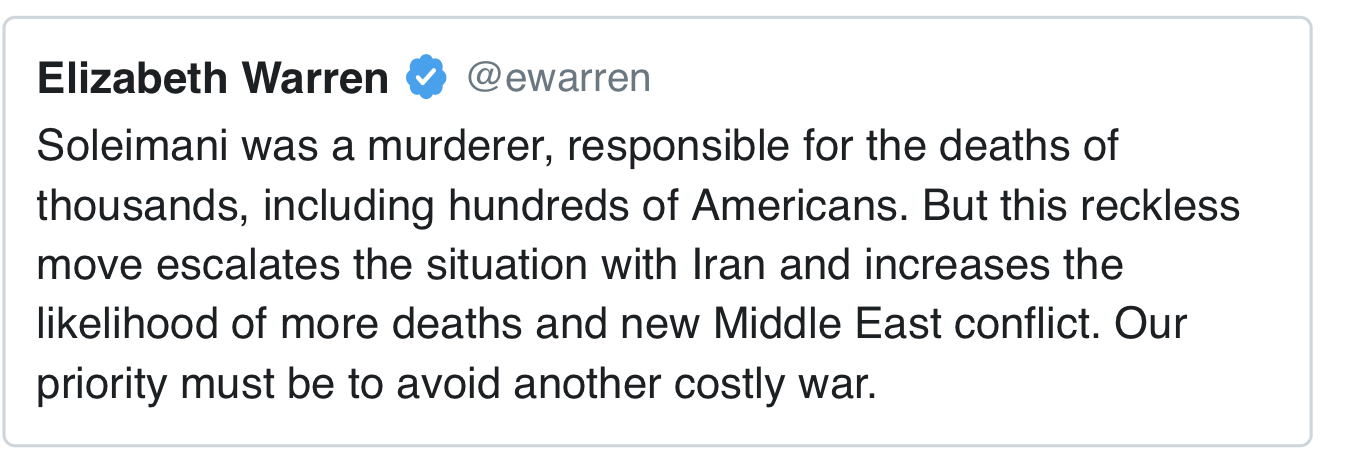
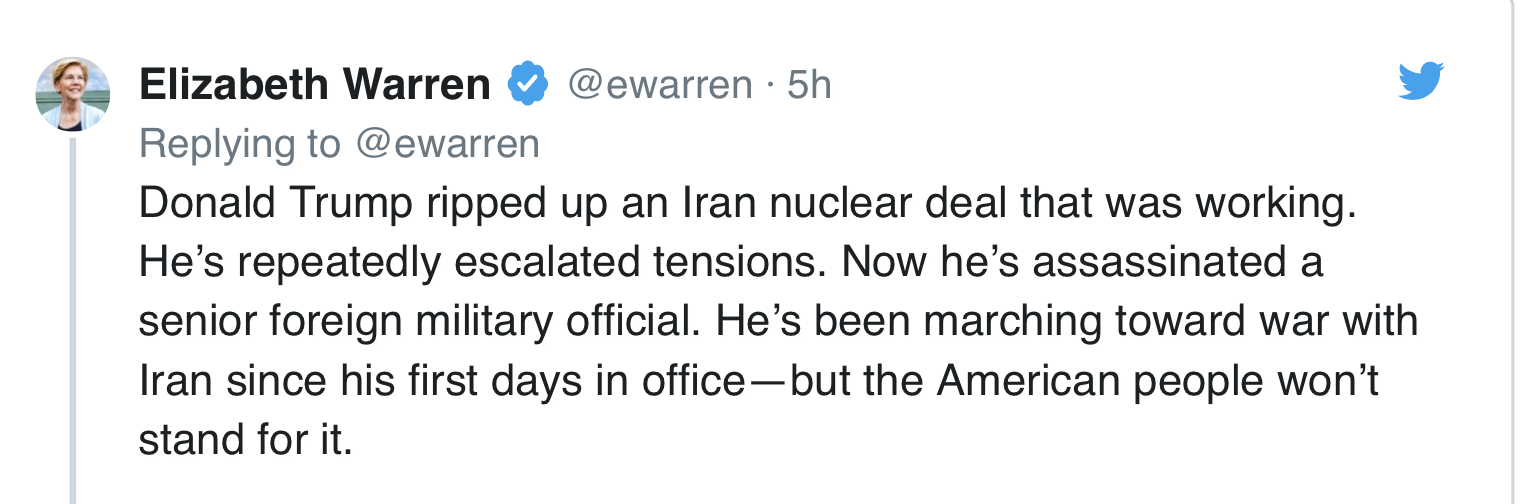
Rewritten: now it’s in line withe her party’s “assignation” talking point, and General Soleimani is gone, replaced by "“a senior foreign military official”.

Screen Shot 2020-01-03 at 5.53.54 PM.png

Related: Democrats call for flags to be lowered to half-mast to grieve death of revered military leader

WASHINGTON, D.C.—At a press conference held on Capitol Hill Friday, mourning Democrat leaders called for flags to be flown half-mast to honor the death of Qasem Soleimani.

Flags were spotted flying at half-mast around the country, notably at The Washington PostThe New York Times, and in front of several celebrities' homes. The celebrities went out and bought an American flag for the first time just to fly it at half-mast for this important time of grief.

"The grieving process is painful but necessary," said Rep. Ilhan Omar. "As a nation, we need to stop and grieve this great, austere, revered religious scholar. He was one of the good ones."

In a rare moment of unity with The Squad, Pelosi gave each of the girls a hug, telling them to just "let it all out" in their time of sadness.

Ocasio-Cortez didn't seem to know what was happening but adjusted her glasses to look smart.

Land in the right location is still selling, and commanding premium prices

204 Otter Rock Drive

204 Otter Rock Drive

204 Otter Rock, Belle Haven, pending at $6.750 million. This was originally a 3+ acre parcel, and was truly spectacular, but the $11 million price tag was daunting. Still, in this location, I think you could have paid that price and still built a house that made economic sense. But no such buyer appeared, so the land was split, with the lower lot selling for $5.1 in December 2018, and now this one.

Meadow Place

Meadow Place

7 Meadow Place, Old Greenwich, has sold for $6.195 million. You could never recreate this filled-yard, and that makes a difference. But it’s still a cramped lot on a relatively cramped street, and I’d have hesitated before spending so much for tidal waterfront.