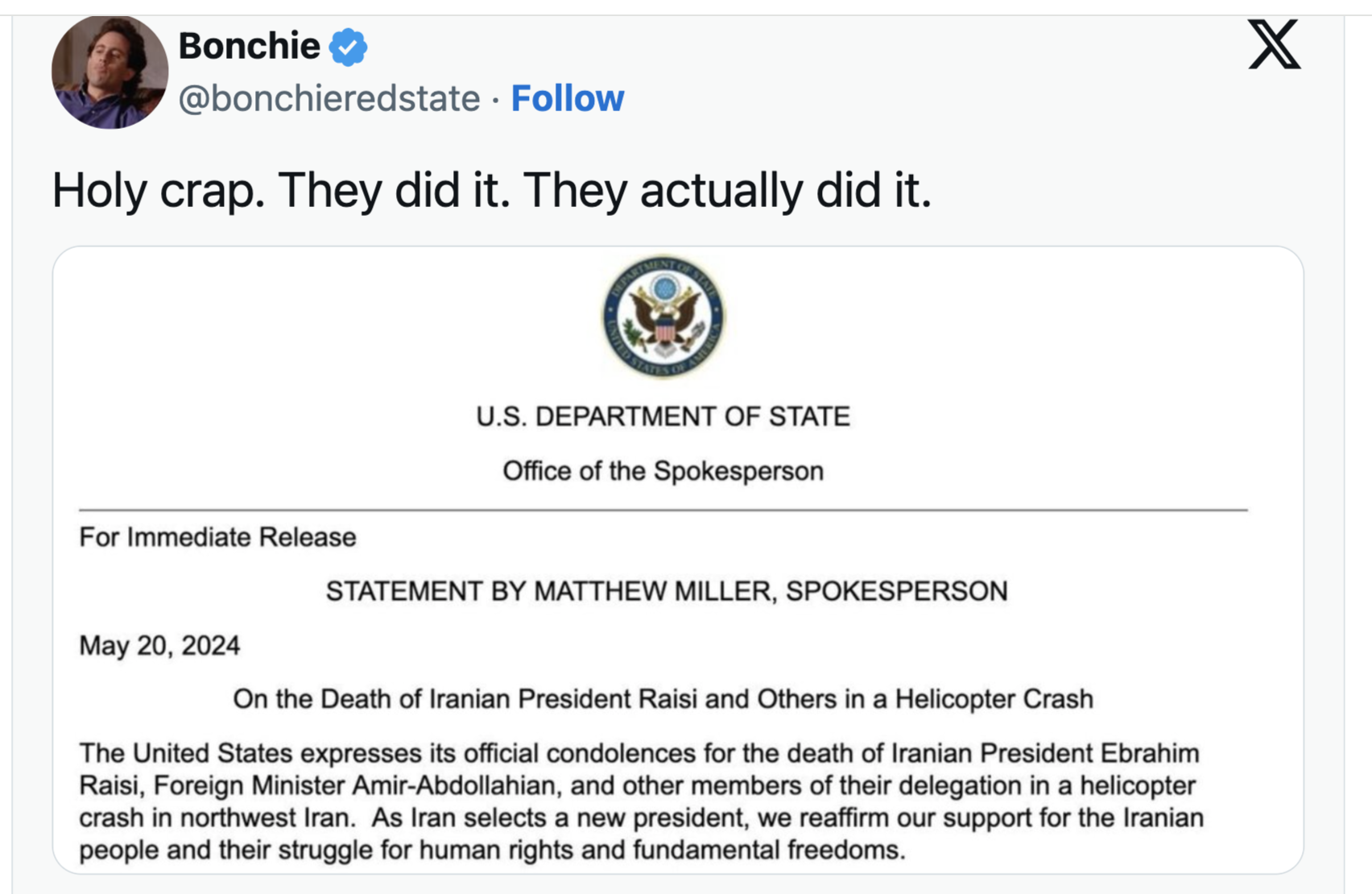
Well, if Hamas is an ally of the left, and Iran supports Hamas, doesn't that make Iran our ally too?

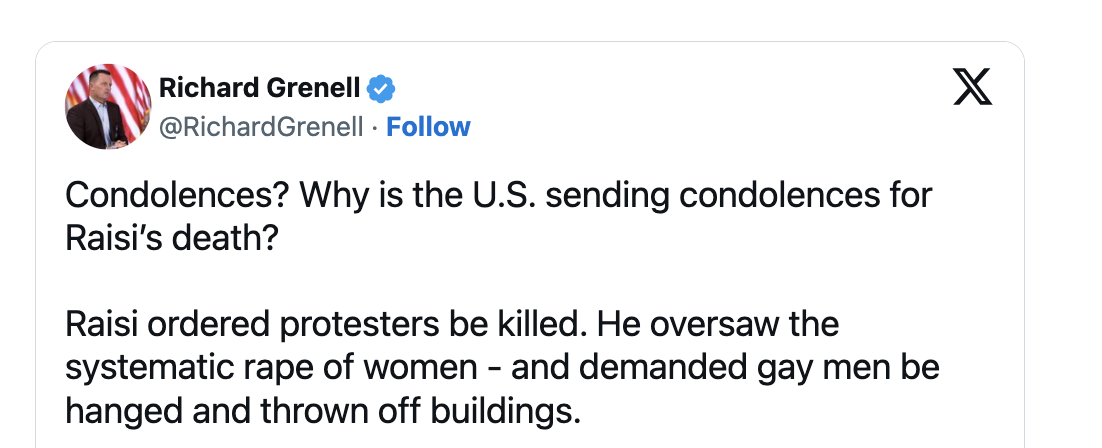
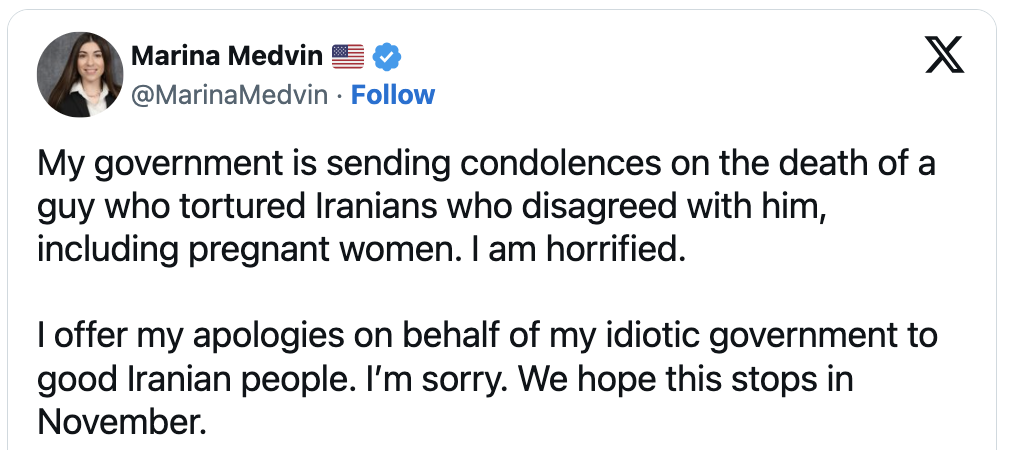
Some people weren’t as sympathetic to the Iranian mullah’s loss, and said so:

To drive how crazy this is home, we need to discuss who Ebrahim Raisi was, though the fact that his nickname was the "Butcher of Tehran" kind of gives the game away without the need for further details. Specifically, Raisi signed an execution order in 1988 that led to the mass murder of thousands of dissidents who opposed the Islamic regime. He became no more moderate in his old age, arresting thousands of women in an attempt to quash protests that broke out in 2022. Hundreds were confirmed to have been raped and executed while in custody. 

That's just a small taste of the murderous tyranny Raisi partook in throughout his time in power. Yet, here is the Biden administration offering "official condolences" for a man who was on the same level as some of history's most violent and oppressive authoritarians. This is no different than had the United States offered condolences to the Germans for the death of Hitler. For context, there have been no American diplomatic relations with Iran since 1980. 

In other words, there was zero requirement or even expectation for condolences to be offered in this case. This was a choice made by Biden and Antony Blinken, the secretary of state who recently did a bad cover of "Rocking in the Free World" in Ukraine because he cares so deeply about "democracy" and freedom. 

Biggerbetterbrighterwider

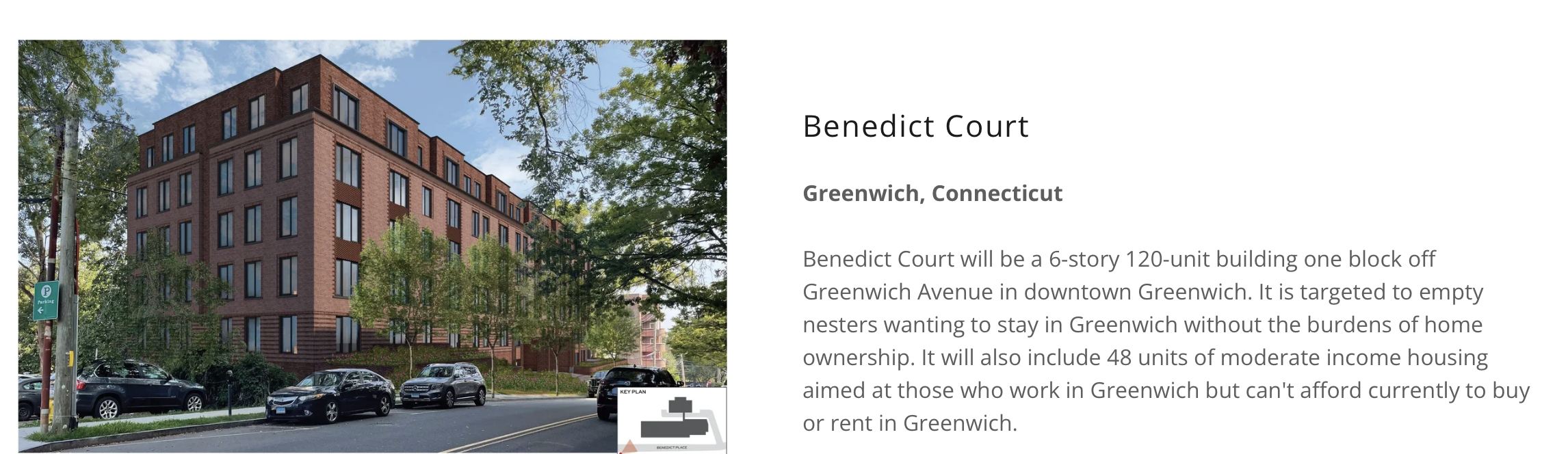
Unhappy Greenwich board OKs huge Benedict Place affordable housing project: 'Incredibly frustrating'

(Robert Marchant, Greenwich Time)

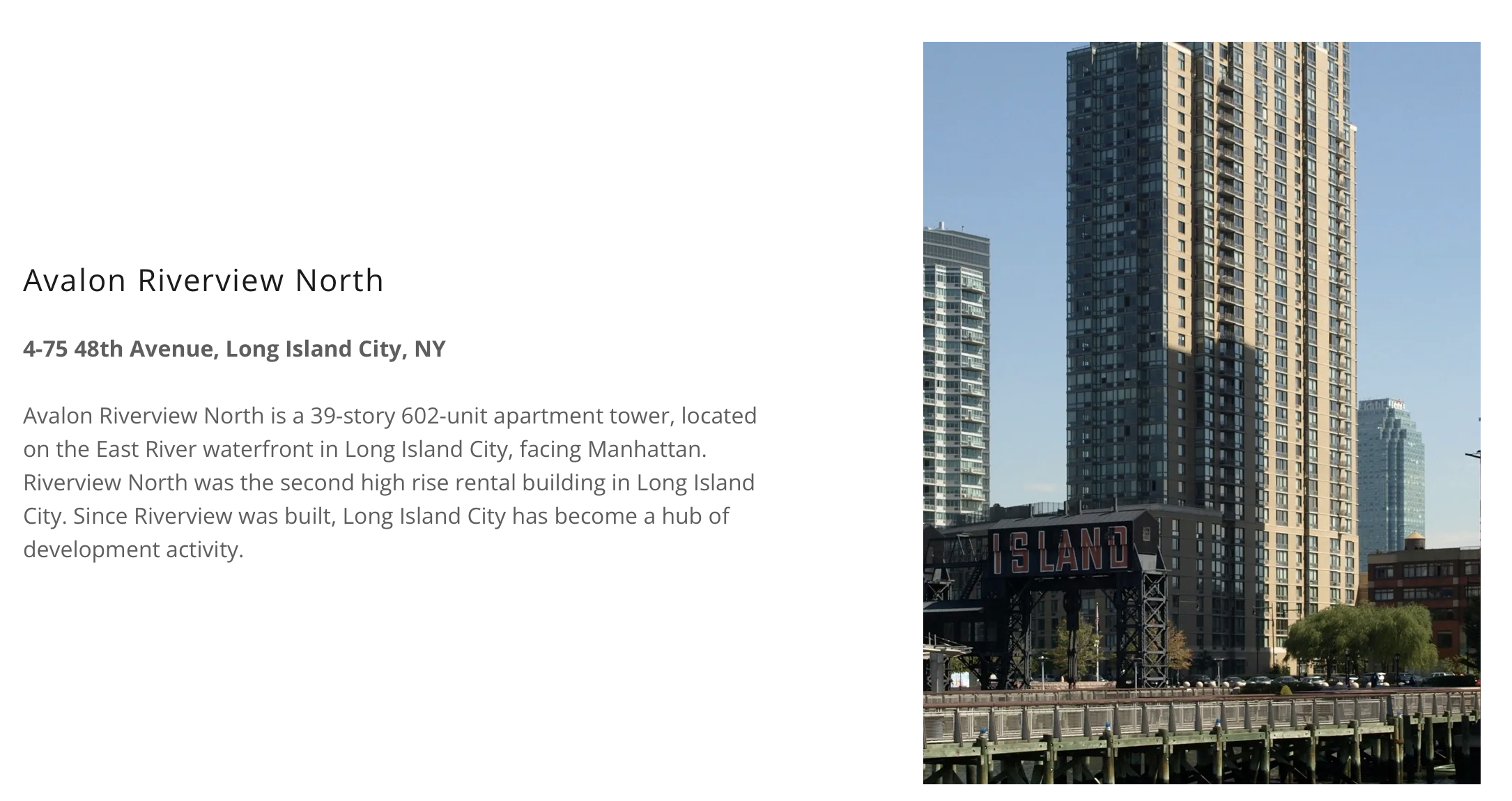
GREENWICH — The largest construction project slated for central Greenwich in years has been approved: a six-story structure with 120 units, nearly half of which are designated affordable.

The building would set aside 40 percent of the total, 48 units, as affordable dwellings. The development is merging 12 existing lots in the area of Benedict Place and Benedict Court containing homes and offices. The current lot is about 1.2 acres in size, 51,306 or square feet.

The construction is taking advantage of state law 8-30g, which can override some local zoning codes for the goal of creating affordable housing.

The plan has drawn substantial public criticism from local residents because of its size.

The development does not meet town zoning regulations in multiple ways. It will provide 180 parking spaces, while the town code would require 260 spaces. The structure will be six stories tall, at 77 feet, while code permits three stories and 40 feet. The building coverage — the percentage of the new construction measured against the lot size — would be 71 percent, while 30 percent is the standard.

Commissioner Nicholas Macri said he opposed the project and criticized the state law that allowed affordable housing developments to skirt town regulations.

"The residents want affordable housing, but not to the sacrifice of the very fabric of this town," he said. "Many residents have voiced their opinions on these issues and are fed up.... In short, the development gets everything and the town nothing."

Chairperson Margarita Alban said the commission had to follow the law and had little choice in the matter.

"This is a state law, and it's been in place for 35 years. So this is a state law, and we live in the state of Connecticut, and our job is to follow the laws. ...That's just the way the legal system works. I know it's frustrating... It's incredibly frustrating that we have to do this," Alban continued.

She noted that the project would offer 40 percent of the total units as affordable, "which is much higher than would normally be."

The developer, Nimbus Properties, seems to be quite legitimate, and the partners no fly-by-nights, but we don’t have to necessarily like it, nor like the Westchesterication that’s on the horizon.

UPDATE: Searching for information on the principle of this firm, Phil Wharton, I came across this post; at least his head, if not his heart, is in the right place.

Philip Wharton’s Post

Philip Wharton

Real estate investor and developer

5mo

If you, like me, are worried about the leadership and atmosphere at Harvard today, I have one concrete step to take. Samuel W. Lessin '05 is running a write-in campaign to be nominated for the Board of Overseers. He would offer a fresh (and younger) perspective to the Board, and I know personally that Sam will be committed to help Harvard refocus on academic excellence. Sam also happens to be my nephew!  If you're a Harvard alum and would like to learn more and/or sign the petition for Sam's nomination, please go to www.samforoverseer.com 


I have no problem with this; you have a problem with this?

“corn pop, can you hear me? we gotta go to motor city”

Biden bizarrely suggests he was VP during pandemic in latest blunder

President Biden declared Sunday that things got “kind of bad” when he was vice president during the COVID-19 pandemic — even though the virus hit more than three years after he left office.

The 81-year-old Biden, who finished his eight years as Barack Obama’s veep in January 2017, suggested he was still in post at the time of the outbreak during a campaign event with the NAACP.

“When I was vice president, things were kind of bad during the pandemic and what happened was, Barack said to me, ‘Go to Detroit! Help fix it,'” Biden said.

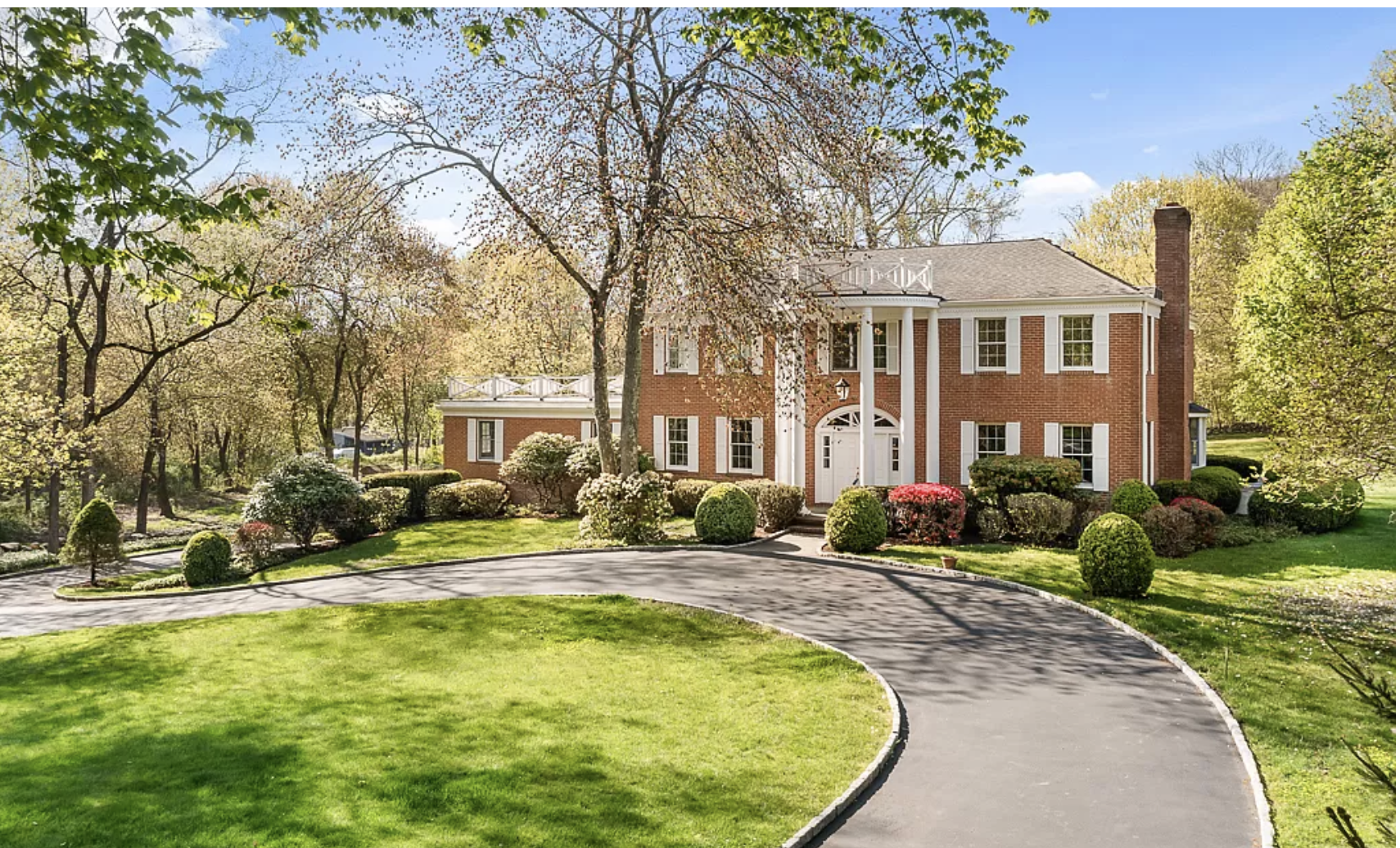
We've been following this home's downward path since it hit the market last fall; here's the latest installment

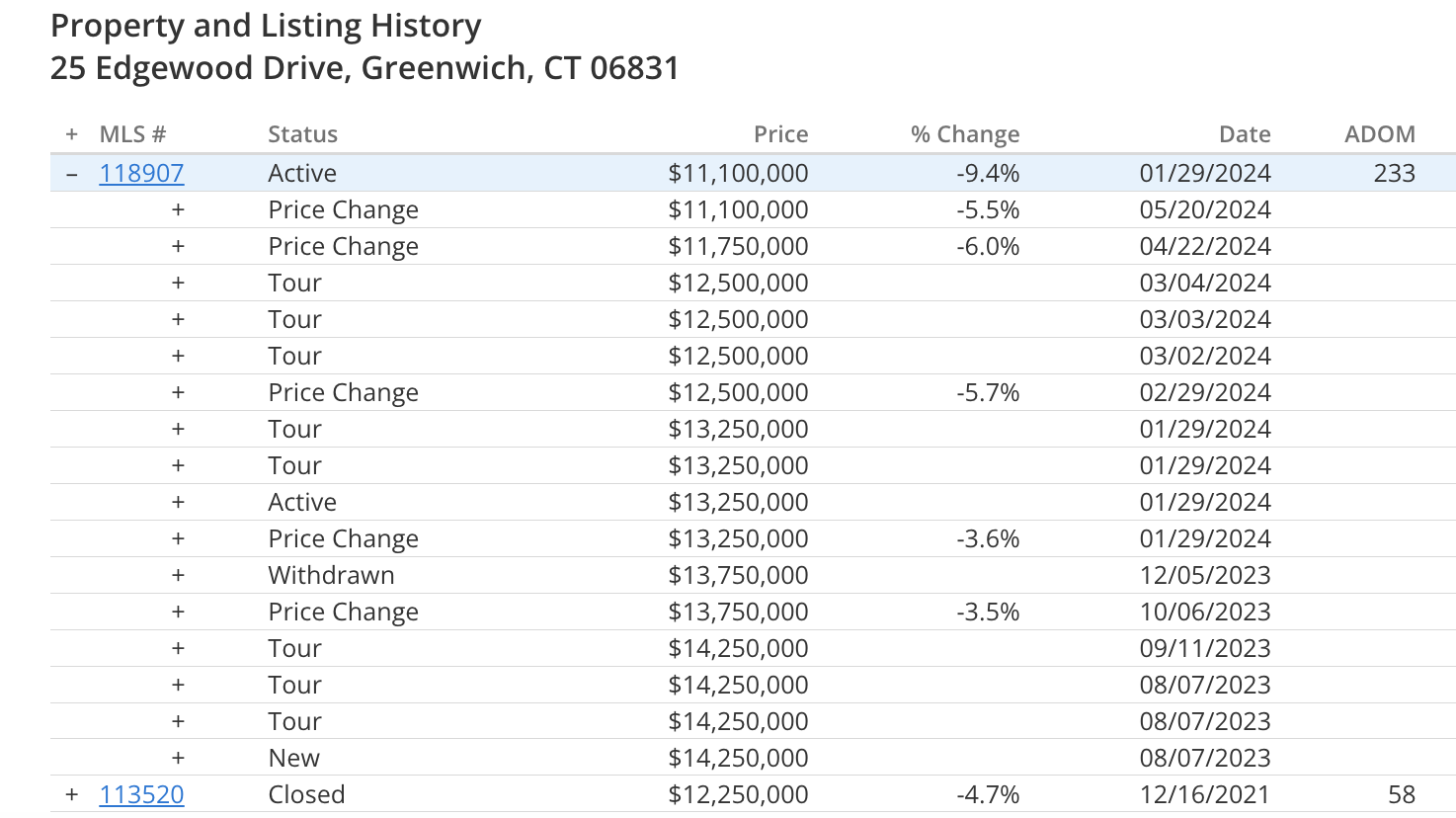
2 Edgewood Drive has cut its price to $11.1 million, down from $11.750. Back in February, on the occasion of the home’s third price, cut I wrote the following:

The owners of 25 Edgewood Drive paid $12.250 million for it in December 2021 but soon tired of it — blinded by its all-white interior, perhaps — and last August they placed it back on the market, unchanged, for $14.250.

It’s possible they felt they’d scored a coup on their original purchase because the house had initially asked $14.880 in 2020, but the market apparently feels that it was fully-priced then and remains so; this morning the owners trimmed its price back to $12.500.

We first pointed out this property’s aggressive pricing ambitions in October of last year A Modest House, But Then, It Has Much to be Modest About; and again this past January: Price Cut; and again in February: Too Soon? ; nothing’s changed since then except the price.

Mad Rush to regulate

Red State: Biden Admin Fast-Tracking Rule Changes As Trump Victory Becomes a Threat

The administrative state is preparing for former President Donald Trump to win reelection by implementing a surge of bureaucratic regulations before a deadline that renders them difficult to undue [sic] by a potential Trump administration. ...

Biden’s administrative state published 111 more regulations than Trump implemented at the same point in his term, Axios reported. Many of the rules will protect the progressive agenda of “climate change,” such as limiting auto tailpipe emissions and forcing power plants to cut carbon dioxide emissions.

The rules implemented during an upcoming “lookback period” can be reversed in a potential Trump administration via the Congressional Review Act. Any rules put into action before the deadline cannot be reversed. When the “lookback period” begins in 2024 is murky, but Axios reported Biden’s deadline to range between next week and September.

They can be reversed, but it will take longer to accomplish. However, if the White House rushes these through by violating the Administrative Procedure Act (APA), a court will reverse them immediately if challenged. The APA is a potent tool for plaintiffs seeking to reverse arbitrary imposition of regulations. 

READ MORE FROM BREITBART

Presidential administrations have historically rushed to issue regulations in their final few months in office, but with nine months still left in this presidential term, that rush to the finish line is already evident. Polls show a tight race between President Biden and former President Trump, and the Biden administration appears to be working overtime to codify their regulatory priorities in time to shield them from change if the November election doesn’t go their way.

April was the busiest month on record for big ticket rules (those with estimated annual impacts of $200 million or more). The Office of Information and Regulatory Affairs (OIRA), which reviews all executive branch agency rules before publication, concluded its review of a whopping 42 such economically significant final rules in April, compared to fewer than five in an average month. According to the American Action Forum, in the first four months of 2024 alone, the Biden administration has issued regulations that—by agencies’ own estimates—will impose new costs on the public of more than $1 trillion dollars per year.

What accounts for this burst of regulatory activity with so many months to go in the term? A once obscure law known as the Congressional Review Act (CRA). If the November election brings Republican control of the White House and Congress, rules issued later in the summer or fall may be subject to review and disapproval in 2025. The CRA provides for expedited Senate procedures after which Congress can send a joint resolution disapproving a regulation to the president’s desk. Presidents tend to veto such disapprovals of their own administration’s rules, but a presidential transition offers a unique window in which a disapproval resolution could land on a sympathetic president’s desk. This is what happened in 2017, when newly inaugurated President Trump signed 15 resolutions disapproving regulations issued toward the end of the Obama administration. President Biden himself signed three disapprovals of Trump-era rules when he took office in 2021.

[Before Trump left office in 2021, he signed an executive order (EO) to reclassify federal government employees into Schedule F, which would have allowed the president to enhance accountability and job performance within the bureaucratic agencies. “You have some people that are protected that shouldn’t be protected,” Trump said in May about Schedule F.

Biden canceled the order when he assumed office in 2021, but if Trump reclaims the White House, he will reportedly reimplement the executive order and purge the unelected technocrats artificially running the federal government. “It would effectively upend the modern civil service, triggering a shock wave across the bureaucracy,” Axios previously concluded about the EO’s impact.

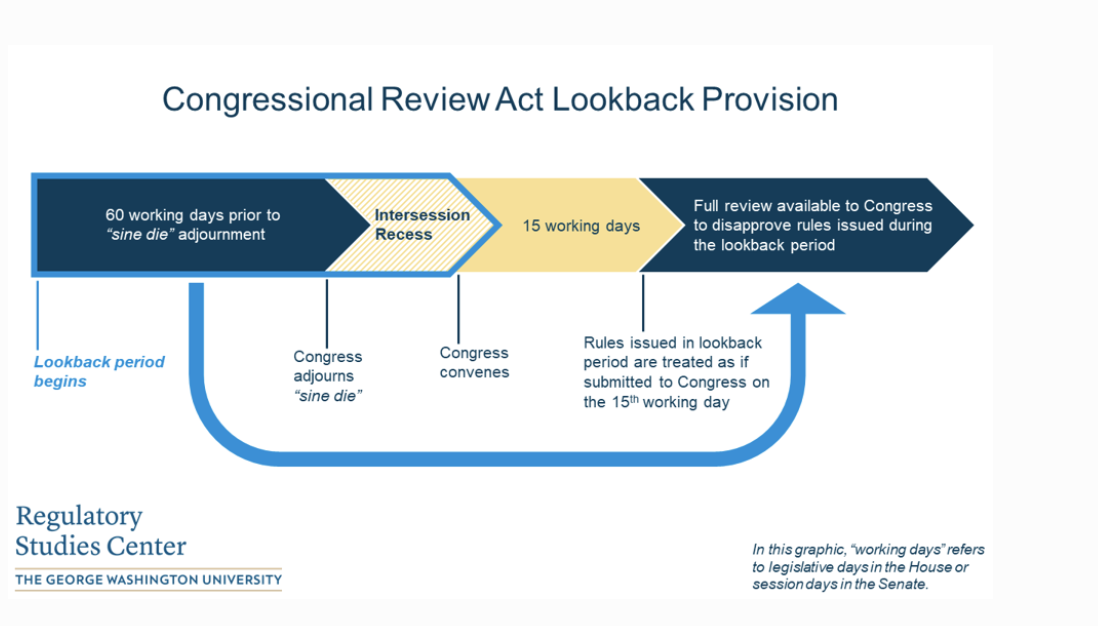
Exactly when the Biden administration’s deadline is for avoiding a similar fate for its priority rules is uncertain. The CRA gives Congress a 60 working day window during which disapprovals can be introduced and considered. But, if a rule is submitted late enough in the year that either the House or Senate doesn’t get the full 60-day review period, a “lookback” provision ensures the next Congress can review the rule (see graphic).

More here

The CRA allows Congress to overturn rules issued by the Executive Branch by enacting a joint resolution of disapproval that cancels the rule and prohibits the agency from issuing a rule that is “substantially the same.”  One of the CRA’s most unique features—a 60-day “lookback period”—allows the next Congress 60 days to review rules issued near the end of the last Congress.  This means that the Administration must finalize and publish certain rules long before Election Day to avoid being eligible for CRA review in the new year.  

Overview of the CRA

The CRA requires federal agencies to submit all final rules to Congress before the rule may take effect.  It provides the House with 60 legislative days and the Senate with 60 session days to introduce a joint resolution of disapproval to overturn the rule.  This 60-day period counts every calendar day, including weekends and holidays, but excludes days that either chamber is out of session for more than three days pursuant to an adjournment resolution.  In the Senate, a joint resolution of disapproval receives only limited debate and may not be filibustered.  Moreover, if it has been more than 20 calendar days since Congress received a final rule and a joint resolution has not been reported out of the appropriate committee, a group of 30 Senators can file a petition to force a floor vote on the petition.   

If a CRA resolution receives a simple majority in both chambers and is signed by the President, or if Congress overrides a presidential veto, the rule cannot go into effect and is treated “as though such rule had never taken effect.”[1]  The agency is also barred from reissuing a rule that is “substantially the same,” unless authorized by future law.[2]    

Election Year Threat: CRA Lookback Period

These procedures pose special challenges for federal agencies in an election year.  If a rule is submitted to Congress within 60 days before adjournment, the CRA’s lookback provision allows the 60-day timeline to introduce a CRA resolution to start over in the next session of Congress.

This procedure ultimately requires the current administration to assess the threat of a CRA resolution against certain rules and determine whether to issue the rule safely before the deadline or risk a potential CRA challenge. 

Mid-May Deadline Estimated for Biden Agency Actions

Agency leaders are working to finalize rules in time to meet this deadline.  At a recent conference held by the American Law Institute’s Continuing Legal Education, Vicki Arroyo, the Environmental Protection Agency’s (EPA) Associate Administrator for Policy, explained that the deadline is “something that [the EPA is] very focused on.”[3]  Although the deadline is uncertain, she noted that to be cautious, agencies may submit rules as “early as the end of April or May.”[4]

Federal agencies have already begun or plan to submit rules to Congress before the late May deadline, including:  

(FWIW interpretation in brackets)

  • An EPA rule that sets new standards to reduce air pollutant emissions from cars and a rule that requires fossil fuel plants to rely on new technologies to reduce pollution levels. [Bans ICE vehicles, cars and trucks, closes gas and coal-powered energy plants]

  • A Department of Labor rule that modifies Wage and Hour regulations to clarify the criteria for classifying workers as independent contractors as opposed to employees and a rule that narrows the standards to classify as exempt from the Fair Labor Standards Act’s minimum pay and overtime requirements. [Bans GIG jobs]

  • A Department of Justice rule that takes additional steps to implement the Bipartisan Safer Communities Act, which makes various changes to federal firearm laws, including expanding background check requirements and broadening the scope of existing restrictions. [Gun control]

  • The Energy Department’s regulations setting consumer water heater energy efficiency standards to lower utility costs for American families and increase energy savings. [and drive the prices of those heaters higher]

  • An Office of Personnel Management rule that would implement stronger guardrails for career employees, allowing them to keep civil service protections unless they voluntarily accept a political appointee position and adding requirements when reclassifying career positions as political appointments. [protect the federal bureaucrats — permanent employment]

  • A Bureau of Land Management rule setting management standards that put conservation on par with resource extraction to protect public lands and restore degraded habitats. [places most federal lands off-limits for coal and oil production]

    The fate of these rules will depend on how soon the Administration can finish these rulemakings and submit them to Congress.  Otherwise, the outcome of the 2024 election will determine whether these rules ever take effect. 

Flash from the past

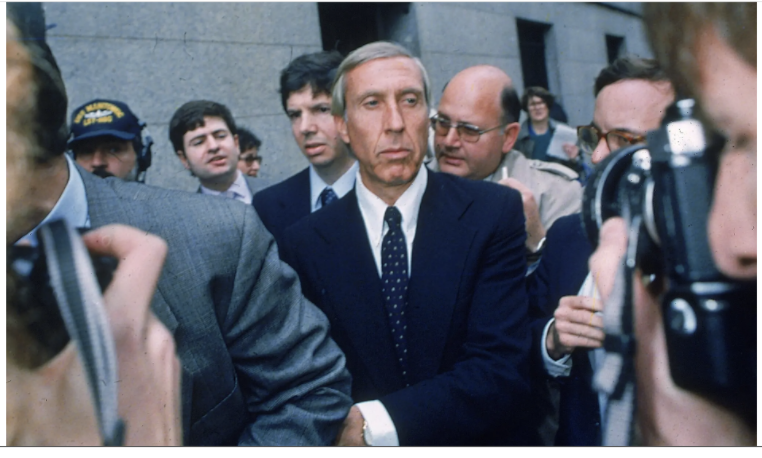
Ivan Boesky, dead at 87

Ivan F. Boesky, Rogue Trader in 1980s Wall Street Scandal, Dies at 87

An inspiration for the Gordon Gekko character in the movie “Wall Street,” he made a fortune from insider trading before his downfall brought a crashing end to a decade of greed.

Those were interesting days, when Wall Street money exploded to previously unheard-of levels and newly-minted multi-millionaires flooded into Greenwich, transforming its culture and, of more immediate notice, its housing market.

I won’t say that change was for the better, but change it did, and Boesky, who himself stayed in Westchester, was one of its most prominent symbols.

Language

9 Mountain Wood Road, priced at $3.5 million, reports a contract after 9 days. It will be interesting to see what it’s final price will be, and what happens to the house itself. The listing’s description doesn’t seem to hold much hope for the building escaping the dumpster, but you never know; certainly, prospective buyers were given fair warning:

“The interior is a vision from the past, awaiting a discerning buyer or builder's inspiration.” **BRING ALL OFFERS** This is an estate, property being sold as-is where is and no property condition disclosures are provided. Seller makes no representations about the condition or legality of structures or improvements on the property. Buyers are encouraged to conduct their own due diligence.

“A vision from the past” is a wonderfully creative phrase for an obsolete house — I shall put it on the vocabulary shelf, right next to “deferred condition”, and use both to describe the next derelict (house) I list. ell done, sir.

If you like your car, you can keep your car; you just won’t be able to buy a new one by 2032

i got mine, jack — no joke

I’d thought — silly me — that most Americans realized that the upcoming mandates restricting ICE vehicles to 20% of all new car sales will end production of most gasoline powered cars, and drive the price of the few that will be allowed to be sold out of reach of the great unwashed. Apparently not, so the auto industry is trying to bring that to their attention, again. They won’t listen, I predict, until it’s far too late to throw it into reverse.

Auto industry experts warn Biden's EV mandate may limit gas car options in the future

'The policy is going to both limit the availability of new gas cars and push the cost of remaining gasoline-powered vehicles out of reach,' says industry expert

When President Biden said that Americans can "buy any kind of car they want," he failed to factor in new emissions standards his administration is putting in place that will reduce consumer choice, industry experts say.

During a speech delivered on Tuesday outside the Rose Garden, Biden focused on protecting U.S. jobs from unfair foreign trade practices and promised to not allow China to control the market for internal combustion engines or electric vehicles (EVs).

"I want to make this clear, notwithstanding what the other guy is saying – can buy any kind of car they want… but we're never going to allow China to unfairly control the market for these cars, period," he said, as "the other guy" appeared to be a reference to former President Trump, who made waves for predicting an auto industry "bloodbath" if Democrats continue their EV push.

Geoff Moody is senior vice president of American Fuel & Petrochemical Manufacturers (AFPM), a trade association representing companies like Chevron, ExxonMobil, Koch and others. He said that Biden's Environmental Protection Agency (EPA) regulation "is functionally a ban on sales of most new gas cars by 2032."

"The policy is going to both limit the availability of new gas cars and push the cost of remaining gasoline-powered vehicles out of reach for most Americans," he said, adding that EPA compliance scenarios he has viewed project new internal-combustion-engine car sales to fall drastically from 84% at present to below 30% in 2032.

"The whole point of the rule is to push American drivers toward electric vehicles by limiting their other options," Moody said.

American Petroleum Institute executive Will Hupman echoed some of that sentiment, predicting that it could effectively eliminate most new gas-powered vehicles in the future. 

… While Biden's EPA's emissions standards do not constitute a blanket prohibition on internal combustion engines, automobile and fossil fuel trade organizations claim that to them, they may as well have.

When asked about Biden's comments and consumer choice concerns in regard to the new mandates, a spokesperson for General Motors said it is continuing to grow its electric vehicle fleet while retaining a broad suite of gas-powered options for customers.

The spokesperson also called it "challenging."

America, meet your future:

havana today

In 2016, Fidel Castro’s brother, Raul Castro, relaxed the need for permission to buy foreign cars and finally lifted the ban on importing American cars and parts. This led to an influx of brand-new cars onto Cuba’s roads.

Many wondered if this would signal the end of Cuba’s classic car industry. While Cubans’ love of vintage cars is ingrained in their culture and makes up a vital part of their tourism industry, there is another reason why you will still see plenty of old cars in Cuba – the cost.

New car imports are still highly regulated, and the pricing makes purchasing a car unrealistic for most Cuban locals. The state still has a monopoly on Cuban car sales, which means prices are high. A Peugeot 508 which typically retails at $29,000, costs a whopping $262,000 in Cuba. With the average Cuban citizen earning around $20 a month, it is unlikely that new imported cars are going to be part of a buying boom.

How long do you think copper piping, wiring, and anything else that can be sold for drugs will last in those $1 million homeless units?

Oakland locals blame homeless encampment for city removing traffic lights to stop copper thieves

A California city removed the traffic lights from a four-way intersection as the city grapples with thefts attributed to a massive homeless encampment nearby. 

Oakland has been experiencing high crime and theft, including people stealing copper wires and the city's infrastructure, according to locals who spoke to CBS News. The city attempted to thwart criminals tampering with its electrical boxes by placing cement barriers over them – to no avail. Now, the city has taken to removing the traffic lights at a busy intersection and replacing them with stop signs. 

It’s been said of junkies that they’ll steal anything that’s not nailed down (and then help you look for it), but in fact, they’re perfectly happy to first steal the nails, and then finish the job. Placing active drug addicts into separate, brand new apartments might provide them with decent shelter for a few weeks, but the denizens will soon have them reduced to a junkie’s natural habitat.

Series Of Copper Thefts Sets Back Property Owner’s Affordable Housing Renovations