Posturing Pukes

Rivians have become the favorite of the elite eager to show they support electric vehicles but not Musk. 

Over the past year, a striking shift has occurred in the Hamptons, Palo Alto and other high-end enclaves: Teslas — and being in any away associated with Elon Musk — are out. Rivians and Lucids are in for those looking to signal their environmentally conscious bonafides.

“Everyone is dumping their Cybertruck — they are desperate to find someone to take them away,” Matthew Ammirati, founder of the Bridgehampton Motoring Company which works with high-end car collectors, told me.

Rivian’s electric trucks are gaining traction among wealthy buyers simply because they have no association with Elon Musk (and by extension Donald Trump). This despite their premium sticker prices: R1T pickup trucks start at $70,000, while R1S SUVs start at $75,000 — roughly three times more than a base-model Tesla.

According to Rivian, the company has more than 100,000 people on the waitlist for their new R2 model that launches in 2026 — an indication that the cars are about status, not urgently needing a ride.

“On the high end, Rivians have become front and center,” Dan Ives, the Managing Director and Senior Equity Research Analyst covering the Technology sector at Wedbush Securities, told me. “You’re seeing a lot more Rivians in East Hampton.”

Rivian has even invested in a new charging station-store combination in the Hamptons, only the third of its kind globally. (The other two are in Joshua Tree and Yosemite)

The embrace of Rivian and Lucid vehicles, however, is really only possible for a handful of wealthy buyers given their penchant for breaking down so frequently. 

“Rivians and Lucid are a nightmare from charging, insurance, accident — it would win most likely to get a car stuck on the beach,” Ammirati said. 

“He and his family have multiple back-up vehicles for when their Rivian breaks down” But the symbolism!

Travis Ketchum, who runs a software firm and reviews cars on the side out of Seattle, Wash., switched from a Tesla to a Rivian last year because of the politics rather than the quality of the car.

While he doesn’t regret it, he acknowledged that it has come with a number of setbacks.

“It’s often months before your car can be seen [for repair at a dealership] and it’ll be there days before people start working on it,” he said. He and his family have multiple back-up vehicles for when their Rivian breaks down

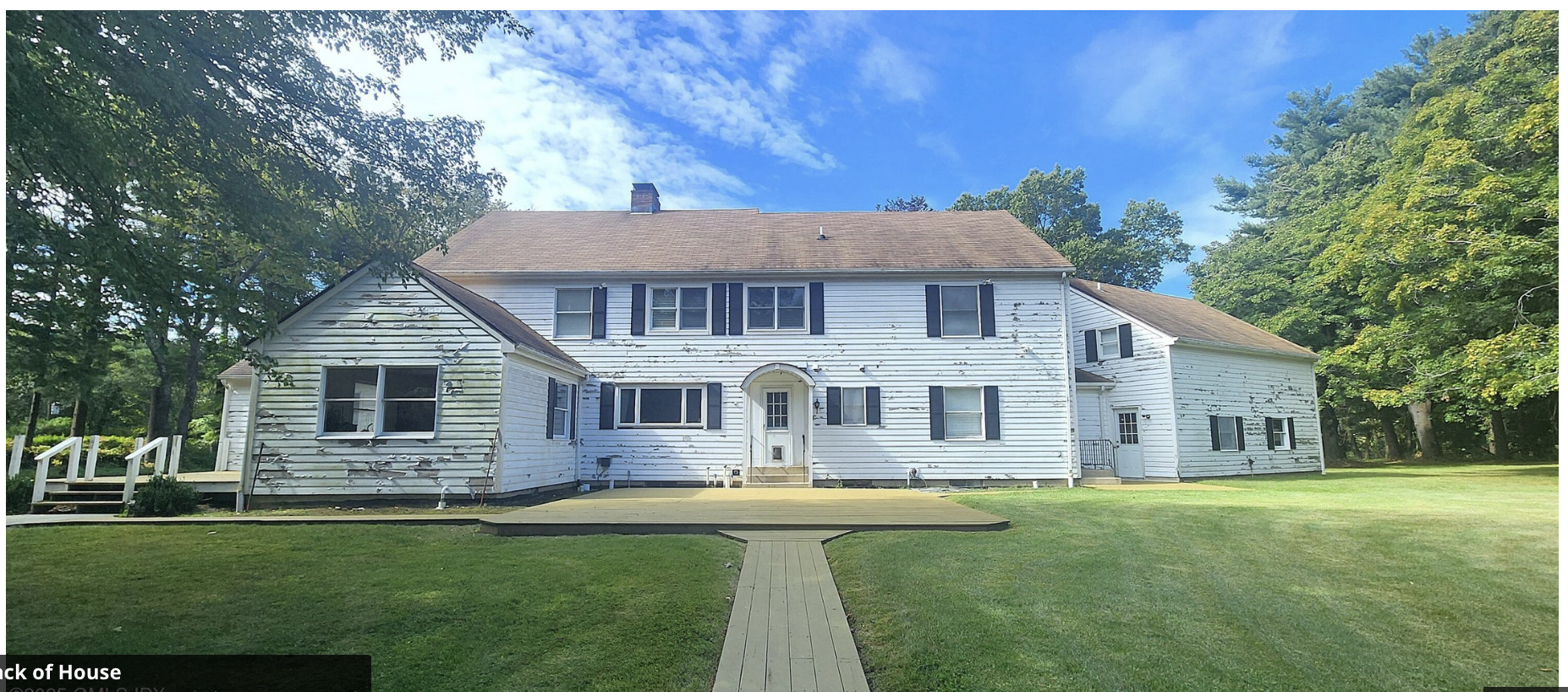
Price cut for distressed property on Cutler Road

85 Cutler Road, listed at $3.250 million in March, has been marked down to $2.750; it’s still got a ways to go.

The property’s been in the process of being foreclosed on since 2023, and that action may have been concluded, to the extent that these things are ever final. The owner paid $2.2 million for it in 2007 ($3.394 million, current dollars) and took out a $1.7 million mortgage from, who else, Washington Mutual. WaMu’s gone now, but not the mortgage: $1,688,467.18 of the principal remains unpaid; looks as though the first few monthly payments were made and then … pfft. Total debt now, as asserted by the holder of the mortgage and confirmed by the court, is $2,704,447.56.

High and dry on Valley Road — in this case, that's not a good thing

232 Valley Road, built on spec in 2017 was on the market from July to November 2018, beginning at $2.999 million and dropping to $2.45 and finally shuffling off to that great builder’s graveyard in the sky. Now it’s back, and priced at $3.999. The price has changed, but not the topography, and that’s a problem.

There was a deal reached on this property in April ‘22 that went as far as pending status that June, but things fell apart, and it was returned to the active roster that July. That listing expired in November 2022 and the house has stayed off the market until today, at this new improved price. Good luck with that.

Who would ever have expected this?

no one to see here, move along, move along

Require landlords, not renters, to pay a broker’s fee, and surely those landlords will simply eat the cost rather than pass them on to tenants, right? Right? No one on the City Council ever worked a real job or studied even basic economics, so results like these continue to astonish them.

End of broker fees drives up rent in NYC overnight. Will renters leave the city?

Keeping as close an eye as anyone on New York City's luxury rental market, Douglas Elliman broker Keyan Sanai is convinced that landlords will be hiking rents by hundreds of dollars a month as a result of a new law on broker fees.

Will that prompt a new stampede to suburban markets like Connecticut? No chance, Sanai says, noting sky-high occupancies in New York City today, five years after the COVID-19 pandemic drained apartment buildings in what turned out to be a short-lived outbound migration.

Under the new Fairness in Apartment Rentals Expenses Act that took effect in New York City on Wednesday, landlords must cover fees that tenants had previously been paying brokers for available rental listings. Landlords that fail to do so can be forced to pay restitution by state regulators, and can be sued for noncompliance.

Sanai, a Manhattan-based broker for Douglas Elliman, says many listings on Zillow's StreetEasy website and others suddenly became more expensive overnight as the new rules took effect — in the midst of the prime lease season that runs through September.

"The data's there — 1,000 listings fell off StreetEasy within 24 hours," Sanai said. "Every single landlord is baking it in, in some capacity. The question is, what percentage are they baking in?"

While renters will save moving costs up front by not having to pay a broker fee, Sanai believes that they will pay more over time as rents reset to higher rates, particularly those who stay more than a few years in the same apartment. Still, he believes the vast majority of New York City renters will just pay more rather than contemplate a move out of the city, noting occupancies have stayed high despite overall rent inflation and other costs of living in the past few years.

Manhattan had the sixth hottest rental market in the country heading into the spring and summer apartment hunting season, according to Rent Cafe analyzing data from Yardi Metrix. The Stamford-Bridgeport corridor was tied with Brooklyn for eighth place on the study.

"There's a couple of things you can bet on with absolute certainty," Sanai said. "You can bet on the fact that New York City will always come back."

Sanini will be proved wrong about the city’s prospects if the voters put a socialist/communist in office, as seems likely; at least, that’s what “the Experts” say, and when have they ever been wrong? Still, stopped clock and all that, and their prediction seems at least plausible, because how much punishment is the middle class willing to endure?

Socialist NYC mayoral hopeful Zohran Mamdani will trigger mass exodus with tax hike plot to pay for $10B policies, experts warn.

I don't think so, fella

CHARLES BREYER, D.O.B. NOVEMBER 3 1941. HIS PORTRAIT, THOUGH OBVIOUSLY GROSSLY OUTDATED, WOULD SEEM TO STILL CAPTURE THE PERSONALITY OF THIS SMUG OCTOGENARIAN

Federal judge questions constitutionality of Trump sending National Guard to LA riots: ‘President is, of course, limited’

WASHINGTON — A federal judge on Thursday ordered the Trump administration to “return control” of thousands of National Guard troops that had deployed to Los Angeles to quell anti-ICE riots to the state of California.

Senior San Francisco US District Judge Charles Breyer issued the order after hearing arguments from attorneys for Trump’s Justice Department and California Gov. Gavin Newsom after the Democrat had sued the feds over dispatching roughly 4,000 Guard members to protect officers carrying out immigration enforcement operations.

“At this early stage of the proceedings, the Court must determine whether the President followed the congressionally mandated procedure for his actions. He did not,” Breyer wrote in his order.

“His actions were illegal—both exceeding the scope of his statutory authority and violating the Tenth Amendment to the United States Constitution. He must therefore return control of the California National Guard to the Governor of the State of California forthwith.”

“That’s the difference between a constitutional government and King George.”

Brett Shumate, the head of the DOJ’s Civil Division, disputed Breyer’s characterization of the president’s order throughout the 70-minute hearing, arguing that the commander-in-chief had “delegated” the federalizing of the Guard through California’s adjutant general, as legally required.

Shumate also claimed that Newsom was merely a “conduit” for that order as it passed through the chain of command from Trump to Defense Secretary Pete Hegseth to the state Guard.

“There’s no consultation requirement, pre-approval requirement,” he argued. “There’s one commander-in-chief of the armed forces.”

The underlying statute that Trump invoked permits a president to call up the National Guard when threatened by an invasion of a foreign nation, “rebellion or danger of a rebellion” against the government or if law enforcement is unable “to execute the laws of the United States.”

Breyer’s line of questioning focused on how orders for the federalization of National Guard forces “shall be issued through the governors of the States.”

While Breyer took issue with the deployment of the National Guard, he appeared more inclined to let stand Trump’s order sending around 700 US Marines to the Golden State to assist with the federal immigration crackdown.

“I don’t understand how I’m supposed to do anything with the Marines, to tell you the truth,” the judge responded, quibbling with Espiritu over whether their involvement violated the Posse Comitatus Act.

Breyer did not immediately issue a ruling, but said he hoped to put one out “very soon.”

In a brief filed with the California court before the hearing, the Justice Department stated: “Courts did not interfere when President Eisenhower deployed the military to protect school desegregation. Courts did not interfere when President Nixon deployed the military to deliver the mail in the midst of a postal strike. And courts should not interfere here either.”

CONTRA, JUDGE BREYER:

When the federal government took control: The last time troops were deployed without a state’s request

BIRMINGHAM, Ala. (WBRC) - In 1965, the federal government made a rare and decisive move. It sent National Guard troops into Alabama — not by invitation, but by federal order.

President Lyndon B. Johnson federalized the Alabama National Guard to protect marchers traveling from Selma to Montgomery. The deployment came after Alabama Governor George Wallace refused to ensure the demonstrators’ safety, despite a federal court order affirming their right to march.

Barry McNeely, historian at the Birmingham Civil Rights Institute, said the moment laid bare the limits of state authority when challenged by the federal government.

“When we think of Alabama, outside of the Selma to Montgomery March and Bloody Sunday, probably one of the most iconic things from the civil rights movement was when George Wallace stood in the schoolhouse door at the University of Alabama,” McNeely said. “That was performative. They both knew where the power lay in that situation. Wallace wanted to make a political scene, even though he didn’t have the authority to usurp the federal government.”

Once the court upheld the demonstrators’ right to march, federal troops were mobilized under presidential command. The National Guard, no longer under Wallace’s control, escorted the marchers to the steps of the state capitol.

“It would have been ludicrous to assume they would’ve had safe passage without that intervention,” McNeely said.

The federal action was grounded in the Insurrection Act of 1807, which allows the president to deploy troops if a state obstructs the enforcement of federal law. But it was also a clear exercise of constitutional supremacy.

“These are the moments when federal and state governments have to work together,” McNeely said. “And sometimes they don’t agree. But in any argument between the two, the federal government is going to win out. That’s the Supremacy Clause.”

McNeely said the decision wasn’t just about politics or precedent — it was about public safety.

“There were long days and nights ahead on the road to Montgomery,” he said. “And the President had to consider not just his party or political allies, but how to protect people’s lives.”

This wasn’t the first time a president used federal power to overrule a state. President Dwight D. Eisenhower sent troops to Arkansas to enforce school integration. President John F. Kennedy placed the National Guard on standby during protests in Birmingham.

“Johnson simply followed the pattern of federal power being used when state leaders refused to act,” McNeely said.