Contracts
/25 Cove Road, Lucas Point, $5.995 million.
formerly known as ….
And in Cos Cob, 219 Orchard Street, $3.195 million.
Greenwich, Connecticut real estate, politics, and more.
Greenwich, Connecticut real estate, politics, and more

25 Cove Road, Lucas Point, $5.995 million.

formerly known as ….
And in Cos Cob, 219 Orchard Street, $3.195 million.


67 Bedford Road, 4.31 acres, priced at $2.895 million. Nothing unusual about that, but what caught my eye is that the owner paid just $1.365 million (in a price war that began at $1.299) in March, 2024 and has done nothing to it since. That’s a lot of appreciation over such a short time.
"Israel is murdering children!!!! Now excuse me, I have to go to the rally for Lindsay Clancy."
— Kamel Amin Thaabet (@K_AminThaabet) August 21, 2026


Or just stupid
Absolutely incredible…
— Geiger Capital (@Geiger_Capital) August 22, 2026
Mark Cuban: "California is run terribly. The taxes are insane. That’s why people keep moving to Texas."
Mark Cuban (10 minutes later): "Vote for James Talarico. Turn Texas blue. What have Republicans ever done for the state." pic.twitter.com/nSSKVodXgK


The Bee has discovered Groks new future:
Liberal White Women Stand Weeping Outside Court Trying Jack The Ripper pic.twitter.com/n075Ed7zXF
— The Babylon Bee (@TheBabylonBee) August 22, 2026

Start with this:
DSA's 'Media training' is literally telling people to not answer questions about their own platform which means they know it's indefensible pic.twitter.com/lLN86KYwJl
— Arash Azizi آرش عزیزی (@arash_tehran) August 11, 2026
That adds a new factor to consider when watching these morons below apparently struggle to answer hard questions about DSA’s goals and their implications; not all of these communists may be as dumb as they sound, and certainly the puppet masters aren’t.
DSA Co-Chair Megan Romer says "We believe in taxing the hell out of millionaires."
— Western Lensman (@WesternLensman) August 7, 2026
She then struggles to explain what that actually means:
Remnick: "What does 'taxing the hell out of them' mean?"
Romer: "Yeah. You know, again, I don't have, like, a solid…"
Remnick: "But… pic.twitter.com/JMKW1egLM9
(cont.) "But shouldn't you?"
Romer: "Ummmmm, that's a good question."
Remnick: "If you're the co-chair of the DSA, shouldn't you be more specific than just taxing the hell out of something? What exactly do you mean?"
Romer: "So again, it's democracy, right?…" This is the Democrat party 'Big Tent.'
MAHER: “Two stories from this week, I think, will show you that this has now infected our political discourse.
Megan Romer, she is the co-chair of the DSA. She was on David Remnick’s podcast, and she talked about taxing the hell out of them. And he said, what do you mean by that? And she said, well, you know, I don’t really have a solid, and then just dribbled off. And he said, ‘But shouldn’t you? Shouldn’t you be more specific about what taxing the hell means?’ They don’t know anything.”
JEREMY PETERS: “By the way, there’s been a slew of interviews just like this where candidates who represent the Democratic Socialists of America have really struggled to articulate how they don’t subscribe to communism, whether or not they really believe in Marxism, and basic facts about how their ideology would help them govern the United States out of this affordability crisis.”
“By and large, a lot of these candidates come out of the activist wing of the party... They’re very into reading Karl Marx and left-wing theory, and we’ve seen time and time again that a lot of them just don’t withstand the scrutiny.”
The DSA’s Marxist Unity Group caucus states its own goal is to create “a fully liberated classless society. In a word, communism.” When they tell you who they are, believe them.
And:
A socialist leader squirmed during a tense Sunday interview after a local California television anchor pressed her on the real-life ramifications of the radical party's calls to abolish police and prisons.
In an interview with NBC 4 Los Angeles, anchor Conan Nolan posed pointed questions to Democratic Socialists of America (DSA) National Political Committee Member Frances Gill on the topics of law enforcement, immigration and the movement's other far-left proposals.
After a brief back-and-forth over what defunding the police means and how that would be applied in practice, Gill resorted to deflecting by refusing to engage in 'hypotheticals.'
"What we really want to see is a horizon where folks are not reliant on armed enforcement to meet our public safety needs," Gill conceded.
"Right, but it says 'defund police' on your website — that's your goal — and also to get rid of prisons and jails, correct?" he pressed, to which Gill answered affirmatively.
"So if my daughter is assaulted and raped, is there any agency that would seek to find her assailant and bring him to justice?" asked Nolan.
"Of course, yeah of course—" said Gill before the host jumped back in with a follow-up question.
"What would it be if not police and where would he be if not a jail?" asked Nolan.
"So I guess I really want to avoid getting caught into these hypotheticals and talk about the reality that we're actually facing right now," Gill dodged.
That reality, she said, is the city spending "outrageous amounts on police and policing," instead of addressing real issues plaguing Los Angeles. She suggested that the lack of street lights, substance abuse treatment and mental healthcare are all contributing to a lack of public safety and rise in crime.
…. On the issue of border security, Gill became defensive and questioned whether Nolan was acting in "good faith" when he quizzed her about whether there would be any border security if, like the DSA promotes, U.S. Immigration and Customs Enforcement (ICE) was abolished.
"I guess I don't understand why we kind of constantly get pinned on these particular questions when the immediate reality of the situation is that immigration enforcement is absolutely out of control, needs to be addressed immediately and we know that in Los Angeles, like, more than almost any other city in the country," she said.

Six years after some numbnuts visited, discovered the absence of Free Willy and Flipper, and posted a one-star review on line, some sharp-eyed genius in the New Bedford Whaling Museum spotted a marketing opportunity and struck (sperm) oil:
The New Bedford Whaling Museum in Massachusetts is cashing in on a viral bad review.
The Google review was left by a disappointed guest back in 2020 who called the whaling museum the "worst aquarium ever," leaving just one star. …. the marketing department couldn't let the blistering review go, turning it into a product line, including shirts and tote bags.
In just one week, the museum's sales soared 250% due to the viral merch.
A museum is cashing in after a one-star Google review calling it the "worst aquarium ever" became an unexpected viral hit.
The New Bedford Whaling Museum in Massachusetts, which highlights the history, science and art of whaling rather than marine animals, embraced the one-star review by boldly printing the phrase on T-shirts, sweatshirts and tote bags.
"A few weeks ago, we added to the ‘Worst Aquarium Ever’ merchandise line with a new crew neck T-shirt and tote bags," Amanda McMullen, president & CEO of New Bedford Whaling Museum, told Fox News Digital.
"Since July 20, we have had more than 2,400 orders from all over the globe."
McMullen said she's thrilled. "We are filling orders so quickly that hundreds of boxes and packages are heading out every day," she said.
"We’ve gotten to know our postal carriers very well," she added.
"It's honestly a great museum," a user commented. "I love that it's gone viral because it's just a wonderful place to support."
I’ll definitely have to visit and while I’m there, stock up on gift garb. A tad pricey, I suppose, but the proceeds are going to the museum, not Sam Walton’s leftwing heirs, so no whining from me.


I saw this story this story this morning, and, while I remember the original 2021 incident, I never learned its outcome. Now that I have, I’m shocked that his claim of self-defense was rejected by a jury. Assaulted and yanked out of his car by a drunken, angry man shouting “you ruined my life, I’m going to kill you”, the elderly lawyer pulled his gun and shot the stranger dead. So what’s wrong with that?
While his appeal has been successful, the verdict was overturned on what was essentially procedural grounds, leaving him still in prison, and the state free to try him again. I don’t like it.
An appeals court on Friday threw out the manslaughter conviction of Robert Fisher, a former Litchfield attorney, ruling that the judge overseeing the trial erred by failing to disclose he applied to serve as the Inspector General.
The position is under the Division of Criminal Justice, the same state agency that was prosecuting Fisher through the state’s attorney’s office.
The judge's application for the position while presiding over the trial "created an appearance of a lack of impartiality," the opinion said. It said the judge, Eliot D. Prescott, should have either disqualified himself, or "disclosed his application to the parties and obtained their waiver prior to proceeding with the trial."
The appeals court opinion reversed Fisher's conviction and remanded the case for a new trial.
Attorney Jon Schoenhorn, who represented Fisher in his appeal, said he intends to file a motion asking a judge in Torrington to release Fisher on conditions.
“He’s over 80 years old now, he’s in very poor health," Schoenhorn said Friday. "I think justice calls for his immediate release while the future appellate proceedings play out."
He said the case could take months or even a year of additional litigation, and noted the state also has the right to bring a new trial.
Prescott was appointed to a four-year term as inspector general last year. His office is responsible for investigating police shootings and in-custody deaths, and can bring criminal charges if they're determined to be warranted.
Here’s the report on the 2025 conviction:
TORRINGTON — A jury on Friday found 78-year-old attorney Robert Fisher Jr. guilty of manslaughter in a fatal shooting outside the lawyer's Litchfield office four years ago.Three hours after starting deliberations, the jury of six's guilty verdict was delivered at approximately 4:30 p.m.
The jury heard four days of evidence in Superior Court, then closing arguments from attorneys and instructions from Judge Eliot D. Prescott Friday morning that focused on whether deadly force was a justifiable outcome.
….. Litchfield County State’s Attorney David Shannon showed the Ruger pistol, its firing mechanism locked, to jurors during his closing argument.
“He had a duty to retreat,” Shannon said. “Was this degree of deadly force necessary to avoid physical injury?”
Shannon demonstrated Fisher’s act of pulling the pistol, within a small holster, from his pocket. Instead of firing through the holster in a panic, Shannon said, Fisher took the time to remove it, then aimed a red dot laser beam at Matthew Bromley, 39. The dot showed the shooter where the shot would end up as the gun was ready to be fired.
The single shot ultimately lodged near Bromley’s left eye, killing him almost instantly.
“If he could have retreated without injury, he had a duty to do that,” Shannon said. “He brandished a weapon when all he had was a fat lip. It was about anger and pride, his desire for payback and refusing to be a victim. How dare this little man assault him in his parking lot.”
The state and defense agreed that still unexplained motives on that afternoon of June 7, 2021, began when Bromley followed, then pulled alongside Fisher’s car outside his Litchfield law firm. The 111-pound younger man reportedly began throwing punches and spit at Fisher, claimed Fisher had ruined his life, hurled expletives and said he was about to kill Fisher.
Shannon claims Fisher had an opportunity to retreat as — according to one eyewitness — the confrontation seemed briefly over before reigniting at the back of Fisher’s car. Defense attorney William A. Conti claims his frail client did not have that opportunity within the minute-long confrontation.
“You can’t bring a gun to a fistfight,” Shannon said.
[I’ll point out that Fisher didn’t bring a gun to fistfight, his assailant brough the fight to him — Ed]
[His defense lawyer] Conti countered that Fisher could not run or retreat to his car due to a variety of medical ailments, a claim substantiated by his doctor. Fisher feared for his life, was told he was about to die and believed it, Conti said.
“He could not drive away, couldn’t close the door, because Mr. Bromley was there,” Conti said. “Retreat, by state statute, must be in complete safety.”
Conti reminded the jury of evidence he presented that painted a fluid scene, first of Fisher being pulled from the Audi as he began to exit it. They never separated, Conti said. Bromley was angry, aggressive and out of control, he said. His blood alcohol level was 0.11, over the legal limit of .08, which could have fueled the aggression.
“There was no way he could get away from him,” Conti said. “Mr. Fisher was pushing him back. ... He had seconds to decide how to save his life.”
Prescott explained the only charge jurors must consider — manslaughter in the first degree. He instructed the three female and three male jurors to set aside sympathy or concerns about possible punishment during their deliberations.
“A person is justified in using reasonable physical force to defend himself from what he believes to be imminent physical force,” Prescott said. He asked jurors to consider what a reasonable person in the circumstances described would have the same beliefs as Fisher did, and to know that self-defense is defensive and not retaliatory.
Friday marked the fifth consecutive day of the trial at state Superior Court in Torrington. Fisher was convicted of manslaughter with intent, a downgraded offense after he initially was charged with first-degree manslaughter in the shooting.
Testimony involved forensic experts, police officers and other attorneys who have known Fisher for years. Fisher also took the stand in his own defense.
“I started to open the door, he grabbed the door or the window and pulled it open all the way,” Fisher testified Tuesday. “He reached in and punched me in the side of the face on the left side of my jaw. He yelled 'You are a (expletive) and (expletive) and you ruined my life. I am going to kill you.' Then he spit in my face.”
Fisher continued: “I was in fear. He was so impossibly angry his face was contorted with rage. I have never seen anything like it. I undid my seat belt and kicked him so he would be farther away. … I got out of the car to face him. … He charged me in the chest. He was shouting. 'I am going to kill you.'”
WTF?

off to afghanistan on a USAID tour
As we watch billions, trillions of dollars being flushed down the toilet by both federal and local governments, focusing on a $75,000 giveaway seems trivial, but it can be hard to imagine a billion dollars, while a $75,000 payment that’s equal to what an ordinary taxpayer might pay after a year’s labor is easier to visualize the complete lack of care with which those trillions are dispersed.
David Strom:
I wish I could say you would only see something so absurd in San Francisco, but I happen to know that such idiocy happens throughout the United States at all levels of government.
The U.S. pours enormous resources into the arts and culture, and the argument for doing so has a surface plausibility. After all, if you step back and take a look at the vast sweep of history, aside from the rise and fall of empires and various earthshaking events, what we actually know of and recall from history is the arts and architecture.
…. Unfortunately, the impulse to promote greatness that motivates us to fund the arts is the foundation for a con. Art is not something a bureaucracy can create or support, and the effort only winds up subsidizing crap.
If you have noticed those weird sculptures outside government buildings, they are the result of programs that require spending some percentage of the spend on "art." The product is what I call 'art droppings,' which are like pigeon droppings, only you can't wash them away.
Worse, though, are the grants given to arts organizations, which are basically graft, like this:
San Francisco is spending $75,000 to “dismantle White supremacy culture” in circus performers and support “equity in circus arts.”
— Natalie Winters (@nataliegwinters) August 19, 2026
I’m not kidding. pic.twitter.com/lVNdIOrfyY
Seventy-five grand to advance equity in circus arts.
Huh? What?
As you can see, the recipient BACCES has a record of great accomplishments, which includes cramming all the right buzzwords into a name. BIPOC. Collective. Care. Ecosystem.
Acro? Apparently that stands for acrobats, I think. We are decolonizing acrobats.
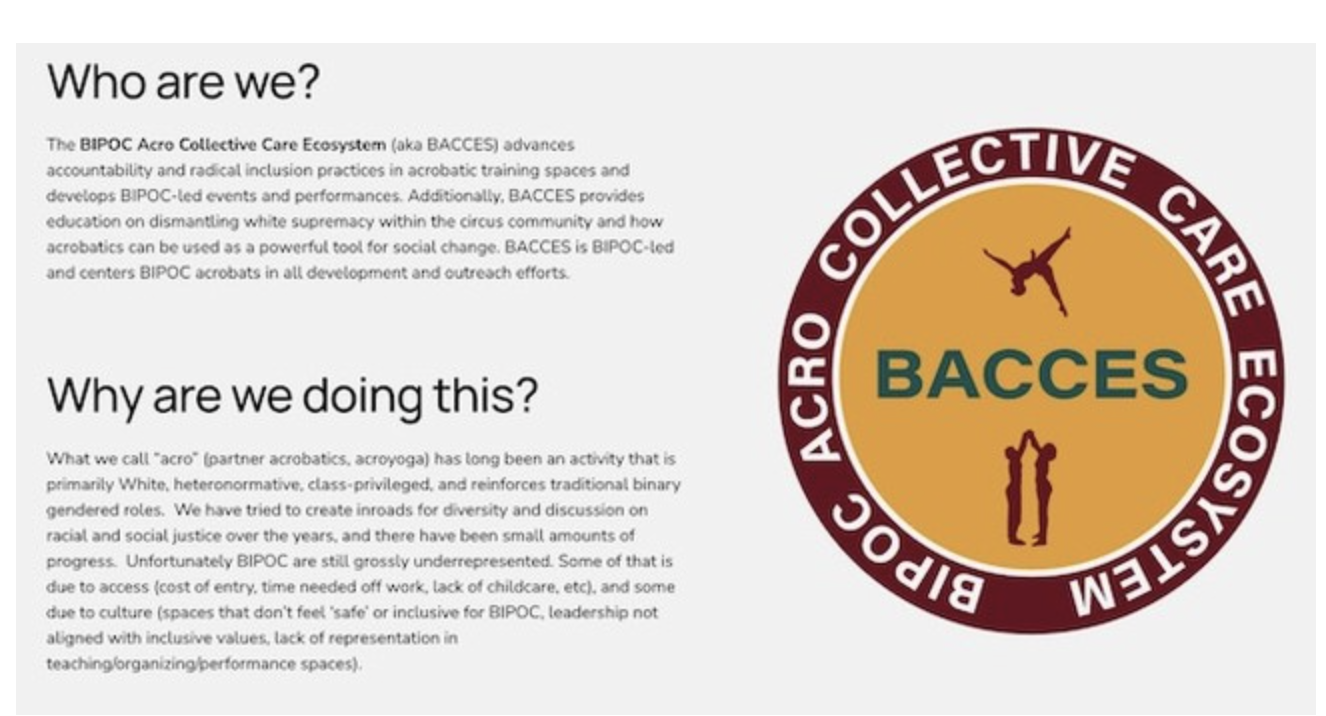
San Francisco apparently is plagued by racism in acrobatics, and thank God the city government can scrape together a few dollars to do "capacity building" to address the problem.
"Capacity building," of course, is just another term for giving money to support people who do nothing useful, and in a place like San Francisco that just means handing out spending money to these otherwise useless people.
This is, in fact, the sort of thing that arts spending tends to go to. I remember that during my brief stint in government I did research for a committee that wasted money on art, and a few things became clear: one, no legislator gave a damn because it was "free money" and didn't affect their constituents; two, the big arts institutions supported throwing money at stupid projects because it built an activist constituency for the funding, which means that they can send annoying brownshirts to get legislators to up the budget to get some peace and quiet; three, when nobody watches the money, it goes down a rathole.
We spent money on sending failed artists to Paris. We funded arts in North Dakota because Minnesotans sometimes go there. We sent money to NGOs that did, as far as anybody knew, absolutely nothing but write grant proposals.
If you were lucky, you would never hear from any of them again, but alas, every two years there are new funding rounds.
The feds do this. The states do this. The counties do this. The cities do it.
Every dollar is a scam.
Don't get me wrong. I like museums that contain art. I think that a culture without art is not a culture worth having. As ineffable as the return on art is, it is what will survive a millennium from now from a long-vanished culture.
But you can't do art by committee, and that includes funding it. Institutional art generally sucks. Art that is celebrated by the "arts community" generally sucks. And when you create a slush fund for art, you get lots of sludge.
Like BACCES.
Or like our own state’s “Rocks in the Head” “sculpture":

“Stone Field Installation”, Hartford, CT — $100,000 paid in 1977 ($571,000 current dollars). Back in 2015, when utility workers mistakenly daubed them in orange paint during a roadwork project, local artist Tao LaBossiere who was overseeing the cleanup was understanding: “You couldn’t blame them for not seeing it as artistic expression,” LaBossiere said. “It looks like rocks in the park.” Exactly.

Another price cut for that former NFL quarterback and TV announcer’s house at 640 Round Hill Road: From $8 million in February to $7.5, to $6.9 to, today, $6.2. It’s a beautiful old (some parts of it dating to 1725) house, but it’s in SOBA, and that’s a long haul to Greenwich, which reduces a home’s, especially an older home’s, appeal to many buyers.

10 Gaston Road has sold for its full price of $3.950 million to a California (Encino) refugee family.
One quarter of Connecticut’s population is on Medicaid. Soon a small percentage: 11.7% of those recipients: able-bodied adults between the ages 19-64, who are not pregnant or the primary caregivers of young children or disabled dependants, are going to be required to show that they are doing something to either give something back to their community or prepare to be a useful member of society. According to Democrats and the medical service provider industry, there’s been nothing as barbaric as this since the beginning of time; or 1935 through 2010, take your pick. In fact, this will merely return things to where they’ve been from the start.
Federal changes to Medicaid, known as HUSKY in Connecticut, take effect Jan. 1, 2027.
Connecticut officials are gearing up for sweeping changes to Medicaid, the joint federal-state program that provides insurance coverage for low-income Americans. Medicaid, known as HUSKY in Connecticut, covers around 939,000 residents, or a quarter of the state’s population.
Come January, federal policy changes to Medicaid eligibility — passed as part of House Resolution 1, also known as the “One Big Beautiful Bill” — will go into effect. Many state officials and industry leaders are warning the changes will lead to massive losses in coverage.
The state Department of Social Services, DSS, estimates that roughly 110,000 residents stand to lose their HUSKY coverage unless they can demonstrate compliance with new requirements.
Work, volunteer, or learn a skill; oh, the horror!
Under the new federal policy, beginning Jan. 1, Connecticut residents with HUSKY D — the Medicaid program for low-income adults without dependents — must meet “community engagement requirements” by proving they work at least 80 hours or earn a minimum of $580 per month.
Enrollees can also fulfill the requirement by demonstrating at least 80 hours of monthly participation in school, community service or a qualified training program. Some people, like those already meeting work requirements for SNAP, or those enrolled in a substance treatment program, are exempt from the work requirements.
I knew, in a general way, that it was always thus execept during the Biden term, but I asked ChatGTP for detqails:
Answer:
Yes. Your memory is basically right, with one important distinction: work requirements have a long history in American cash welfare, but until very recently they were generally not a condition of Medicaid eligibility itself. [Buts ee below, for why; spoiler alert: the entitlement programs just grew, and grew, and grew — Ed]. The new HUSKY D requirement borrows a mechanism familiar from welfare policy and applies it to health insurance.
One small update to the article you read: the provision Connecticut is implementing is part of a new federal Medicaid requirement, not simply a Connecticut policy choice. Under current federal rules, affected adults generally must satisfy an 80-hour monthly “community engagement” requirement, or earn at least 80 times the federal minimum wage—$580 at the current $7.25 rate. States generally must implement it by January 1, 2027.
The lineage looks roughly like this:
1935–early 1960s: welfare was originally not supposed to put mothers to work. The original Aid to Dependent Children (ADC, later AFDC) program was conceived largely as a way of allowing poor widowed or single mothers to remain home and care for their children. There was no federal work requirement. Some states and localities nevertheless imposed their own work-related restrictions—including notorious rules requiring some mothers and older children to take seasonal agricultural work.
1962–67: the federal government begins moving toward work. Congress permitted states to establish community work-and-training programs in 1962. Then the Social Security Amendments of 1967, under Lyndon Johnson, created the Work Incentive Program (WIN). This is really the ancestor of what you're remembering. For the first time, federal AFDC policy combined incentives to take employment with requirements that certain recipients participate in employment and training.
1971–80s: the requirements became considerably tougher. This is probably the period you're remembering from the 1970s. The 1971 Talmadge amendments strengthened WIN and made participation substantially more compulsory. Mothers generally had to register for work or training unless they had a child under six (along with certain other exemptions), and refusal could result in a reduction in the family's welfare payment. Congress subsequently strengthened sanctions and job-search provisions.
So if your recollection is, "Didn't people receiving welfare already face work requirements in the 1970s?" — yes, absolutely.
The Reagan era pushed further toward the idea that able-bodied welfare recipients should perform work or work-related activities in return for assistance. States received greater latitude to experiment with workfare-type programs.
Then the bipartisan Family Support Act of 1988, signed by Reagan, replaced WIN with the JOBS program (Job Opportunities and Basic Skills Training). It generally required participation by mothers whose youngest child was three or older, while permitting states to lower that age to one.
That is an important point because the popular shorthand—"Clinton introduced work requirements"—is historically misleading. Clinton didn't invent them. They had been evolving for roughly three decades.
The Clinton-era reform was nevertheless a watershed.
The Personal Responsibility and Work Opportunity Reconciliation Act of 1996 (PRWORA) abolished the old federal entitlement, AFDC, and replaced it with Temporary Assistance for Needy Families (TANF). Instead of an open-ended entitlement to cash assistance for eligible families, states received block grants and had to meet federally specified work-participation targets. Recipients generally had to engage in work after a limited period on assistance, and federal cash assistance was subjected to a five-year lifetime limit (with exceptions and considerable state variation).
So the progression is approximately:
ADC/AFDC: We support needy children so their mother can care for them
→ WIN: We should encourage—and increasingly require—some recipients to work
→ 1980s/JOBS: Employment and training should be a normal expectation of welfare
→ 1996 TANF: Cash welfare should be temporary and explicitly conditioned on movement into work.
That's the history behind the word “workfare.”
Follow-up question on Medicare history
At the beginning, being poor by itself generally did not make you eligible for Medicaid. Today, in an ACA-expansion state such as Connecticut, it often does.
Medicaid was created by the Social Security Amendments of 1965, alongside Medicare. But the two programs were constructed very differently.
Medicare was essentially insurance for the elderly. Medicaid was grafted onto the existing welfare system. Its core beneficiaries were people who qualified for one of the existing cash-assistance programs—principally:
poor families with dependent children receiving AFDC;
poor elderly people;
blind people; and
people with disabilities.
In other words, Medicaid originally had two tests: you had to be poor and belong to an eligible category. Congressional Research Service histories describe the original program as essentially health coverage linked to receipt of cash welfare.
That produced a result that can seem peculiar now. Imagine two equally poor 30-year-olds in 1970. One is a mother receiving AFDC because she has dependent children; the other is a healthy, childless man with exactly the same income.
The mother could qualify for Medicaid. The childless man generally could not. His income could be zero and that alone didn't create Medicaid eligibility.
That's an enormous difference from modern Medicaid.
The national numbers make your intuition quite clear.
CMS's historical series shows approximately 4 million Medicaid enrollees in 1966, the program's first full year. By 1970 it was about 14 million, and in 1975 about 20.2 million. It then remained remarkably flat for a while: about 19.6 million in 1980 and 19.8 million in 1985.
For perspective, the United States had roughly 200 million people around 1970. So Medicaid was covering something on the order of 7% of the population, not 25%.
Then watch what happens:

Be notified of new posts! Sign-up here: