Get out of your house and off your ass — This generation of welfare dependants can’t do that, or won't?
/
One quarter of Connecticut’s population is on Medicaid. Soon a small percentage: 11.7% of those recipients: able-bodied adults between the ages 19-64, who are not pregnant or the primary caregivers of young children or disabled dependants, are going to be required to show that they are doing something to either give something back to their community or prepare to be a useful member of society. According to Democrats and the medical service provider industry, there’s been nothing as barbaric as this since the beginning of time; or 1935 through 2010, take your pick. In fact, this will merely return things to where they’ve been from the start.
CT health providers work to curb HUSKY losses from ‘Big Beautiful’ bill
Federal changes to Medicaid, known as HUSKY in Connecticut, take effect Jan. 1, 2027.
Connecticut officials are gearing up for sweeping changes to Medicaid, the joint federal-state program that provides insurance coverage for low-income Americans. Medicaid, known as HUSKY in Connecticut, covers around 939,000 residents, or a quarter of the state’s population.
Come January, federal policy changes to Medicaid eligibility — passed as part of House Resolution 1, also known as the “One Big Beautiful Bill” — will go into effect. Many state officials and industry leaders are warning the changes will lead to massive losses in coverage.
The state Department of Social Services, DSS, estimates that roughly 110,000 residents stand to lose their HUSKY coverage unless they can demonstrate compliance with new requirements.
Work, volunteer, or learn a skill; oh, the horror!
Under the new federal policy, beginning Jan. 1, Connecticut residents with HUSKY D — the Medicaid program for low-income adults without dependents — must meet “community engagement requirements” by proving they work at least 80 hours or earn a minimum of $580 per month.
Enrollees can also fulfill the requirement by demonstrating at least 80 hours of monthly participation in school, community service or a qualified training program. Some people, like those already meeting work requirements for SNAP, or those enrolled in a substance treatment program, are exempt from the work requirements.
I knew, in a general way, that it was always thus execept during the Biden term, but I asked ChatGTP for detqails:
Answer:
Yes. Your memory is basically right, with one important distinction: work requirements have a long history in American cash welfare, but until very recently they were generally not a condition of Medicaid eligibility itself. [Buts ee below, for why; spoiler alert: the entitlement programs just grew, and grew, and grew — Ed]. The new HUSKY D requirement borrows a mechanism familiar from welfare policy and applies it to health insurance.
One small update to the article you read: the provision Connecticut is implementing is part of a new federal Medicaid requirement, not simply a Connecticut policy choice. Under current federal rules, affected adults generally must satisfy an 80-hour monthly “community engagement” requirement, or earn at least 80 times the federal minimum wage—$580 at the current $7.25 rate. States generally must implement it by January 1, 2027.
The surprising part [to Chat, not to me — Ed]: this goes back well before Clinton
The lineage looks roughly like this:
1935–early 1960s: welfare was originally not supposed to put mothers to work. The original Aid to Dependent Children (ADC, later AFDC) program was conceived largely as a way of allowing poor widowed or single mothers to remain home and care for their children. There was no federal work requirement. Some states and localities nevertheless imposed their own work-related restrictions—including notorious rules requiring some mothers and older children to take seasonal agricultural work.
1962–67: the federal government begins moving toward work. Congress permitted states to establish community work-and-training programs in 1962. Then the Social Security Amendments of 1967, under Lyndon Johnson, created the Work Incentive Program (WIN). This is really the ancestor of what you're remembering. For the first time, federal AFDC policy combined incentives to take employment with requirements that certain recipients participate in employment and training.
1971–80s: the requirements became considerably tougher. This is probably the period you're remembering from the 1970s. The 1971 Talmadge amendments strengthened WIN and made participation substantially more compulsory. Mothers generally had to register for work or training unless they had a child under six (along with certain other exemptions), and refusal could result in a reduction in the family's welfare payment. Congress subsequently strengthened sanctions and job-search provisions.
So if your recollection is, "Didn't people receiving welfare already face work requirements in the 1970s?" — yes, absolutely.
Reagan and the 1980s
The Reagan era pushed further toward the idea that able-bodied welfare recipients should perform work or work-related activities in return for assistance. States received greater latitude to experiment with workfare-type programs.
Then the bipartisan Family Support Act of 1988, signed by Reagan, replaced WIN with the JOBS program (Job Opportunities and Basic Skills Training). It generally required participation by mothers whose youngest child was three or older, while permitting states to lower that age to one.
That is an important point because the popular shorthand—"Clinton introduced work requirements"—is historically misleading. Clinton didn't invent them. They had been evolving for roughly three decades.
What Clinton changed in 1996
The Clinton-era reform was nevertheless a watershed.
The Personal Responsibility and Work Opportunity Reconciliation Act of 1996 (PRWORA) abolished the old federal entitlement, AFDC, and replaced it with Temporary Assistance for Needy Families (TANF). Instead of an open-ended entitlement to cash assistance for eligible families, states received block grants and had to meet federally specified work-participation targets. Recipients generally had to engage in work after a limited period on assistance, and federal cash assistance was subjected to a five-year lifetime limit (with exceptions and considerable state variation).
So the progression is approximately:
ADC/AFDC: We support needy children so their mother can care for them
→ WIN: We should encourage—and increasingly require—some recipients to work
→ 1980s/JOBS: Employment and training should be a normal expectation of welfare
→ 1996 TANF: Cash welfare should be temporary and explicitly conditioned on movement into work.
That's the history behind the word “workfare.”
Follow-up question on Medicare history
Yes. Medicaid in 1965 was a much narrower program than Medicaid today, and the biggest conceptual change was not simply that the income cutoff was raised. It was that the government gradually stopped requiring a low-income person to fit into one of a few particular categories of deserving poor people.
At the beginning, being poor by itself generally did not make you eligible for Medicaid. Today, in an ACA-expansion state such as Connecticut, it often does.
What Medicaid was in 1965
Medicaid was created by the Social Security Amendments of 1965, alongside Medicare. But the two programs were constructed very differently.
Medicare was essentially insurance for the elderly. Medicaid was grafted onto the existing welfare system. Its core beneficiaries were people who qualified for one of the existing cash-assistance programs—principally:
poor families with dependent children receiving AFDC;
poor elderly people;
blind people; and
people with disabilities.
In other words, Medicaid originally had two tests: you had to be poor and belong to an eligible category. Congressional Research Service histories describe the original program as essentially health coverage linked to receipt of cash welfare.
That produced a result that can seem peculiar now. Imagine two equally poor 30-year-olds in 1970. One is a mother receiving AFDC because she has dependent children; the other is a healthy, childless man with exactly the same income.
The mother could qualify for Medicaid. The childless man generally could not. His income could be zero and that alone didn't create Medicaid eligibility.
That's an enormous difference from modern Medicaid.
And yes—the program was much smaller
The national numbers make your intuition quite clear.
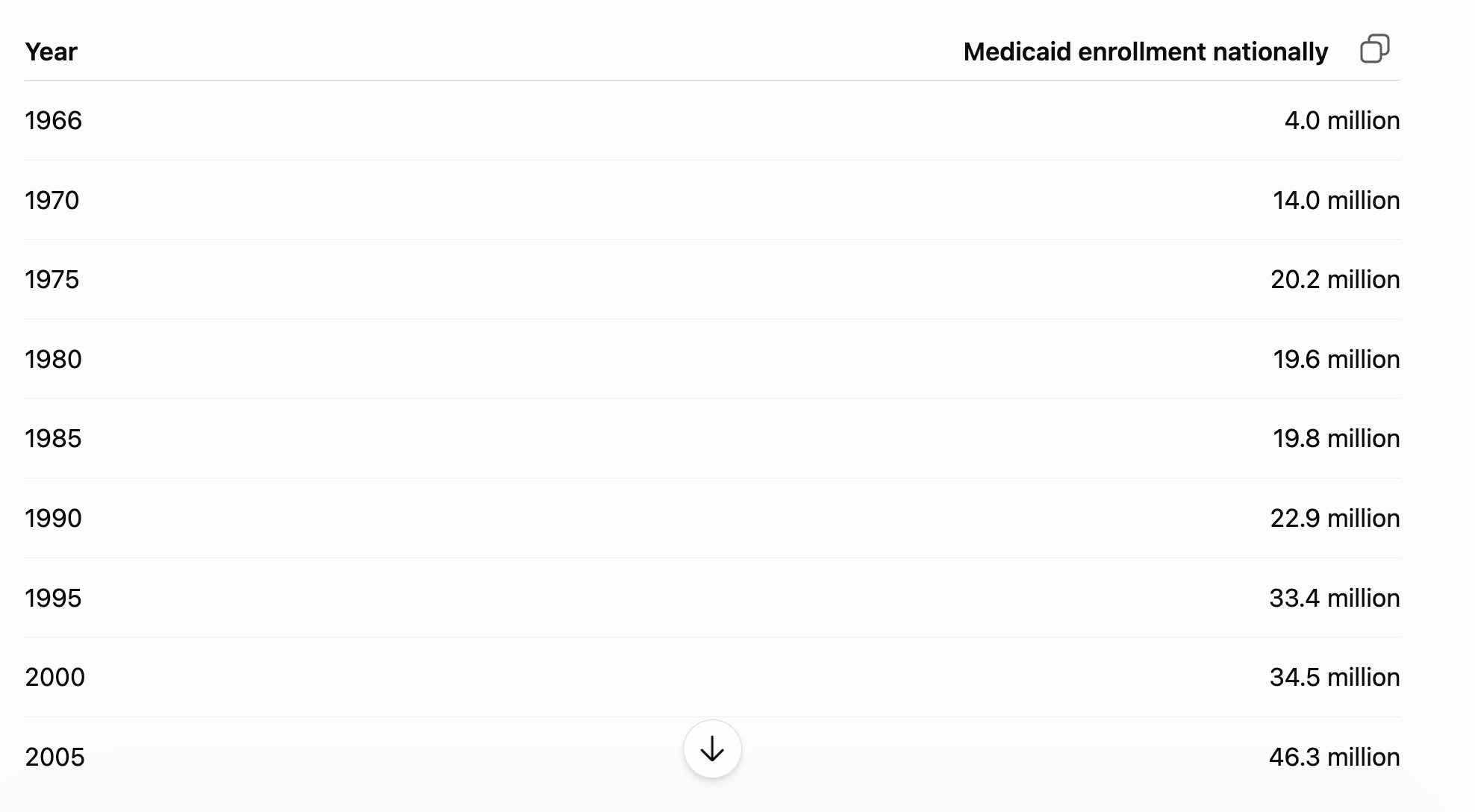
CMS's historical series shows approximately 4 million Medicaid enrollees in 1966, the program's first full year. By 1970 it was about 14 million, and in 1975 about 20.2 million. It then remained remarkably flat for a while: about 19.6 million in 1980 and 19.8 million in 1985.
For perspective, the United States had roughly 200 million people around 1970. So Medicaid was covering something on the order of 7% of the population, not 25%.
Then watch what happens: