And then there are the private equity vulture capital folks
/
“Look how many we’re firing! Look how much we’re saving by switching to plastic wrap!”
Ironic that one of these models posing as SVP cost-cutters is wearing a vest from an employee-owned competitor that also sells fishing waders, Patagonia. I suspect that the casting director had used and compared both brands and succumbed, however briefly, to a fit of honesty.
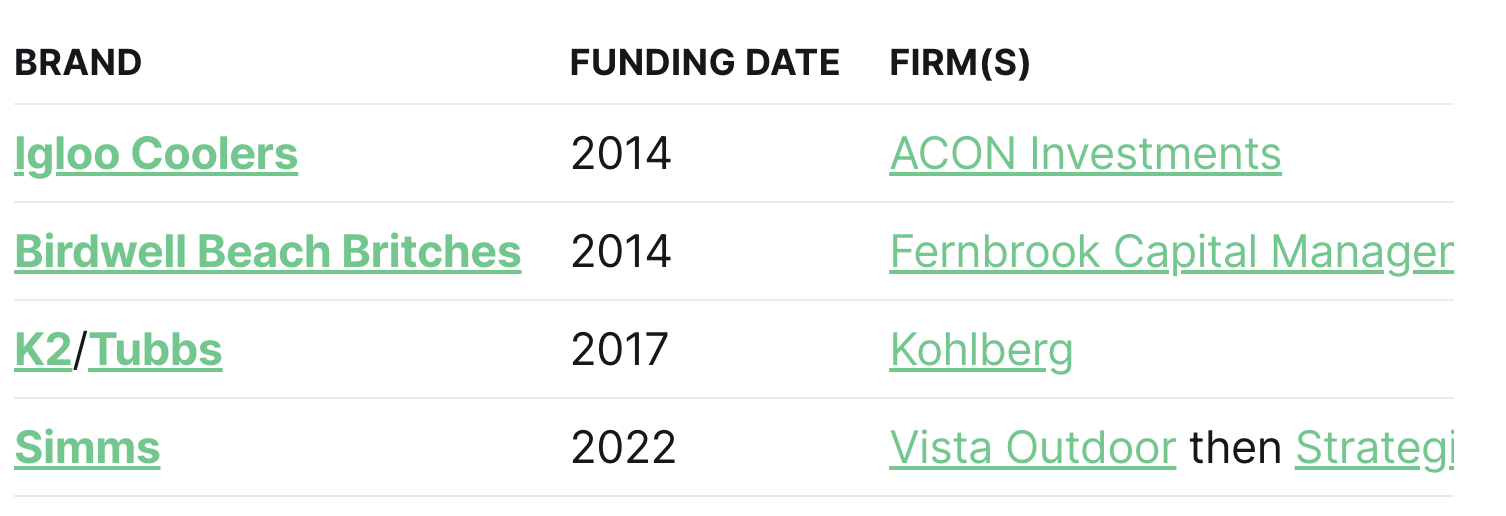
It’s a deal doubtless cooked up around a campfire and brandy snifters at Jackson’s Hole, and consummated in Greenwich at 100 W Putnam Avenue, with predictable results. I’ve owned a pair of Simms waders since somewhere around 2010, and they’ve been great; I’ll buy another brand when these finally wear out.
Private Equity Is Ruining a Beloved Fly-Fishing Brand, Retailers Say
Fly shops across the US are publicly dropping Simms after a private equity roll-up and broader turbulence in the outdoor industry.
December 18, 2025 at 11:00 AM UTC
Soon after opening his fly shop in Colorado in 1983, John Flick started stocking Simms Fishing Products. The brand was only a few years old, but its chest waders were already synonymous with quality. For decades, Flick and his co-owner watched as their store, Duranglers, which is blocks from the Animas River in Durango, grew alongside Simms as its waders, boots and accessories flew off their shelves.
But Flick’s loyalty was sharply tested by recent ownership and strategic changes at Simms that he says had eaten into his profit margins. In July he and his business partner made the tough decision to drop the brand from his store. “This is the direction we need to go to keep us healthy, but I didn’t want to because I felt so devoted,” Flick says. “But it got to a point where these people didn’t give a f—.”
…. Simms was sold again in January 2025, this time to private equity firm Strategic Value Partners (SVP) as part of a $1.1 billion purchase of Revelyst, a spinoff of Vista Outdoors that included Bushnell and Fox Racing brands.
About that time, Simms shifted its approach to marketing and distribution. The brand expanded its presence at big-box retailers such as Bass Pro Shops and Sportsman’s Warehouse, and it pushed licensing deals such as a partnership with the Grateful Dead, featuring a $169 hoodie embroidered with angling skeletons, which left some industry observers scratching their heads. Some of these changes aligned with recommendations on how to expand the brand from consultants at McKinsey & Co., according to former Simms employees who spoke to Bloomberg Businessweek on condition of anonymity for fear of reprisal. (McKinsey didn’t respond to requests for comment.)
An exodus of Simms employees that was already underway accelerated after the SVP deal closed. Some say the brand had forgotten its soul. “Things were so screwed up in early 2025, I just couldn’t deal with it anymore,” says Scott Harkins, a former sales rep who left Simms in April after 13 years of working with once-loyal retailers in Colorado, New Mexico, Utah and Wyoming.
Smaller, specialty fly shops struggled to compete on pricing with larger sellers and Simms itself, which had already been a challenge. In May, Simms sent out a new contract to some of its authorized independent retailers that set nonnegotiable terms on pricing. Several owners say they felt betrayed. The relationship with Simms used to feel like a “partnership,” says Charlie Craven, owner of Charlie’s Fly Box in Arvada, Colorado, which dropped Simms this summer after more than 20 years of carrying the brand. “But these days it’s ‘the Simms way.’”
Leading global fly fishing brand sold for second time in two years
The sellers at Vista were certainly pleased.
Vista Outdoor co-CEOs Eric Nyman and Jason Vanderbrink said they were excited about both deals in a memo to employees.
“We are thrilled to have concluded the extensive process our Board and management undertook over the past two years to unlock the value of our Outdoor Products and Sporting Products businesses,” they said in the memo. “We are confident these transactions maximize stockholder value while also pursuing the best path forward for our company, stakeholders and valued employees.”
“The Board has worked tirelessly to deliver maximum value to its stockholders and we are pleased to have reached agreement with SVP to help us achieve that objective,” said Michael Callahan, Chairman of the Vista Outdoor Board of Directors
Nyman and Vanderbrink will receive $1.2 million in bonuses upon the completion of Vista’s strategic review. Four other executives at Vista Outdoor were granted $500,000 retention bonuses.
Not bad for two years’ ownership.
And another perspective:
Brand Dead: Is private equity ruining fly fishing gear?
A surefire sign your favorite outdoor brand is doing the old private equity shuffle? A Grateful Dead collaboration.
Sep 22 2025; Simms announces a Grateful Dead collab
Simms, the most storied and trusted brand in fly fishing waders, splashed out this fall. It's trying to bring a different kind of funk. Simms did a licensing deal with the Grateful Dead and launched the "Dead on the Water" collection of waders, shirts, and hats.
Simms' flagship wader model, the Grateful Dead G3 Guide Waders, will run you $1,000. They command a $250 premium over the standard G3, Simms' top-of-the-line guide wader. For that extra $250, here's what you get: "Grateful Dead pocket and trim elements" and "a Grateful Dead fly patch". The collection also includes T-shirts and hats.
…. Ultimately I'm concerned because I've heard this jam before. Enough times for it to feel familiar, in an economic sense. For some outdoor brands, a Grateful Dead tie-in is a marketing effort that signals private equity is fully in control. It's an easy tune that's part of the unofficial PE songbook, to reach a mass of buyers who might not mind if the waders don't last. For a brand like Simms, I worry this means its vaunted product quality may be headed down the river for good.
… The PE playbook is simple
The playbook is pretty simple, with a few variations: A private equity firm buys a company it considers undervalued, cuts costs, gooses growth, and then sells it along to someone else, sometimes bundled up with similar assets, sometimes after stripping out the valuable parts and selling those off.