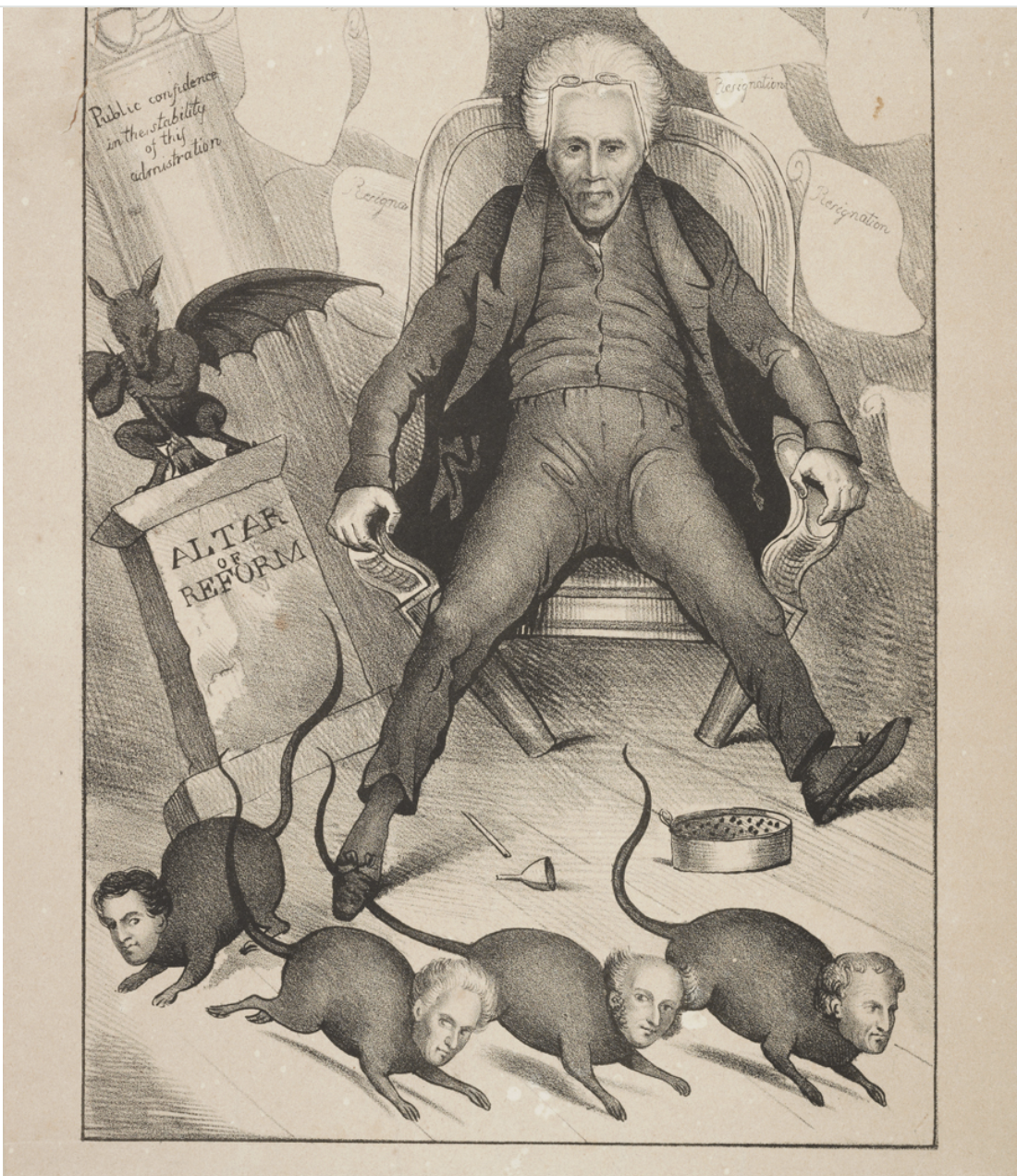
Gee, we were discussing flushing rats down the toilet just yesterday
/
Middlebury developer challenges constitutionality of legislative ‘rat’
A line snuck into state budget blocked a warehouse project
It was a classic “rat,” a legislative favor added without public notice to a massive budget bill at the end of the General Assembly’s 2023 session. The purpose: Block construction of a large warehouse on a bucolic former corporate campus near a legislator’s home in Middlebury.
Two years later, lawyers for the would-be developer allege in a federal lawsuit that the legislation targeting his project and overruling local zoning was unconstitutional, a “brazen” violation of the equal protection clauses of the U.S. and Connecticut constitutions.
The lawsuit filed in U.S. District Court on behalf of Southford Park LLC, the owner of the targeted property, seeks millions of dollars in damages from Middlebury, claiming the Waterbury suburb illegally relied on the unconstitutional language to stop the project and devalue the land’s worth by 90%.
The General Assembly, which generally has immunity against claims for civil damages, is not a defendant, but the behind-the-scenes actions of lawmakers could come under rare scrutiny as the claims against Middlebury are pursued.
“We think that the intent that legislators had and the process that they followed to enact the statute is going to be relevant to those claims,” said David R. Roth, a partner with the law firm, Wiggin & Dana.
Roth filed the suit on behalf of Southford Park — whose principal is David Drubner — and an adjacent property owner, Route 188 LLC. Assisting Roth is Jed Rubenfeld, a constitutional scholar on the faculty of Yale Law School.
The suit asks the court to consider the “rat,” the colorful term for a favor snuck into an unrelated piece of legislation, an “abuse of the legislative process” that “arbitrarily and irrationally deprived Southford Park and Route 188 of their protected property interests.”
Together, the lawsuit says, damages could exceed $27 million.
Drubner had a contract to sell the site for $25 million, contingent on final zoning approvals for what he called “an intermediate storage warehouse,” to Flint Development of Kansas, a builder and operator of industrial logistics facilities. The rat and Middlebury’s subsequent denial killed the deal, he said.
Neither Drubner nor Flint had a tenant lined up for what opponents had mischaracterized as a distribution center akin to an Amazon fulfillment facility Drubner said.
“They’ve characterized this as a distribution center like the Amazon thing. We specifically do not have approval for that. It’s just an intermediate storage warehouse,” Drubner said.
Defendants in the lawsuit include Middlebury, its Zoning Board of Appeals and zoning enforcement officer, and its new chief elected officer, First Selectwoman Jennifer A. Mahr….
Mahr is being sued only in her official capacity — as are the other individual defendants — meaning any liability rests with the town of 8,000 residents. But she has had a prime role in thwarting Drubner’s project as a founder of the Middlebury Small Town Alliance, a group that sued the town to stop the project.
…. Rep. William Pizzuto, R-Middlebury, acknowledged to the Connecticut Mirror two years ago he sought the legislative intervention as his neighbors and other opponents failed to stop the project through more conventional means, including an appeal of the local planning and conservation approvals in court.
He said Friday he sees nothing wrong in the General Assembly involving itself in a local zoning controversy after local options were exhausted.
“I don’t think anything was done improperly, except to say we’re here to represent the people of this town,” said Pizzuto, who lives about 100 yards from the bottom of the long drive leading to the proposed construction site, the former corporate headquarters of the Timex Group.
As Pizzuto acknowledges and the plaintiffs’ lawyers assert, the one-sentence rat now ensconced as Section 8-3m of the Connecticut General Statutes was drawn to block Southford Park without naming it.
“By design, on the date it was enacted into law, the text of § 8-3m fit the Southford Road Warehouse Project like a glove, because the statute was enacted precisely and specifically to block the Project,” the lawsuit reads.
The language bans communities with populations between 6,000 and 8,000, as determined by the 2020 census, from permitting any warehouse or distribution facility exceeding 100,000 square feet on any site that is smaller than 150 acres, has more more than five acres of wetlands and is within two miles of a school.
While the estimated population of Middlebury now could exceed 8,000, the 2020 census pegged it as 7,574. The size of the site and proposed facility fall within the parameters, it had 7.2 acres of wetlands as originally proposed, and is within one mile of a school.
The lawsuit says “the statute arbitrarily combines a hodgepodge of wholly unrelated factors and criteria” with no rational purpose.
It notes the only use banned by Section 8-3m are warehouses and distribution centers, not presumably more impactful things such as “chemical production facilities, pharmaceutical production facilities, bus terminals, truck terminals, pig farms, oil refineries, leather tanning facilities, prisons, commercial dry cleaning facilities, sewage treatment facilities, or even nuclear waste storage facilities.”
The references to wetlands and a school are similarly suspect, the suit says, as the language ”would permit any of these intensive, dangerous, environmentally hazardous facilities to be approved on property consisting entirely of wetlands located right next door to an elementary school.”
Two sides to every story, allegations are not facts, yadayadayada, but the plaintiffs are represented by Wiggin & Dana, and that’s a firm not ordinarily associated with (completely) frivolous lawsuits, so there’s probably something here. Fortunately, it will be the taxpayers of Middlebury who are exposed to footing the bill for damages here, not the actual government officials and politicians who were merely doing their job. Phew!