Excellent move — now do Columbia
/
Trump admin yanks Harvard’s international student program, kicking out thousands in latest escalation
WASHINGTON — Homeland Security Secretary Kristi Noem terminated certification for Harvard University’s exchange program for foreign nationals on Thursday, kicking out thousands of students.
Noem fired off a letter to Maureen Martin, the university’s director of immigration services, before announcing the cancellation of the Student and Exchange Visitor Program, accusing Harvard’s leaders of “perpetuating an unsafe campus environment.”
The Department of Homeland Security is eliminating Harvard’s student visa program over “pro-terrorist conduct” at protests on campus.AFP via Getty Images
“This administration is holding Harvard accountable for fostering violence, antisemitism, and coordinating with the Chinese Communist Party on its campus,” Noem said in a statement. “It is a privilege, not a right, for universities to enroll foreign students and benefit from their higher tuition payments to help pad their multibillion-dollar endowments.”
“Harvard had plenty of opportunity to do the right thing. It refused,” she added. “Let this serve as a warning to all universities and academic institutions across the country.”
The student program allowed up to 6,793 internationals to come to Harvard in the 2024-25 school year.
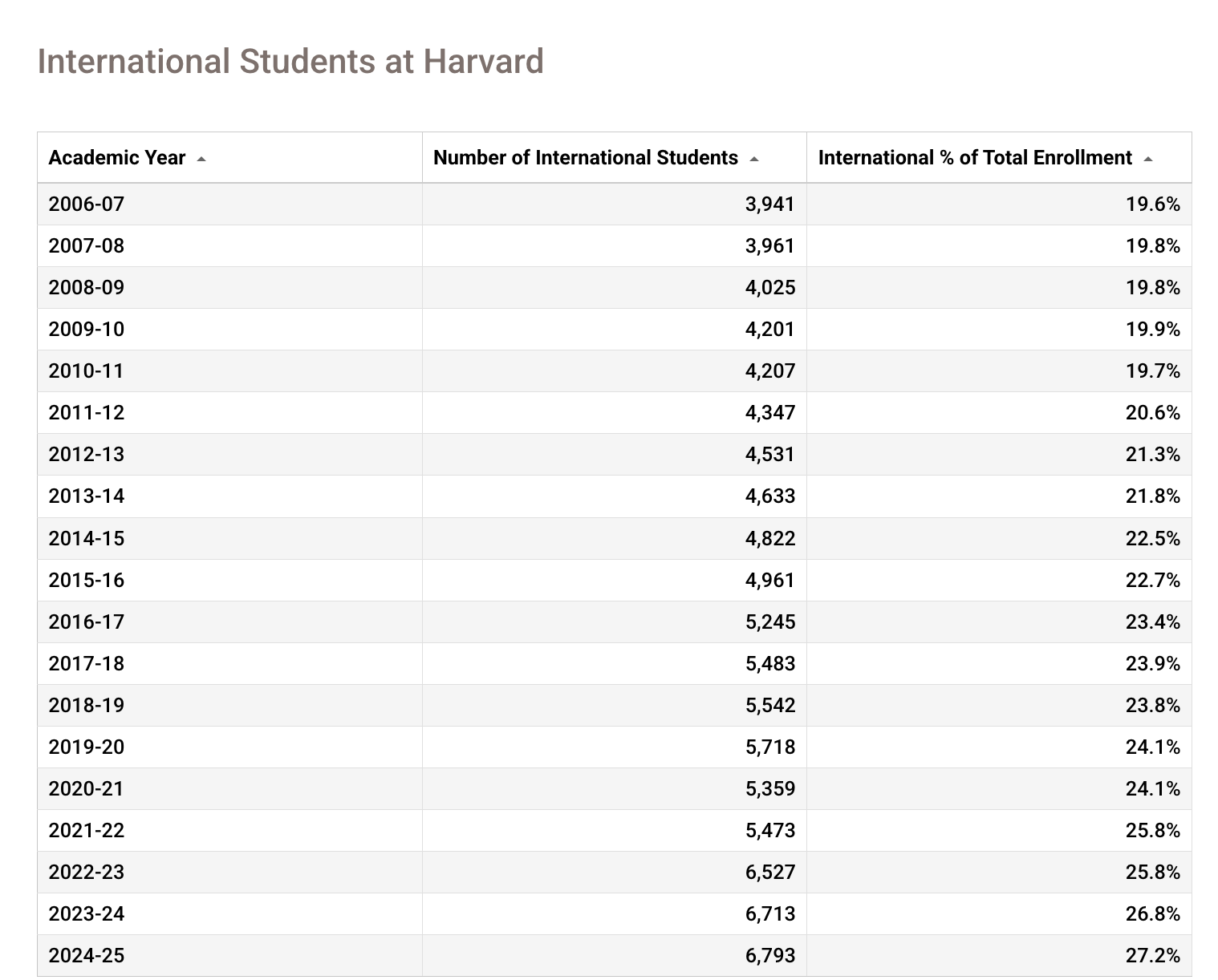
There are currently 1.1 million foreign students at U.S. colleges and universities, and because the majority of those students come from wealthy families that can pay full-freight+ tuition, they are beloved and cherished cash cows for those institutions.
Here’s how Google’s AI answered the prompt, “do colleges charge foreign students full tuition?” . I trust this particular response because (a) it provides links to the supporting facts, and (b) it’s exactly what I’ve read for years.
Yes, in most cases, colleges in the US charge international students the full cost of tuition and fees, often including extra fees for support services and government-required tracking. Public universities typically charge international students out-of-state tuition, which is usually higher than in-state tuition. Private universities generally have the same tuition for all students, but international students may not qualify for the same need-based financial aid as domestic students.
Here's a more detailed breakdown:
International students at public universities are usually charged out-of-state tuition rates, which can be significantly higher than in-state tuition.
While private universities often have a flat tuition rate for all students, international students may not be eligible for the same need-based financial aid as domestic students.
Additional Fees:
Some colleges charge additional fees to international students to cover expenses like student programming, support services, and government-required tracking.
Financial Aid:
While international students may be able to qualify for scholarships or grants, they generally do not qualify for the same need-based financial aid as domestic students, which is often tied to federal and state funding.
Exceptions:
Some public universities and private colleges offer full-ride scholarships or other forms of financial assistance to international students, but these are not the norm.