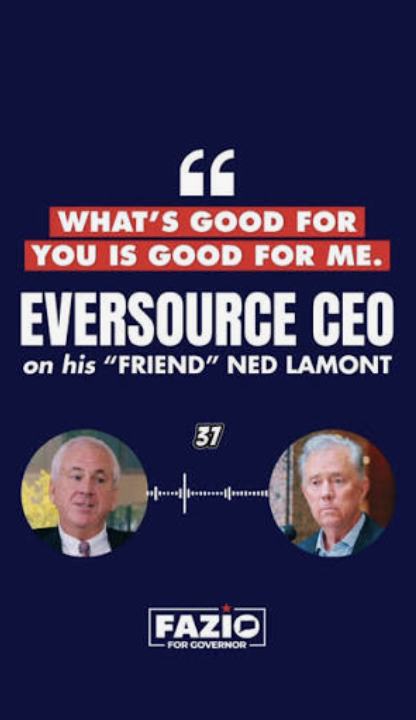
Well butter my buns and call me a biscuit — an objective look at what’s going on with the latest Eversource “scandal” and why in fact it doesn’t matter — your rates are going up anti-disirregardless
/
I like ryan, and i understand why in a political campaign you take your issues as they’re manufactured, but I’m not convinced on this one
The article that appears in today’s Greenwich Time is by Hearst’s Connecticut political columnist Dan Haar, whose opinions I often disagree with — that’s why they’re called opinions — but generally strike me as fair: Democrat-leaning, for sure, but he presents the fact behind those opinions, allowing the reader to judge their soundness, and that’s rare. His column today delves into and ultimately dismisses an ongoing controversy concerning a supposed too-cozy relationship between Eversource’s CEO and Dan Lamont, and then turns to the nub of the matter:
Why your electric bills are going up regardless of what a CEO and Lamont say or do
Hand-wringing and political intrigue aside, comments by Nolan and Lamont have precisely zero to do with how much you and I will pay for power….
In this world? Joe Nolan and Ned Lamont could be the Hatfields and McCoys or they could be old frat brothers sailing on the Sound every Saturday. It doesn't matter one little bit.
What matters are these five reasons why Connecticut ratepayers are extremely likely to see their rates rise, not fall:
Eversource is seeking a rate hike averaging 13% for delivery of electricity to households. Politicians of both parties say that's outrageous. Maybe it is. Sure, a sharp pencil can find some bloated costs. But the company hasn't had a regular rate increase since 2018. Yes, it has had some "tracking" increases to cushion the blow of a full rate hike, but guess how much consumer prices have gone up in those eight years. Thirty-three percent, friends. Excessive profits? Connecticut Light & Power, the Eversource electric business in this state, has shown returns of about 7% in recent years. Not much wiggle room there.
Those pent-up storm costs are huge. We the ratepayers must reimburse the company at least $861 million starting next year, and that's just for storms from 2018 to 2023. On Thursday, Eversource appealed a decision by the state Public Utilities Regulatory Authority, PURA, to deny $400 million in interest charges for the years the company has not been paid. Lamont, perhaps sensitive to the idea that he's too chummy with Nolan, issued a terse statement calling the lawsuit "an absurd money grab by Eversource, and we won’t stand for it." Strong language but the law matters more. Win or lose, rates are going up just for the storm payments. And remember, we have three more years of storms to pay for. News alert: Weather isn't getting tamer in the post-climate-change era.
Smart meters will cost more than $1 billion and we haven't started installing them yet in Connecticut after years of haggling. Massachusetts reached a nice deal with Eversource years ago and is well underway at a lower price than we will have to cough up.
Eversource sustained credit-rating declines in its yearslong standoff with PURA. That raises the cost of borrowing, not to mention rising interest rates for all of us for deeper reasons. Utilities borrow huge amounts of money to make investments that we later reimburse. And who's paying for the higher interest rates? I don't think you need a hint.
Finally, power supply is the wild card. That's the biggest part of our bills and it is not related to Eversource at all. Anything can happen, but we know the main sources are natural gas and nuclear. Gas prices hit us hard because we have too little pipeline capacity coming into Connecticut; and the 10-year deal we have with Millstone to buy power at 4.99 cents per kilowatt-hour expires in 2029. Plus, demand is rising even without much population growth. My guess on prices: Up.
Getting back to the Eversource investment squeeze in Connecticut, I was the first to report it in May 2024. Nolan said then that Connecticut would see a decline of $100 million a year for five years, and that didn't even include forgoing special projects like a massive switching station in Cambridge, Mass., which is making that region more efficient.
Since then, Lamont has remade PURA after the exit of the lightning rod commission chair, Marissa Gillett. And lo and behold, Eversource has announced a new investment schedule for Connecticut that's rising by $50 million a year, from a base of just over $600 million. The faucet is back on, for now.
It's hard to say what that means for rates and reliability. For example, we don't know whether the power surge in East Hampton this week was affected by Eversource's slowdown in routine upgrades and maintenance. It's like when you delay changing the oil in your car. Did that lead to your sluggish acceleration? Maybe yes, maybe no.
The good news is that we're back to something closer to a normal relationship between the state and the regulated monopoly power company. Fazio was wrong to criticize a friendly working relationship between Lamont and Nolan, which isn't a bad thing. Call me naive if you want.
Lamont was wrong to let this crisis fester for more than three years without mediating the standoff between PURA and Eversource, as some of us were suggesting. Whether Jonny Dach, his former chief of staff, would have been the best person for that role, we will never know.
I’d like to see Haar write a column on the effect the entire Zero Carbon campaign has had on the price of energy itself, from cancelled pipelines and forced expenditures on windmills and solar farms, for instance, but I’ll settle, today, for this good look at why those prices aren’t coming down anytime soon.