And styrofoam coffee cups are better than paper leakers*
/
moral: don’t leave environmental policies to 7-year old’s school projects or paste-eating “Good intentions” eco-warriors.
A new study from South Korea found that paper straws are somehow worse for the environment than single-use plastic straws. None of the "eco-friendly" solutions actually worked, and switching away from plastic straws didn't really help the environment. https://t.co/aJYnZEWRuT
— Pubity (@pubity) October 25, 2026
A South Korean government-commissioned study has determined that paper straws are actually worse for the environment than plastic straws.
Researchers measured the full life cycle impact of four types of straws: plastic straws, paper, biodegradable, and bio-based polyethylene.
From The Korea Herald:
Conventional plastic straws had the smallest impact in 10 of the 16 categories, including climate change, acidification, particulate matter, and human toxicity.
Bio-PE straws had the largest impact in 10 categories, including ozone depletion, acidification, and smog.
Paper straws had the largest impact in three categories, while biodegradable plastic straws did so in two.
South Korea has some skin in the game here. They restricted plastic straws at cafes and restaurants in 2022. A survey, of course, found that almost 90% of Koreans prefer regular old plastic straws.
And they’re environmentally correct in doing so.
Compared with conventional plastic straws, paper straws also had 2.04 times the acidification impact.
Bio-PE straws were even worse, with 16.18 times the human carcinogenic impact and 5.9 times the acidification impact.
Biodegradable plastic straws had 3.34 times the carcinogenic impact and 1.98 times the acidification impact.
*I have a lengthy, lengthy ChatGTP analysis of the environmental impact of styrofoam vs paper cups, suitable for framing and available on request, but it’s far too long to burden readers of this blog (especially our Irish ones), so here’s just the concluding summary:
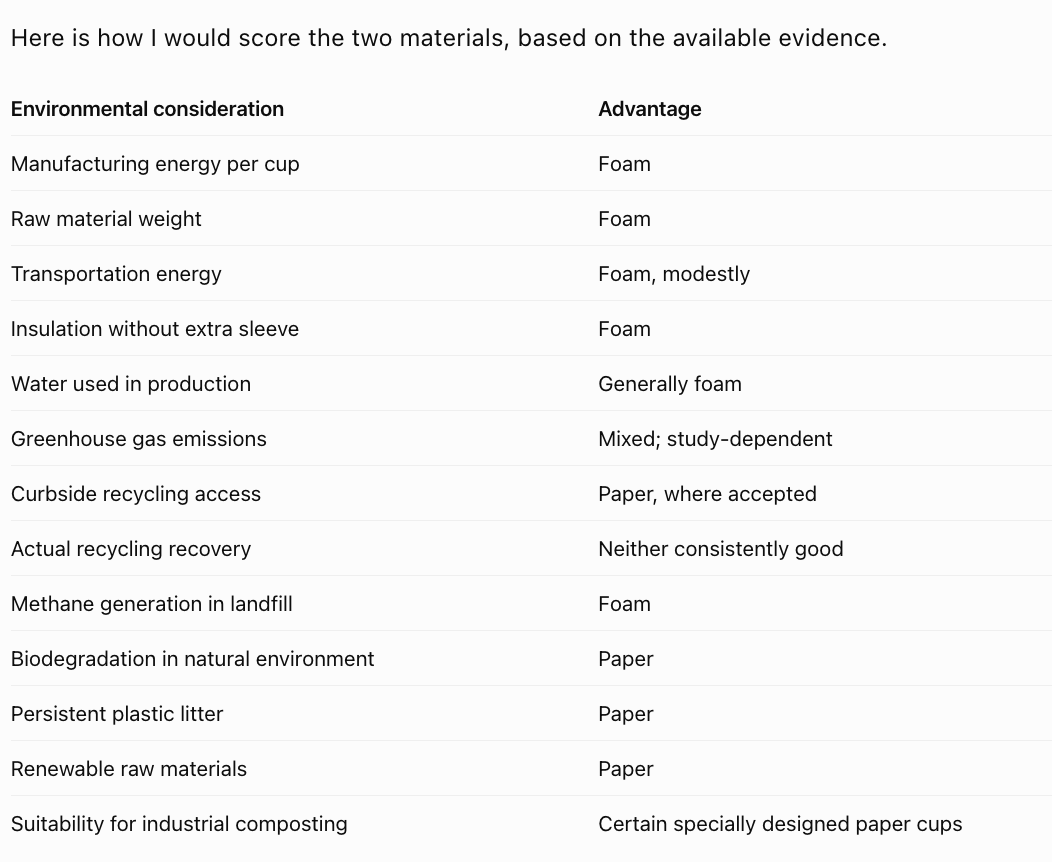
Foam tends to perform better on resource efficiency; paper tends to perform better on environmental persistence and litter. The importance assigned to those different impacts determines the winner.
One final point: A particularly revealing study is A Critical Comparison of Ten Disposable Cup LCAs (2013). Rather than advocating for either material, its authors examined why different scientific studies reached different conclusions.
That is the sort of work I would give more weight to than the claims of either the plastics industry or the anti-plastics movement.
And if I were evaluating a proposed ban on foam coffee cups, I'd insist that its supporters distinguish between reducing plastic litter, which is a defensible environmental objective, and reducing energy consumption or greenhouse gas emissions, which the evidence does not consistently support. Those are different policy goals, and conflating them makes for poor public policy.