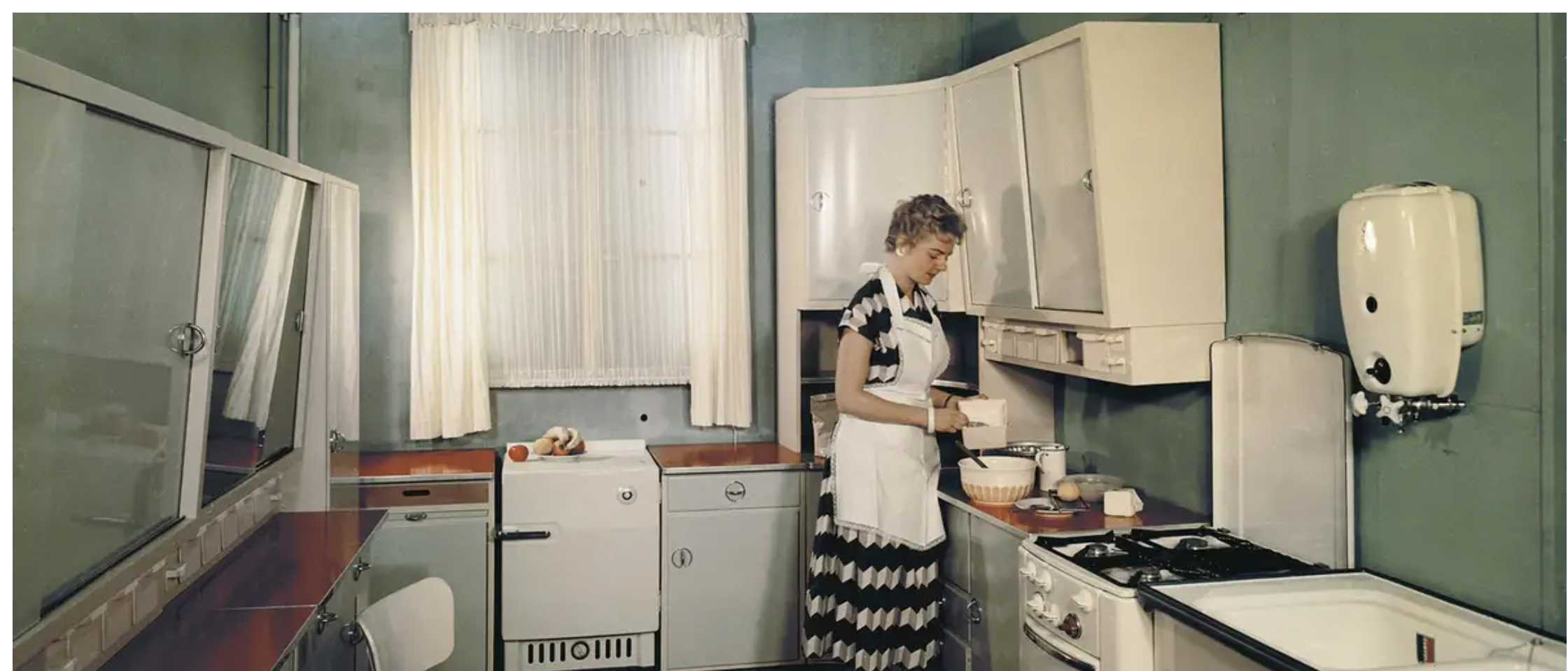
Speaking of happy home design, let's not forget the original communist model, the Frankfurt KItchen, designed by a communist and built for the 1925-1930 New Frankfurt Project
/
It’s architect trundled off to the Soviet Union along with the other originators of the scheme, but her influence remains; in fact, look for the resurgence of the entire package: communal housing, kitchens and right-thinking alike, come next Tuesday.
The Guardian October 7, 2021
Meg Conley:
Invisible fridges and cooling cubbies: how kitchens have been designed for the rich
The latest status symbol in kitchens is invisible appliances – but hiding behind that fridge disguised as a cabinet is a long history of people trying to engineer society
…… A practical theory of kitchen design didn’t emerge until the 20th century. Until then, kitchens were just random bits of furniture and a stove shoved in attics, basements and poorly ventilated back rooms. Architects didn’t care about kitchens because their high-end clients’ kitchens were filled with servants.
After the first world war, the architects behind New Frankfurt, in Germany, were tasked with finding a way to build affordable housing that fostered community and equality by design. This time, the architects decided to include kitchens in their world building. Grete Schüette-Lihotzky, the first female architect in Austria, was in charge of the kitchens. In a 1997 interview before her 100th birthday, she said: “Before I conceived the Frankfurt kitchen in 1926, I never cooked myself. At home in Vienna my mother cooked, in Frankfurt I went to the Wirtshaus. I designed the kitchen as an architect, not as a housewife.”
She was not a housewife, but that did not keep her from respecting the women who were. Lihotzky believed the work of the home was real work. She thought it should be treated with professional dignity.
Using the research of the home economist Christine Frederick, Lihotzky created an orderly layout of storage, appliance and work surface. Frederick was an odd silent collaborator. Lihotzky was a passionate communist dedicated to an egalitarian future, while Frederick is widely credited with disseminating the 20th-century version of the separate spheres of men and women. She was also influential in arguing that all mass-produced home goods should be made to fall apart so that industries could keep making mass-produced home goods. (This is called planned obsolescence, and tech companies still do it today.)
Still, Lihotzky took Frederick’s measurements seriously. Cabinets, shelves, appliances, work surfaces were each fixed in place, fitting precisely.
Inspired by the efficiency of research labs, Lihotzky standardized kitchen workflow and under cabinet storage. Your kitchen looks a little like a lab, standing work surfaces and cabinets lining the wall, because in 1926 a woman decided to give it the dignity and efficiency of one.
Lihotzky’s kitchen is boldly utilitarian. It’s gunmetal green because research suggested flies disliked the color [Whose “research?” Lysenko’s — ED]. Form follows doggedly after function on every surface and in every cubby. She created the first fitted, or built-in, kitchen, complete with standardized cabinets and standardized liberation. Ten thousand of Lihotzky’s Frankfurt kitchens were built in New Frankfurt.
In 1930, buoyed by the success of her kitchen, Lihotzky accepted a commission to help design cities for the first of Stalin’s five-year plan. The first plan was supposed to turn the Soviet Union into a great industrial power while creating a collective Soviet culture. She was asked to help design a world that could foster Soviet ideals. Lihotzky helped design Magnitogorsk, an industrial city built around steel production. Magnitogorsk served as a shining example of the supremacy of the Soviet Union.
Shockingly, the Guardian author actually inserted this tiny caveat into her artcle before resuming her Marxist cant:
While Lihotzky designed a new world, others were subjugated for it. People were imprisoned so they could provide the hard labor required by Soviet ideals. Agricultural land owned by the peasant class was collectivized through brutal, bloody force. People kept dying but Lihotzky remained.
Then back to her regularly scheduled program:
She finally fled the Soviet Union in 1938 during Stalin’s final Great Purge. Even the architects who helped build Stalin’s world were not safe any more. In 1940, she returned to Vienna to join the resistance against the Nazis. She was caught by the Gestapo and jailed for four years. Her liberation was designed by US troops in 1945. Despite the success of the Frankfurt kitchen, Lihotzky was not invited to help rebuild her country after the war. People were too wary of communist design. She spent the rest of her career working as a consultant for communist governments, rationalizing liberation through standardized measures.
The Frankfurt kitchen sought to help women put drudgery in its place. Twentieth-century American appliance advertisements promised to free women of the drudgery altogether. Washing machines, dryers, dishwashers, toasters, refrigerators, garbage disposals and adjustable temperature irons all made their first domestic appearances in the first half of the century.
Once appliances could be mass produced, they needed to be sold. Thanks to planned obsolescence, once they were sold, they’d always be bought again.
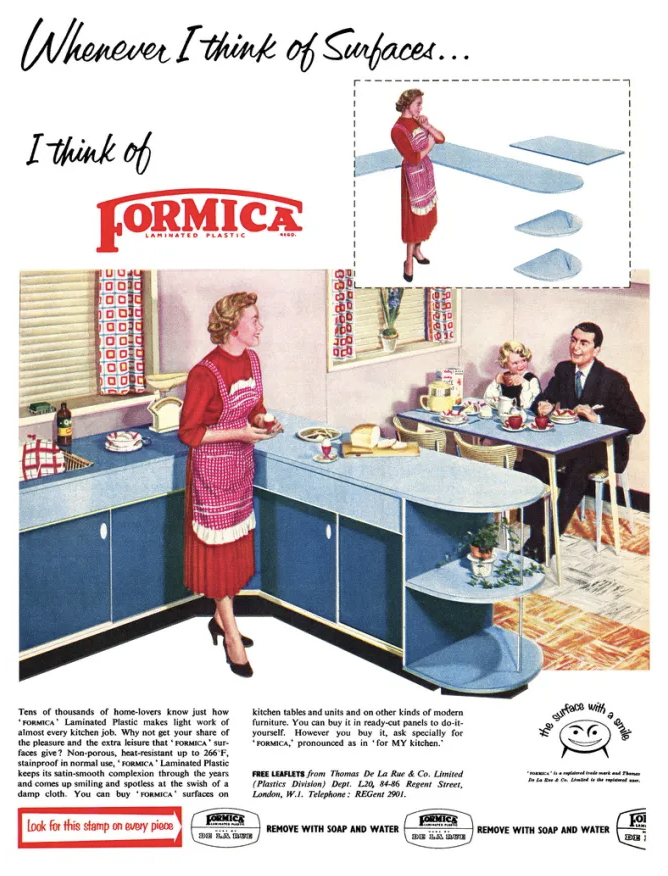
In the 1920s and 30s, appliance advertisements called appliances “invisible servants”. By the 1950s, the domestic help angle was dropped in favor of domestic pride. Kitchen design was overtly political once again, and the purpose of the home was remade.
Historically, homes have been a unit of consumption and production. Some homes consumed grain while producing children and textiles, for example. In cold war America’s propaganda and policy, the home became exclusively a unit of consumption. The kitchen was the consuming center of that home. It was a white woman’s patriotic duty to have a house full of capitalist produced, time-saving appliances. She was supposed to use her saved time to devote herself to the American model of womanhood – a careful, carefree housewife with pristine children and a pristine home. Her home wasn’t a work space, it was a lifestyle.
Marietta Shaginian, a Soviet journalist in the 1950s, called the American kitchen “‘ideologically inappropriate’ because it was designed not to help the working woman achieve self-realization but to compensate the middle-class ‘professional housewife’ for her lack of a place in the public arena”. American housewives were not expected, or welcome, in the public arena. And they certainly weren’t about to be paid for their work in the private arena. You could hardly pay a woman for her work in the home if you were determined to prove consumerism ended her work.
Some racist white feminist architects envisioned a life truly free of domestic work spaces. They sought to free white women, and their homes, of kitchens altogether. The oppression of Black women and women of color was often an integral part of their designs. In the early 1900s, Alice Constance Austin was commissioned to design a socialist commune of kitchenless houses. Food would be cooked in a central kitchen and sent to communal patios by a series of underground rails. Laundry would be taken care of this way too. The central kitchen would be staffed with paid labor.
Applications to become a member of the commune were open exclusively to white socialists. The commune’s founder didn’t think it was “expedient to mix the races in these communities”. There’s no way to know what their employment terms would have been, however. Austin’s vision of a home without a hearth was never built – the commune fell apart over a lack of water and leadership.
Sometimes the kitchenless house got literary support. In Women and Economics, Charlotte Perkins Gilman, author of the feminist classic The Yellow Wallpaper, opines: “Take the kitchens out of the houses, and you leave rooms which are open to any form of arrangement and extension; and the occupancy of them does not mean ‘housekeeping’. In such living, personal character and taste would flower as never before … The individual will learn to feel himself an integral part of the social structure, in close, direct, permanent connection with the needs and uses of society.”
An early precursor to today’s “No Human is Illegal, Who’s Going to Empty Our Bedpans and Rake Our Leaves?” open border crowd:
Certainly a house without a kitchen still holds people who need to eat. If the men and women of the house aren’t doing housework, who is? Who is dusting those rooms where taste flowers and the form of society itself is touched? For Gilman this was “a need for labor unmet”. In 1908, she published a paper in the American Journal of Sociology explaining how to meet that need, titled, “A Suggestion on the Negro Problem”. Gilman wrote that the mere fact of Black people in America caused “social injury”. Her “suggestion” for that “problem”? A forced labor corp, complete with uniforms and bases.
She argued that Black people “should be taken hold of by the state” and “enlisted” into forced labor. “Men, women, and children, all should belong” to her “proposed organization”. The “enlisted” would be made to labor on farms, in mills and in building roads and harbors. Gilman suggested the state build “a training school for domestic service” at each enlistment base. Once trained, “individuals could be sent … on probation … to remain out in satisfactory home service. In case of unsatisfactory service they should be re-enlisted.” In Gilman’s ideal world, Black people were “free” to clean Gilman’s house or face enslavement – a chilling and dystopic vision.
And the author’s conclusion? Exactly what the next generation of paste-eaters is being fed in our schools todaay:
None of their blueprints made room for the meaning of the work in the kitchen
White communists, white socialists, white feminists, white capitalists and white supremacists were all hoping to engineer whole societies by designing the kitchen. Each saw kitchens as permanently fitted with women – they just disagreed over what that meant. All kept the footprint of patriarchal understanding and most anchored deep into racist foundations. None of their blueprints made room for the meaning of the work in the kitchen. Forget the meaning, they could hardly be bothered with the function.
It’s time to design the kitchen for the world we’ve engineered. Women have traditionally cooked in the kitchen. But they’ve wept and screamed there too. What work surface will bear our scratches best? Is there a line of cabinets deep enough to hold our grief?
Maybe the rich have got it right with their hidden fridges. Why pretend the substance matches the surface? It never has. We could start covering everything with cabinet panels. Sinks, stoves, counters, windows. The new status symbol is an invisible kitchen. Everything is cabinet now.
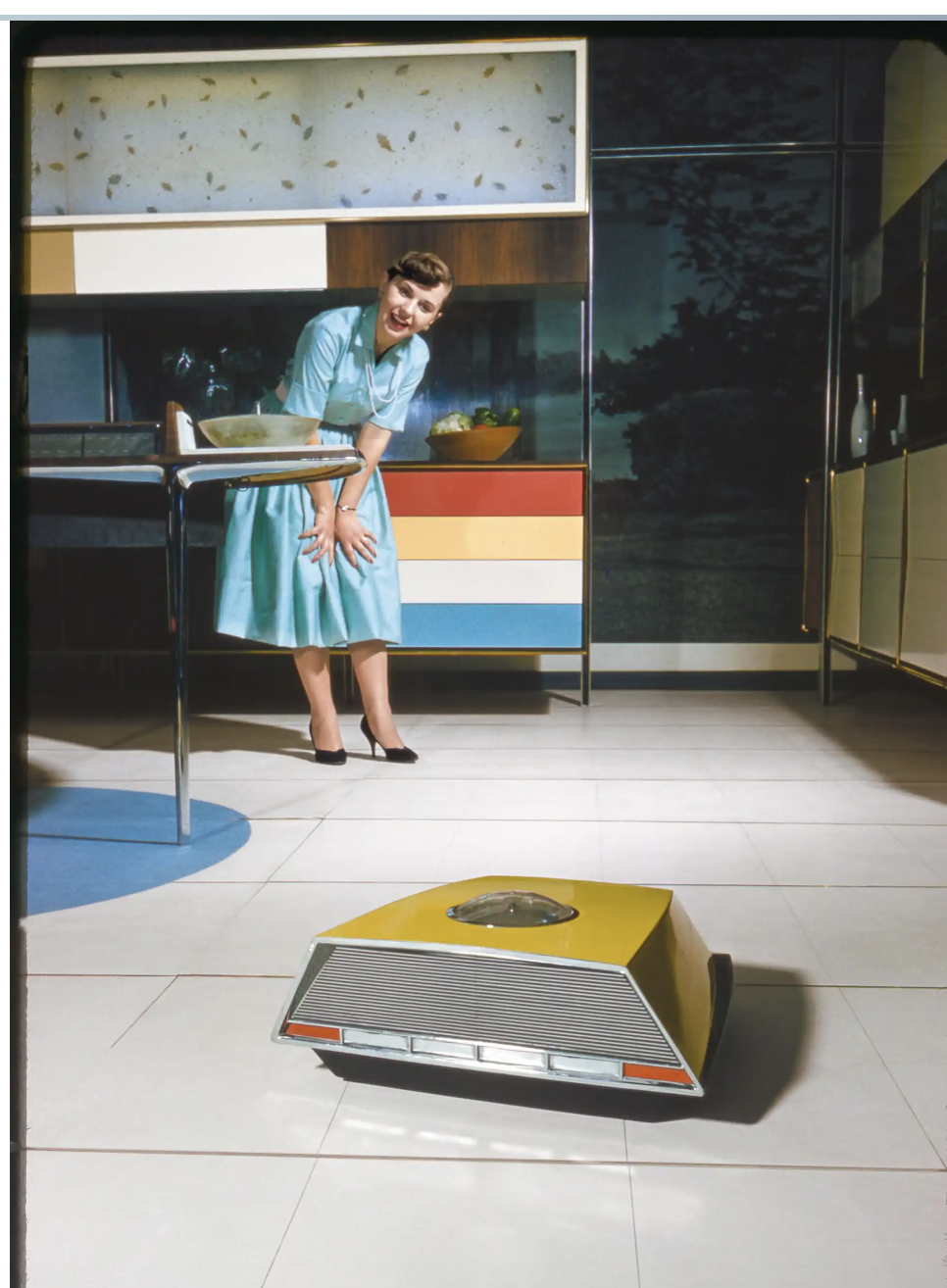
Your kitchen of the future, Soviet style: