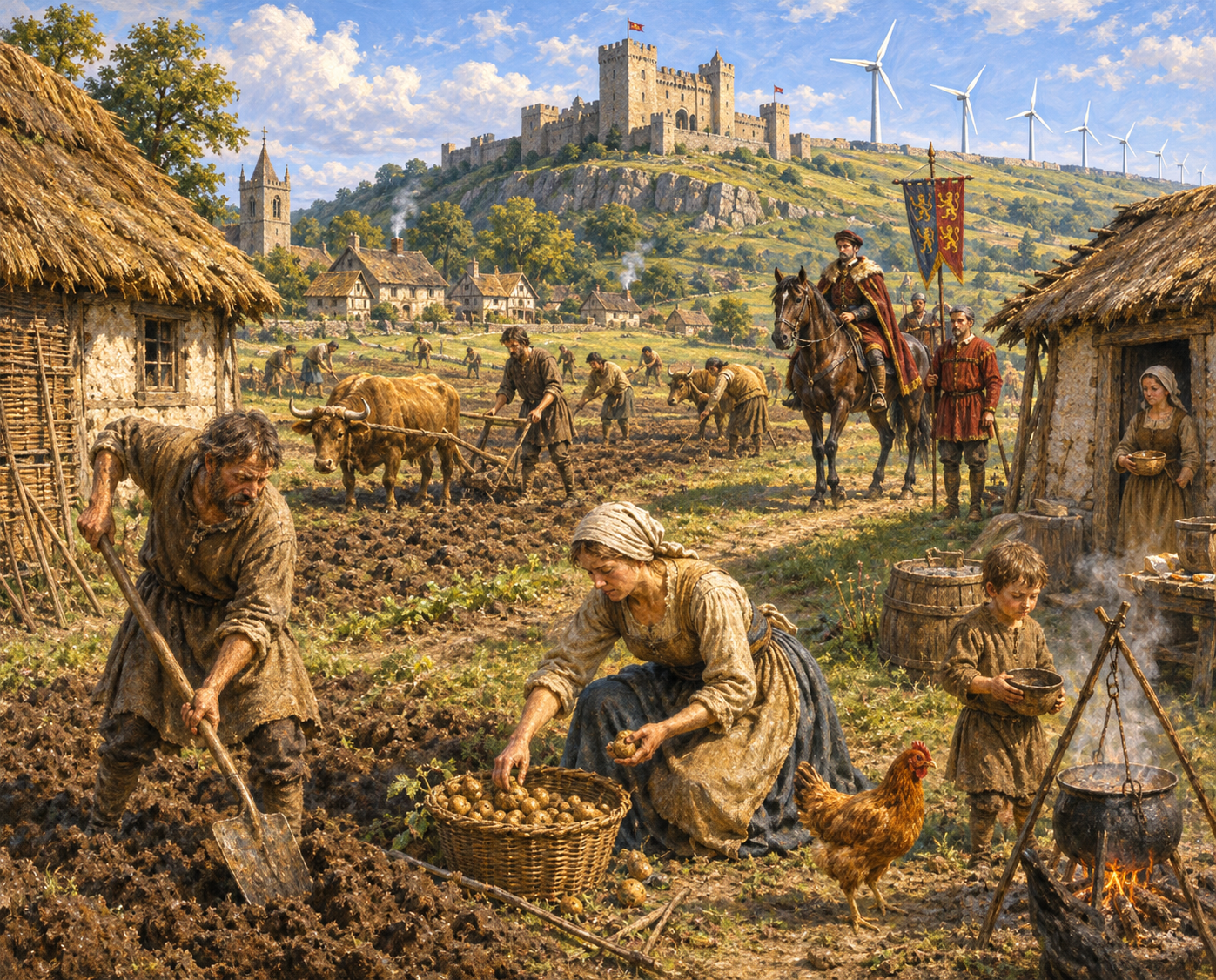
There won't always be an England — not an industrialized one, anyway.
/
[There’s No] Escaping the Green Disaster
Even its so-called conservative party, although spotting the problem, can’t admit the obvious solution, and will doom the country. At least it will have company.
John Hinderaker, PowerLine:
“In this morning’s London Times, former Tory Prime Minister Rishi Sunak addresses his country’s energy crisis.
“Sunak begins with the fact that Britain pursued a “green” energy course without having any idea how its goals could be achieved:
When I was in Downing Street, we were convinced that Labour’s pledge of clean power by 2030, the commitment that 95 per cent of electricity would come from clean sources, was going to be a lot more expensive to achieve than it claimed. So we asked the civil service to run the numbers. It said it couldn’t. My team were incandescent. They assumed that officials had looked at the polls and decided they dare not risk offending their future political masters. Protests were made. But it then transpired that the reason for the refusal was it was almost impossible to work out how the goal would be achieved, let alone what it would cost.
Hindraker: “This was true all around the world. Governments committed to “green” goals without having any plan as to how they could be accomplished. And in fact, they turned out to be impossible. Sunak notes in particular the folly that is wind energy, which superficially seems cheap but in fact is ruinously expensive.
“Sunak acknowledges frankly that Britain’s “green” policies have devastated its economy: “
[Energy] costs are now one of the biggest constraints on our growth. Cheap energy doesn’t just matter for traditional manufacturing such as steel-making. Advising Anthropic and Microsoft, I have been struck by the extent to which artificial intelligence is an energy-intensive industry. Data centres need energy, and lots of it. … Countries with plentiful, cheap and secure energy will have an advantage in nearly every sector of the economy in the decades ahead.
***
Yet if things are bad for households, they are even worse for businesses. We have the most expensive industrial electricity of any advanced economy. As long as that remains the case, manufacturing will become increasingly uncompetitive and more strategically important industries will shut down.Energy security is key to economic security, which is now inextricably linked with national security.
Hinderaker: “The question, then, is what to do to restore Britain’s economic viability. Unfortunately, Sunak–and thus the Conservative Party–is not rational enough to advocate the real solution: to abandon the mad quest for “green” energy and burn coal, oil and natural gas while constructing nuclear power plants. Instead, he advocates shifting the insane costs of “green” energy from ratepayers to taxpayers:
[W]e are a European outlier in how much of our energy infrastructure and policy costs (think green energy and social support schemes) are paid in [utility] bills rather than general taxation. We also made the choice to let business bear the brunt of those costs.
The best immediate option is to take the costs off business bills and make them the government’s responsibility.
The government’s responsibility? That is, the taxpayers’.
This is not cost-free: it would mean the state having to make billions of pounds of cuts elsewhere. But the alternative is us becoming ever more uncompetitive. The best industrial policy right now is cheaper electricity.
HInderaker: “Cheaper for businesses, more expensive for taxpayers. It is depressing to see how few world leaders, even nominal conservatives, are willing to acknowledge the obvious reality that “green” energy was, from the beginning, an unsustainable scam. Donald Trump, to his everlasting credit, is on that short list.”