It's all good, but unless Congress changes the laws that give regulatory agency bureaucrats unlimited power, this can easliy be reversed by another executive order
/
(Not if they don’t buy a car, eh? Oh, well …)
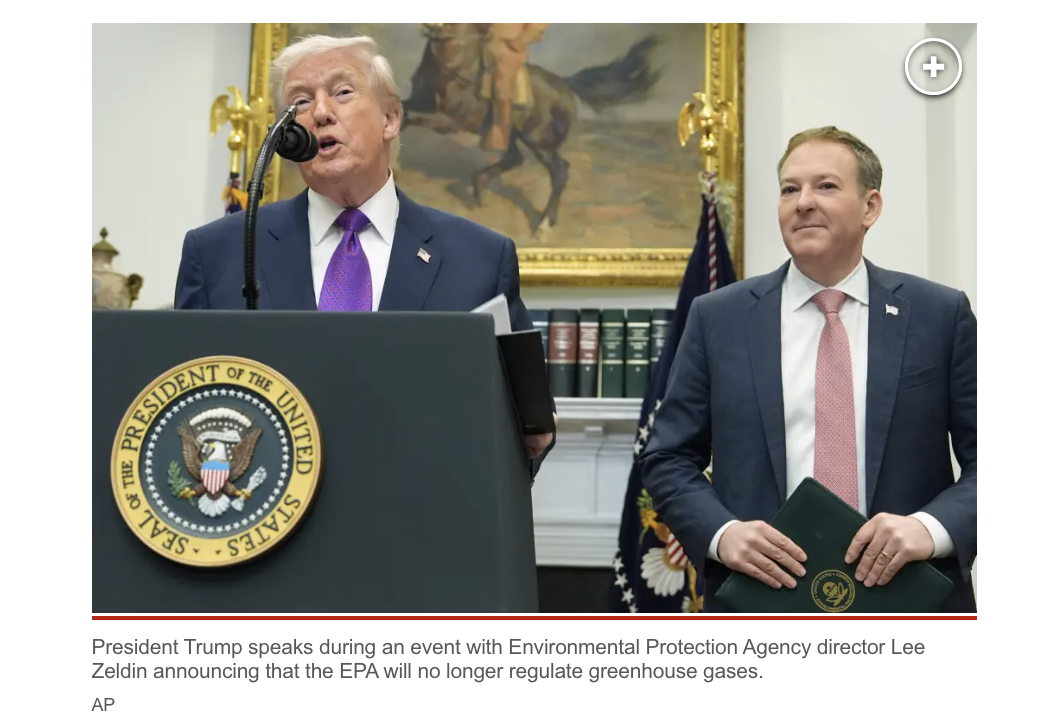
WASHINGTON — President Trump and EPA Administrator Lee Zeldin unveiled what they called the largest deregulation in US history Thursday by axing a sweeping anti-greenhouse gas policy — saying it could save Americans $1.3 trillion, or about $3,823.50 per US resident.
“Today, the Trump EPA has finalized the single largest act of deregulation in the history of the United States of America,” Zeldin said alongside Trump in the White House Roosevelt Room.
“Referred to by some as the holy grail of federal regulatory overreach, the 2009 Obama EPA endangerment finding is now eliminated.”
President Trump speaks during an event with Environmental Protection Agency director Lee Zeldin announcing that the EPA will no longer regulate greenhouse gases.AP
The repeal ends a policy allowing the feds to regulate the emissions of fossil fuels by declaring them dangerous to public health.
The so-called “endangerment finding” allowed the EPA to regulate six greenhouse gases under the Clean Air Act — providing for a regulatory framework to measure and constrain the expulsion of carbon dioxide, methane and nitrous oxide.
Trump called the finding “a disastrous Obama-era policy that severely damaged the American auto industry and massively drove up prices for American consumers,” predicting they would save “trillions of dollars” as a result of Thursday’s action.
The president added that his administration was “terminating all additional green emission standards imposed unnecessarily on vehicle models and engines between 2012 and 2027 and beyond.”
Zeldin said that action could lower car costs by an average of about $2,400.
The environmental chief and Trump singled out one practical impact of Thursday’s announcement: The looming absence of the car feature that switches engines off while drivers are idling at stop lights.
“Under the endangerment finding, they forced the hated start-stop feature onto American consumers, which unnecessarily shuts off a car’s engine. When you stop at a red light, in other words, the engine goes off. That’s great,” Trump said.
Zeldin also said that “manufacturers will no longer be burdened by measuring, compiling or reporting greenhouse gas emissions for vehicles and engines.”
Under our current laws, Congress enacts feel-good, noble-sounding laws and then turns them over to unelected staffers at regulatory agencies to define and implement them. What one president can do, another can undo, as we’ve witnessed so many times recently: Biden cancels the XL Pipeline by executive order on his first day in office, Trump reverses that by his own executive order on his first day in office. And so one. Given the lead time required for manufacturers to redesign and restart production of products whose specifications change with each change in government, this is aa lousy way to run a country.
Congress could end much of this bs by reclaiming its authority, but it won’t; both parties like things just the way they are, allowing them to sound good while avoiding taking responsibility for the unexpected and expected consequences.
It’s been a long time since I dabbled in administrative law, but the summary below, even if provided by an anti-trump, pro-regulatory group, jibes with with my memory of the processes involved. Regardless, count on the lawsuits to begin flying by the close of business today.
FACT SHEET 5: Reversing or Revising Agency Regulations, Generally
Source: Environmental Law Institute — Regulatory Reform in the Trump Era
ACTORS: Federal Agencies, Department of Justice, Congress
Most environmental regulation takes the form of detailed rules promulgated by agencies under their statutory authority, using a public notice-and-comment procedure. Final agency rules cannot simply be undone by the president, but they may be challenged in court, amended or reversed through a subsequent agency rulemaking process, or revoked by congressional act. Many Obama Administration rules, including the Clean Power Plan and Waters of the United States (“WOTUS”) Rule, are vulnerable to each of these forms of revision, and more than one might get attempted at the same time.
Process. When enacting environmental statutes, Congress typically outlines a general regulatory structure for protecting public health and natural resources, then delegates the details to EPA or other federal agencies. These agencies fulfill Congress’ intent and fill statutory gaps by issuing administrative rules that spell out detailed standards, create permitting and approval procedures, and govern agency monitoring, inspection, and enforcement. Some rules are mandated by the statute, which may even set out specific deadlines. Others are developed over time or in response to new information or events, allowing the agency to bring its expertise to bear in interpreting its congressional mandate.
Most regulations go through a formal rulemaking procedure governed by the Administrative Procedure Act (APA), 5 U.S.C. ch. 5, which requires public notice of a proposed rule; a period for receiving comments on the proposed rule; and issuance of a final rule, including responses to the comments received and an explanation of whether and how they were taken into account. The record of this process includes the agency’s justification for the rule and provides the basis for any subsequent judicial review. These “administrative records” can be voluminous, spanning several years and comprising thousands of pages, from initial scientific studies to advisory committee deliberations and public hearings to publication of the final rule.
Judicial Review. A final agency rule may be challenged in federal court on the grounds it is “arbitrary and capricious, an abuse of discretion, or otherwise not in accordance with the law.” 5 U.S.C. § 706(2)(A). This standard sets a high bar, but does allow judges to intervene where an agency has, for example, failed to follow the notice-and-comment procedure, offered incomplete or inconsistent justifications for its action, or exceeded its statutory mandate. If the challenge is to an agency’s interpretation of its governing statute, the court looks to the statutory language to determine Congress’ intent; if the statute is silent or ambiguous, the court will accept any agency interpretation that is “reasonable.” This so called “Chevron deference”1 has tended to favor EPA in environmental cases, where Congress often has not spoken with precision and courts defer to the agency’s scientific expertise.
Discussion. Although they are promulgated by the executive branch, agency rules cannot simply be undone by executive order or other presidential action. Agencies remain governed by their underlying statutory mandates, and must still follow the procedures established by the APA. Thus, while the president may direct agencies to begin the process of reversing or revising an existing regulation, they generally must go through another full rulemaking. More immediately, where an existing rule has been challenged in court, the Department of Justice may decline to appeal an adverse ruling, or reach a settlement more favorable to industry. Congress also may attempt to revoke specific rules or remove certain subject matter from an agency’s jurisdiction.
Reversing Rules Through Subsequent Rulemaking. In general, formal agency rules can only be amended or reversed through another rulemaking, including a notice-and- comment period and development of a full administrative record. In order for the new rule to survive judicial review under the “arbitrary and capricious” standard, the record must provide a “reasoned explanation,” beyond a mere change of presidential administration, of the basis for the revision.2 Key Obama Administration rules that relied on reams of scientific evidence and months of public procedure, like the Clean Power Plan or WOTUS Rule, might require an equally laborious effort to undo. It will be even harder to vacate something like EPA’s “endangerment finding,” the underpinning for the CPP and other climate measures, where the agency’s analysis has been upheld in court.
Declining to Defend Agency Rules. For rules facing litigation, there is also a question of whether or how vigorously the Department of Justice will defend the rules in court. Representing federal agencies is a core part of DOJ’s mission, but a change in administration presents the opportunity to reevaluate litigation priorities, change tactics, and revise legal interpretations to bring them more in line with new policy goals. For pending challenges … DOJ might petition the court to delay its decision schedule (which has already occurred in several cases), or to remand the rule to allow the agency to reconsider it.
If a court reaches a decision invalidating (and vacating) all or part of a rule, DOJ might decline to pursue an appeal, in which case the agency could rewrite the rule or drop it altogether. DOJ also might opt to settle cases on terms at odds with some stakeholders’ interests. To guard against these possibilities, environmental groups or state attorneys general often seek intervenor status, so they can participate in settlement discussions or maintain an appeal if DOJ fails to do so.
Congressional Revocation. Finally, Congress retains the option to weigh in against an agency rule at any time. This may take the form of legislation disapproving or revoking a specific rule (similar to the Congressional Review Act, see Fact Sheet 6, but via regular congressional procedures); or a broader repeal of the agency’s statutory authority to issue a rule. …