U.S. out of U.N., U.N. out of U.S.
/
UN hands Iran vice-chair role on democracy panel despite abysmal human rights record
Critics say Tehran's vice-chair role on Commission for Social Development contradicts its record of brutalizing women and massacring civilians
AI Overview
Based on reports from early 2026, there are credible,, documented allegations that Iranian security forces have raided hospitals to execute and abduct injured protestors
.
Executions in Hospital Beds: Sources and doctors working inside Iran reported that security forces entered medical facilities and shot wounded protesters in the head while they were in hospital beds, sometimes still attached to IV lines or breathing tubes.
Targeting Wounded Protesters: Reports indicate that agents targeted individuals wounded during protests, with instances of "finishing off" protesters who had been admitted for treatment.
Hospital Raids: Security forces have been accused of storming hospitals, such as the Imam Khomeini Hospital, to hunt down, beat, and abduct injured people, even using tear gas and shotguns inside the facilities.
Medical Repression: Medical staff reported being pressured to report injured protesters, leading to the arrests of patients. Some injured individuals were reportedly forced out of care to free up beds for security forces.
Context: These actions were part of a intensified crackdown on nationwide protests that began in late 2025 and continued into early 2026, with reports of thousands killed.
These reports, which emerged in February 2026, are consistent with accounts from various human rights organizations and medical professionals within the country.
More from AI:
New "Hijab and Chastity" Law: In late 2024, the Iranian government moved toward implementing the "Chastity and Hijab" Bill, which classifies "nudity and indecency" as serious crimes. Under this law, women who repeatedly defy mandatory hijab rules or encourage others to do so could face death sentences or up to 15 years in prison.
Mahsa Amini (2022): The most prominent case remains the death of Mahsa Amini in September 2022. She died in the custody of the "morality police" after being arrested for an "improper hijab". While authorities denied it, UN reports concluded her death was caused by physical violence suffered while in custody.
Recent Executions of Activists: Iran has recently upheld the death sentences of female activists who were involved in the "Woman, Life, Freedom" movement. For example, the United Nations has expressed grave concern over the death sentence of Pakhshan Azizi, a Kurdish activist. While these women are often charged with "armed rebellion" or "corruption on Earth," their activism is deeply rooted in the fight against mandatory hijab laws.
Other Harsh Punishments: Women continue to face severe non-capital punishments. In January 2024, Roya Heshmati was subjected to 74 lashes for posting a photo of herself without a headscarf.
Human rights organizations and UN experts have condemned these measures as "gender apartheid" and a fundamental attack on women's rights.
And:
AI Overview
Yes, the Islamic Republic of Iran has executed individuals for homosexual acts, as same-sex relations are criminalized and punishable by death under its Sharia-based penal code
. Following the 1979 revolution, it is estimated that hundreds to thousands were executed, with reports indicating some were for homosexuality.
Key details regarding this issue include:
Legal Status: Same-sex sexual activities are strictly prohibited and punishable by imprisonment, corporal punishment, or execution.
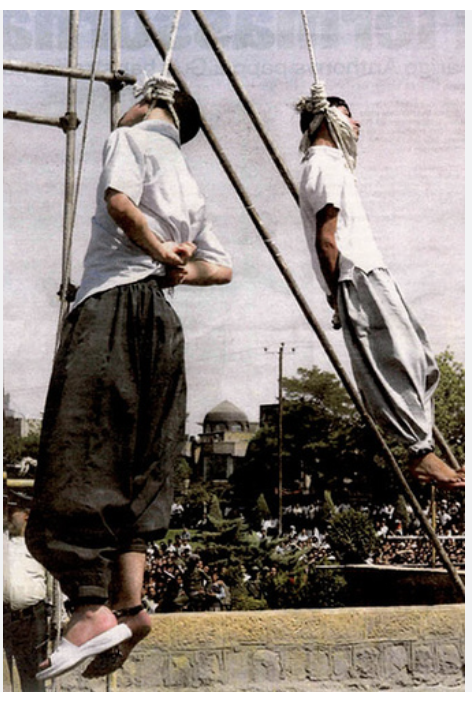
Documented Cases: While exact numbers are often difficult to verify due to opaque judicial processes, there have been documented instances, such as the 2005 execution of two young men in Mashhad.
Historical Context: Since the 1979 revolution, the Iranian government has maintained one of the world's most restrictive policies against LGBTQ individuals.
Other Violence: Beyond state-sanctioned executions, homosexual individuals in Iran also face severe violence, including honor killings.
It is important to note that the Iranian government often frames these executions under broader criminal charges, but human rights organizations heavily document them as targeting individuals for their sexual orientation.
Mahmoud Asgari and Ayaz Marhoni - Wikipedia
Execution. Mahmoud Asgari and Ayaz Marhoni were executed on July 19, 2005, in Edalat (Justice) Square in Mashhad, northeast Iran, ...