Spot on. And a reminder of what's coming back to crush us just as soon as the Democrats return
/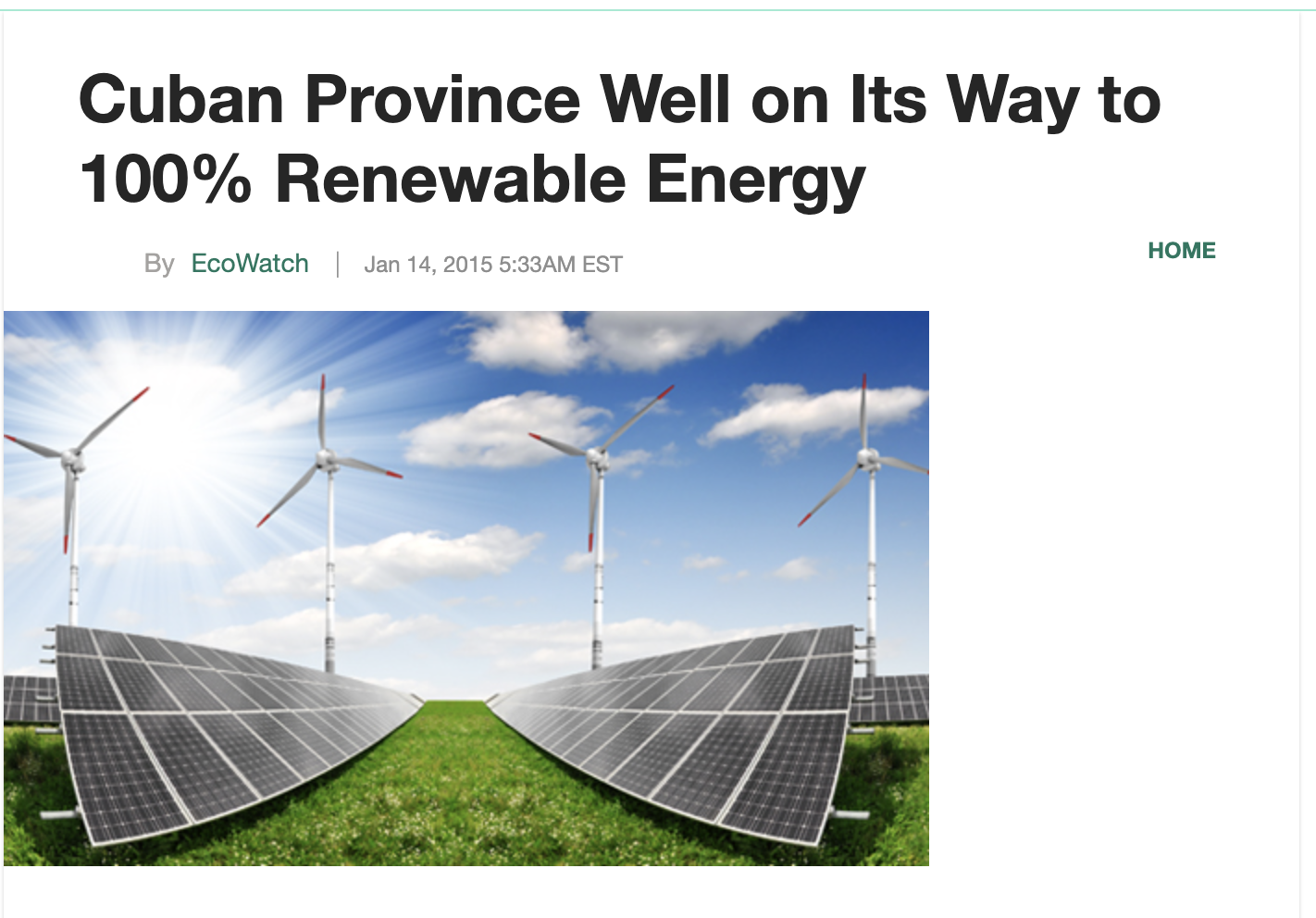
EcoWatch: President Obama’s recent announcement that he wants to begin normalizing relations with Cuba generated news around the world. But the Cuban province of Granma may soon be making headlines for another reason: its embrace of renewable energy.
GREAT MOMENTS IN ENVIRONMENTALISM:
Cuba Becomes The First Country To Reach Net Zero. Shouldn’t We Be Celebrating?
There it was on the front page of Saturday’s New York Times: with a small assist from the United States, the island nation of Cuba has almost entirely ended the use of fossil fuels. Finally, we have the first country in the world to achieve the climate movement’s Holy Grail and nirvana — Net Zero! Or at least a very close approximation. This should be cause for a huge celebration.
You would think that the Times, which has been demanding the elimination of fossil fuels for at least a couple of decades, would be leading the celebrations. But weirdly, now that Cuba has finally shown the way, the Times chooses to put a completely different spin on the achievement. The headline and subheadline are (print edition): “U.S. Choking Oil Deliveries To Cuba Ports; Military Action Brings a Nation to Its Knees.”
The piece reports that the Trump administration is helping Cuba to achieve Net Zero by preventing oil tankers from landing there. Somehow in this piece, that is spun as a bad thing. It has brought Cuba “to its knees.”
The funny thing is that here in the U.S., it was just over a year ago that we had President Biden and an administration full of zealous environmentalists who were using every governmental power at their disposal to force Americans to stop using fossil fuels. By Executive Order 14057 of December 8, 2021, Biden had directed all federal agencies to pursue an aggressive “all of government” operation to achieve “net zero” on an accelerated schedule. Goals number 1 and 2 from that EO are “100 percent carbon pollution-free electricity on a net annual basis by 2030,” and “100 percent zero-emission vehicle acquisitions by 2035.” In 2023, the Department of Transportation released a “Blueprint” for eliminating all carbon emissions from the transportation sector. In 2024 EPA released a plan to eliminate fossil fuels from electricity generation. Similar initiatives were everywhere in the government.
More from the linked-to article in The Contrarian:
What am I missing? Since when are fuels like oil, gasoline, natural gas, and diesel any longer necessary, or even useful or economic, for providing energy to the people? The Times for years has been pounding a relentless drumbeat emphasizing that wind and solar are now the cheapest ways to produce energy, and all sane people are flocking to them as the best sources. For example, from August 17, 2023:
“As the planet registers the highest temperatures on record, rising in some places to levels incompatible with human life, governments around the world are pouring trillions of dollars into clean energy to cut the carbon pollution that is broiling the planet. The cost of generating electricity from the sun and wind is falling fast and in many areas is now cheaper than gas, oil or coal. Private investment is flooding into companies that are jockeying for advantage in emerging green industries.”
In other words, to eliminate use of fossil fuels all Cuba would have to do would be to slap up a few wind turbines and solar panels, and then it could run its economy on the abundant renewable electricity without need for any of those icky fossil fuels. And saving money too! Cuba actually has a bunch of wind farms. Why doesn’t it just crank them up to provide the power formerly supplied by the fossil fuels?
It seems like the people who are writing these pieces for the Times don’t read their own newspaper.
Presumably, Trump helping Cuba reach Net Zero has the backing of the German Greens, who dusted off the Morgenthau Plan to return Deutschland to the Dark Ages, Scientific American, and Kamala Harris:

Bonus Material
While looking at that EcoWatch page touting Cuba’s transformation I came across this article from the same time; this is the kind of garbage reporting being fed to school children, and is the reason why they’re unwittingly cheering on the destruction of their comfortable world.
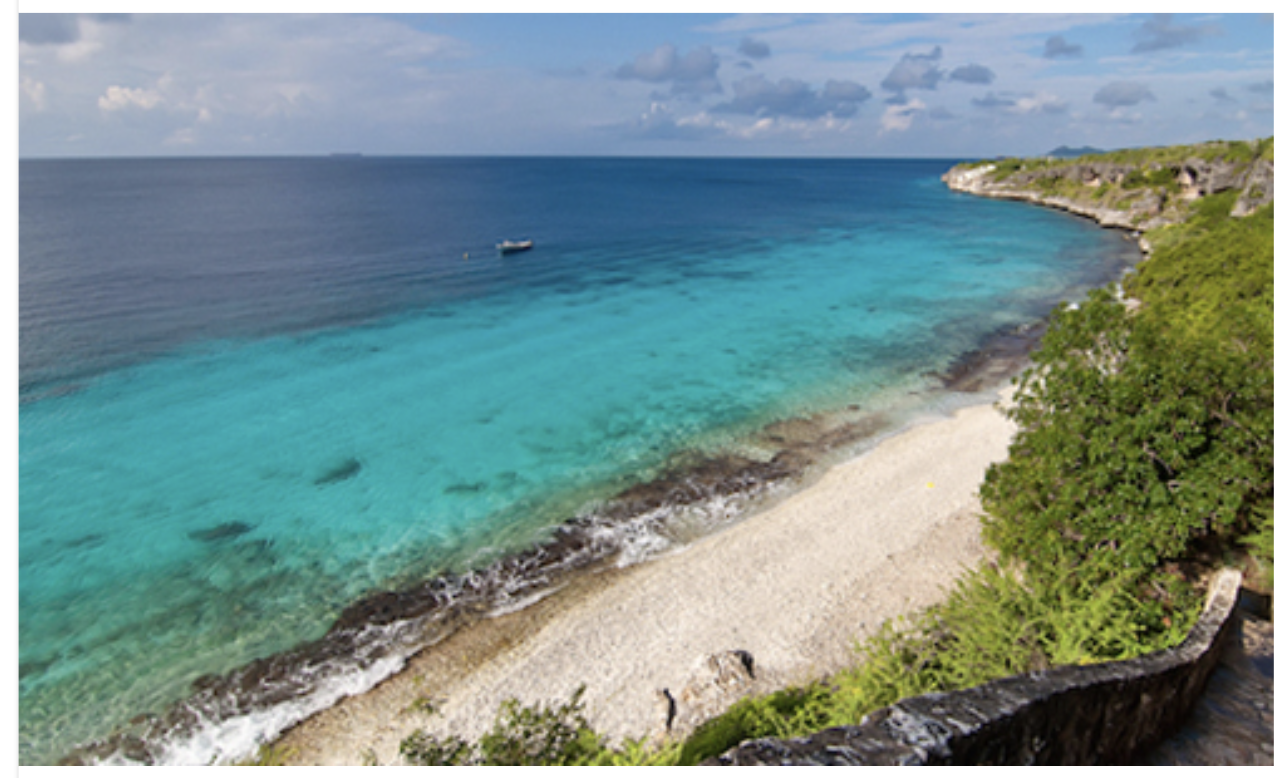
Bonaire (pop. 14,500), a small island off the coast of Venezuela, is famous for its beautiful marine reefs, which are visited by 70,000 tourists every year. What many of the tourists don’t realize is that the majority of the electricity powering their needs comes from renewable energy. Yet for the residents of Bonaire, the switch from fossil-fueled to renewable energy systems has made a world of difference.
Like many Caribbean islands, Bonaire originally relied on diesel fuel to generate electricity for residents, with a peak demand of 11 megawatts (MW). This fuel had to be shipped in from other nations, resulting in high electricity prices for Bonaire residents, along with uncertainty about when and how much prices might increase with changing fuel costs.
In 2004, everything changed when a fire destroyed the existing diesel power plant. Although tragic, the situation provided an opportunity for Bonaire to consider what kind of new electricity system to build. Temporary diesel generators were rented to provide power for the short term. Meanwhile, the government and local utility began working together to create a plan that would allow Bonaire to reach a goal of generating 100 percent of its electricity from renewable sources.
Bonaire’s Electricity System Transformation
The result is a transformed electricity system on Bonaire. The island is now home to 12 wind turbines with a total of 11 MW of wind power capacity, which contribute up to 90 percent of the island’s electricity at times of peak wind, and 40-45 percent of its annual electricity on average. Battery storage (6 MWh) is included in order to take advantage of available power in times of excess wind, and provide that stored electricity in times of low wind.
The battery also boosts the reliability of the overall system—it is capable of providing 3 MW for over two minutes, allowing time for additional generation to be started when there is a sudden drop in wind.
“Over two whole minutes! We’re saved!”
The Bonaire system also includes 14 MW of diesel generation, five total generators, which provide the necessary power to meet the load when there is not enough wind power available. The generators are equipped to run on both traditional diesel as well as biodiesel. The next steps in the island’s energy transformation involve using local algae resources, grown in the large salt flats on the island, to create biofuel, which can then be used in the existing generators. This will allow Bonaire to operate a 100 percent renewable electricity system—with on average 40–45 percent from wind and 55-60 percent from biodiesel.
The new electricity system led to more reliable electricity, more employment opportunities, reduced dependence on oil (and its fluctuating prices), and a reduction in electricity bills. Bonaire residents currently pay $0.22/kWh for electricity, much lower than prices on other nearby Caribbean islands, which are often $0.36/kWh or above. When oil prices spiked in 2008, while Bonaire was still using temporary diesel generators before making its transition to renewables, electricity prices on the island reached $0.50/kWh. The new electricity system also created jobs for the construction and ongoing operation of the wind farm, and for research and development of algae production capabilities and conversion to biofuel. Additional employment opportunities will be created for continuing algae production and operation of the biodiesel plant.
Bonaire as Inspiration for the Caribbean
The success of the updated electricity system on Bonaire provides an important example to other nearby islands of the opportunity to achieve high levels of renewable energy penetration.
Is that true? Did it really switch to 100% renewable energy? Well … no.
AI Overview
No, the island of Bonaire does not operate 100% on renewable electricity
As of 2022–2023, approximately 20–30% of its electricity is generated from renewables (mostly wind, with some solar). The remainder of the power is produced by a hybrid, petroleum-based (diesel) system, though the island aims for 80% renewable energy by 2030.
Key Findings on Bonaire's Electricity:
Current Mix: Roughly 22% of electricity needs are met by renewables, primarily via the ContourGlobal wind farm and expanding solar installations.
History: The share of renewable electricity peaked around 2014 at roughly 42% but has since varied between 20% and 30%.
Challenges: Due to intermittent wind, the island relies on diesel generators and has installed battery storage to stabilize the grid.
While the island has achieved 100% renewable generation at specific, short-term peak times, it does not currently sustain this level of generation around the clock.