Good; now fire the principal, and remove the lower court judge from the bench
/
California appeals court lets schoolgirl, 6, off the hook for poignant hand-written BLM letter principal said was ‘racist’
[In fact, that’s not quite what’s happened, and the case is still alive, even if on life support. The court has reversed an order of summary judgment, which awarded victory to the school board before trial. Summary judgments are granted when a judge finds that there is no genuine dispute over material facts (or put another way, assumes just for purposes of the motion, that the plaintiff’s allegations are true) and the moving party is entitled to judgment as a matter of law. So the case is being sent back to the lower court for a further proceedings. If the school board has any sense, it will concede defeat, but it’s shown no sign of intelligence so far, so we’ll have to await developments. Still, it’s a positive step forward — Ed]
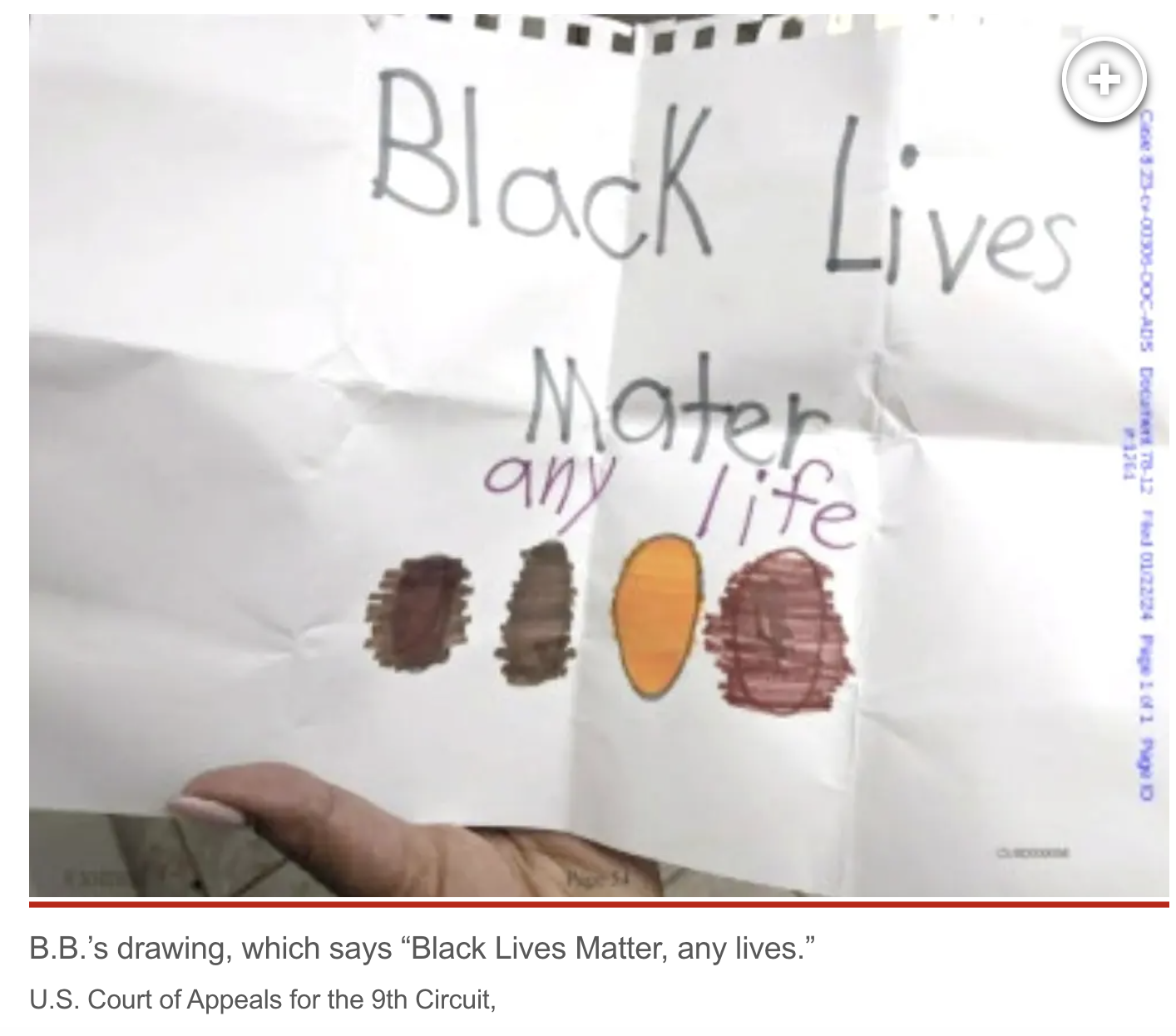
A California appeals court backed a child who wrote “any life” and innocently drew the thumbprints of her friends under “Black Lives Matter” in a picture at school, which she was later punished for.
A lower court previously backed the child’s school principal, Jesus Becerra, who worked at Viejo Elementary School in Mission Viejo, California.
The child, who is white and identified as “B.B.” in court documents, in 2021 drew the picture and gave it to a black classmate, “M.C.,” after the class listened to a story about the Rev. Martin Luther King Jr.
The black child then took the latter child took the picture home where M.C.’s mother raised concerns with the school. B.B.’s mom, Chelsea Boyle, alleges Becerra told B.B. that the drawing was racist, forced her to apologize to M.C., and banned her from recess for two weeks.
Boyle later filed suit against the school, alleging B.B.’s First Amendment rights were violated.
The lower court disagreed, concluding the drawing was not protected speech and interfered with the black student’s right to be let alone.
But the higher court, using the landmark Tinker v. Des Moines Independent Community School District case that established that high school students have the right to protest the Vietnam War, decided to vacate the decision.
“This case presents an important issue: to what extent is elementary students’ speech protected by the First Amendment?” the three-judge panel wrote in a per curiam opinion.
“Applying the criteria set forth in Tinker v. Des Moines Independent Community School District , we hold that elementary students’ speech is protected by the First Amendment, the age of the students is a relevant factor under Tinker , and schools may restrict students’ speech only when the restriction is reasonably necessary to protect the safety and well-being of its students. Because the Tinker analysis raises genuine issues of material fact, we vacate the grant of summary judgment and remand,” they added.
The lower court judge, U.S. District Judge David Carter, a Bill Clinton appointee, argued that age was a factor in his decision.
“Thus, the downsides of regulating speech there is not as significant as it is in high schools, where students are approaching voting age and controversial speech could spark conducive conversation,” Carter wrote.
But the higher court said age is a relevant but “non-dispositive” factor.
“Disagreeing with the district court’s determination that the drawing was not protected by the First Amendment, the panel held that elementary students’ speech is protected by the First Amendment, Tinker applies in the elementary student speech context, and elementary students’ young age is a relevant, but non-dispositive, factor,” the panel wrote.
Caleb Trotter, senior attorney at the Pacific Legal Foundation, which is representing B.B. and her mother, said they were “thrilled” with the decision but that it’s “somewhat frustrating” the matter had to be litigated in the first place. “Today’s ruling affirms what should be obvious: Students don’t lose their constitutional rights just because they’re young. The Constitution protects every student’s right to free expression. No child should be punished for expressing a well-intentioned message to a friend.”
That sentiment was echoed by several First Amendment advocates in interviews with USA TODAY.
“When people say, ‘don’t make a federal case about this,’ this is the kind of thing they’re talking about not making a federal case out of,” said Adam Goldstein, vice president of strategic initiatives at the Foundation for Individual Rights and Expression.
Three cheers for the Pacific Legal Foundation, which represented the child for free. As an aside, I received an email from them some years ago (unsolicited — I don’t know how they found my blog) after the National Association of Realtors announced a new rule that would punish members who published “offensive” material, even on non-related social media. The foundation’s attorney encouraged me to alert them if the NAR came after me, because “we’re looking for test cases like this.” No such complaint has surfaced, yet, but I’ve saved the Foundation’s number.