This has been repeatedly warned about by various observers since drones were first used in Afghanistan, but the danger has grown in inverse proportion to their plummeting cost and size (Updated)
/
The Biggest News Story Nobody Is Talking About
As all eyes are glued to the happenings in the Middle East, this story flew under the radar for most of us.
But in a lot of ways, the implications for our national security could be greater than what happens in the next few weeks in the Persian Gulf.
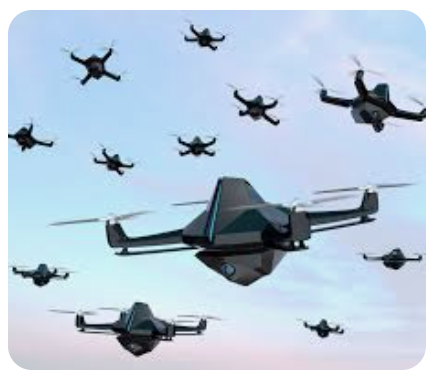
Drone warfare has come to the United States—to the heart of our nuclear deterrent capabilities—and our defenses proved inadequate to stop sophisticated drones from interfering with wartime operations.
Amid the raging conflict in the Middle East, the astonishing events at Barksdale Air Force Base earlier this month have attracted only limited media attention. It is reported that swarms of unidentified drones repeatedly loitered over Barksdale between March 9 and 15, drawing no publicly known effective response from the military or the Department of Homeland Security (DHS).
Barksdale is the headquarters of the Air Force’s Global Strike Command, which is responsible for the nation’s nuclear intercontinental ballistic missiles and strategic bomber forces, including B2, B1, and B52 aircraft. The base is home to the 2nd Bomb Wing B52s and is the central hub of communications and logistical support for coordinating and directing those forces. The fact that potentially threatening drones were able to operate over such a critical complex with apparent impunity over several days, after a similar event, spanning 17 days, occurred more than two years ago at Langley AFB, is astonishing. Reports indicate that Barksdale personnel were repeatedly ordered to take cover as drones roamed over buildings and aircraft.
>>>>
Barksdale Air Force Base in Louisiana, in Bossier Parish not far from Shreveport, was attacked by drone swarms during the week of March 9. The attack disrupted B-52H aircraft launches in support of Operation Epic Fury against Iran. It is the first time a US airbase was temporarily put out of operation in wartime, something that never happened even in World War II.
Each wave forced the Air Force to halt operations and send its personnel to shelters. Barksdale is the command hub of the US Air Force Global Strike Command. Not only are B-52s based there, but the base is part of America’s nuclear triad. It shelters long range nuclear cruise missiles (such as the AGM-86B) and will soon house a new Long Range Standoff cruise missile. Shelters and storage sites for the new missiles are under construction.
…. The drone waves lasted around four hours each day, an extraordinarily long loiter time for a drone. It is not known if the drones were fixed wing or quadcopter types, or how they were powered (liquid fuel or electrical). Each wave consisted of 12 to 15 drones, and the drones flew with their lights on, intentionally making them visible.
Barksdale AFB does not have air defenses, nor does it have fighter jets that can take down drones.
The airbase does have some electronic countermeasures that were designed to disable GPS and the datalinks between the drones and their remote operators. The electronic countermeasures failed to work.
…. These aren't your standard DGI drones. They are large, sophisticated, have long loiter times, and presumably have sensors and the ability to carry significant weapons. They aren't anything like the normal drones used in Ukraine, either, and those have done devastating damage. These potentially have far more capabilities.
And not only couldn't we stop them. Apparently we haven't been able to capture any or trace where they came from.
…. What we know is that the drones had extraordinary range, could resist broad spectrum jamming, and featured non-commercial signal characteristics. Even more provocatively, the drones used various ingress and egress routes and operated in dispersed patterns, making traceability (via trying to triangulate on signals) virtually impossible.
…. One has to assume that the Pentagon is working furiously to address this problem, but in addition to hardware, it will require a complete rethink of how to deal with air defense within the United States, where the airspace is crowded not just with commercial and military aircraft, but a thriving civil aviation industry and even drone deliveries.
Drones aren't just a big deal in Ukraine, Russia, and Iran. They are now a significant threat right here at home, and we aren't prepared.
Here are just a few of the articles on the drone threat I’ve read on Instapundit just over the past year — there are more, on many more websites:
Stephen Green, February 23, 2026
Drones ‘change everything’ about combined arms combat, US Army aviation chief says.
DRONES IN WARFARE – WHICH MILITARIES ARE TAKING THE CHEAP DRONE THREAT SERIOUSLY? The most credible warnings about Western readiness for the next war are not coming from think tanks. They’re coming from retired US/NATO soldiers … who also fought in Ukraine. And they’re all saying the same thing: We’re not ready.
Sarah Hoyt Nov 22nd, 2025
DRONES IN WARFARE – WHICH MILITARIES ARE TAKING THE CHEAP DRONE THREAT SERIOUSLY? The most credible warnings about Western readiness for the next war are not coming from think tanks. They’re coming from retired US/NATO soldiers … who also fought in Ukraine. And they’re all saying the same thing: We’re not ready.
After the armoured vehicle fiasco, a dud cannon to waste our billions on.
Stephen Green November 4, 2025
NOTHING TO SEE HERE, MOVE ALONG: Drones seen near air base storing U.S. nuclear weapons resemble ‘spy operation,’ Belgium’s defense minister says.
We are badly prepared for what’s coming.
Stephen Green Aug 21th, 2025
Project Flytrap began in March with initial research and testing. It has grown in scale and ambition, with 4.0 the first time troops integrated counterdrone systems into battalion-level fighting. The engagement scenario involved several dozen troops attacking roughly 180 defenders in traditional land battles augmented with hundreds of drones, employed in the most realistic ways possible short of lethality, said organizers.
To crank up intensity, they packed into the four-day exercise a relentless series of attacks, engagements and threats modeled on fighting in Ukraine and other conflicts.
“It’s terrifying, watching the drones counter each other,” said Zouzoulas of the scenes on Ukraine’s front lines.
Adapting to that reality is Flytrap’s focus. Troops from the Army’s 2nd Cavalry Regiment, based in Germany, and the U.K.’s Royal Yorkshire Regiment used new devices—some developed in-house and some from private companies—to track, jam and shoot down drones sent at them by other U.S. forces.
“It’s very much a cat-and-mouse game,” said Army Lt. Col. Jeremy Medaris, a leader of the exercise. Drones keep adapting, “so then you have to have an adaptation as well” to counter them. Instead of seeking a single solution, he said, the emphasis is on developing a flexible and layered approach with a range of tools.
Zouzoulas’s Terrestrial Layer System-Brigade Combat Team Manpack tackles the first stage in drone-fighting: spotting attackers. A sort of antenna, known as a Beast+, resembles a cactus growing out of a backpack, connected by wire to a screen the size of a smartphone. Designed for foot soldiers on the move, it scans for nearby drones’ radio signals and jams them.
An even smaller wearable system resembles two big walkie-talkies. Dubbed Wingman and Pitbull, they also seek and jam drones’ radio signals.
(FWIW) The good news? Unlike his predecessor, Trump has not ignored the threat, and is addressing it
AI Overview
In June 2025, the Trump administration launched a major anti-drone initiative, including a $500 million program to secure critical infrastructure and events like the 2026 World Cup against unmanned aircraft system (UAS) threats
. The effort focuses on expanding counter-drone technology, enhancing detection capabilities, and increasing legal enforcement.
Key Aspects of the 2025 Anti-Drone Program:
Executive Orders: President Trump signed orders in June 2025, specifically "Restoring American Airspace Sovereignty," to boost security against drone threats and strengthen national resilience.
Funding and Resources: The administration announced a $500 million investment to aid state and local governments in developing anti-drone security strategies.
Strategic Focus: The initiative targets security for major events, including the 2026 FIFA World Cup, and protects against foreign surveillance and illegal activity.
Counter-Drone Technology: The Department of Homeland Security (DHS) began implementing technology to detect, track, and identify drones, with capabilities to jam or disable unauthorized devices.
Training and Enforcement: A National Counter-UAS Training Center was created to assist law enforcement in responding to drone threats
We’re livin in interesting times.
UPDATE Submitted by FWIW’s military strategist Gideon from a secret, undisclosed location (possibly, the trunk of a Jaguar)
🚨 THE WAR JUST CHANGED IN THE STRAIT OF HORMUZ
— Jim Ferguson (@JimFergusonUK) March 27, 2026
The U.S. has deployed robot war boats.
Uncrewed. Autonomous. Potentially explosive.
Let that sink in.
Pentagon confirms drone vessels are now patrolling during Operation Epic Fury:
• 450+ hours already logged
• 2,200 nautical… pic.twitter.com/4Eahhz5j15