Happy birthday!
/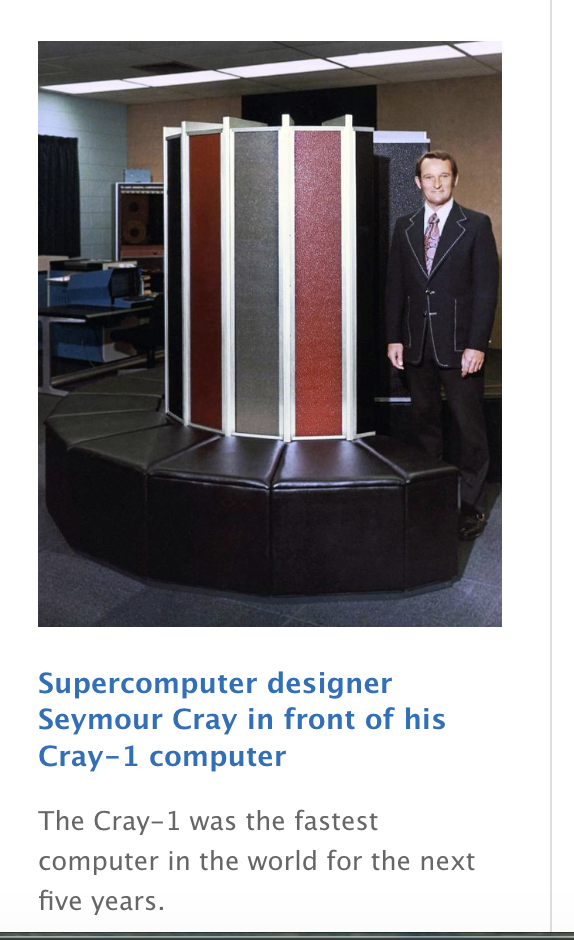
Fifty years ago today, March 4, 1976 the world’s first super computer was shipped to its first customer, the Los Alamos Laboratory. Here’s what it was, and here’s how things have changed:
AI Overview
Cray-1 supercomputer was the world’s fastest, most advanced vector processor, designed by Seymour Cray for, $8–$9 million, featuring a iconic circular design for speed. It performed roughly 80–160 million calculations per second (80-160 MFLOPS), whereas today's top supercomputers (exaflop scale) are over 10 billion times faster and a $70 Raspberry Pi is hundreds of times faster.
The 1977 Cray-1 Supercomputer
Performance: ~80-160 MFLOPS (million floating-point operations per second).
Design: Cylindrical tower to keep wire lengths under 3 feet for maximum speed, often nicknamed "the world's most expensive loveseat" due to the base bench.
Usage: Primarily used by government and research labs (like NCAR) for weather modeling, nuclear simulations, and aerospace design.
Power/Physical: Consumed over 100 kW of power, requiring massive liquid cooling.
Facebook +4
Comparison: 1977 vs. Today
Speed: The Cray-1 (1976) performed roughly 80 MFLOPS. A modern top-tier supercomputer (like Frontier) operates at over 1 Exaflop (
FLOPS), making it roughly 10-12 billion times faster.
Performance Per Dollar: A $70 Raspberry Pi 5 is estimated to be over 190 times faster than the 1970s Cray-1.
Size/Energy: The 5.5-ton, 115 kW Cray-1 has been replaced by systems with similar or better performance that fit in a palm (smartphones) or on a desk.
Memory: The Cray-1 typically had 8 megabytes of memory. A modern smartphone usually has 8-16 gigabytes of memory (1000-2000x more).
Facebook +5
Essentially, the computing power that cost nearly $9 million in 1977, required specialized cooling, and weighed as much as an automobile, is now thousands of times surpassed by the phone in your pocket.