The "Luigi Effect"
/
Disgruntled worker invokes Luigi Mangione in $500M warehouse inferno he filmed in anti-capitalist rage: feds
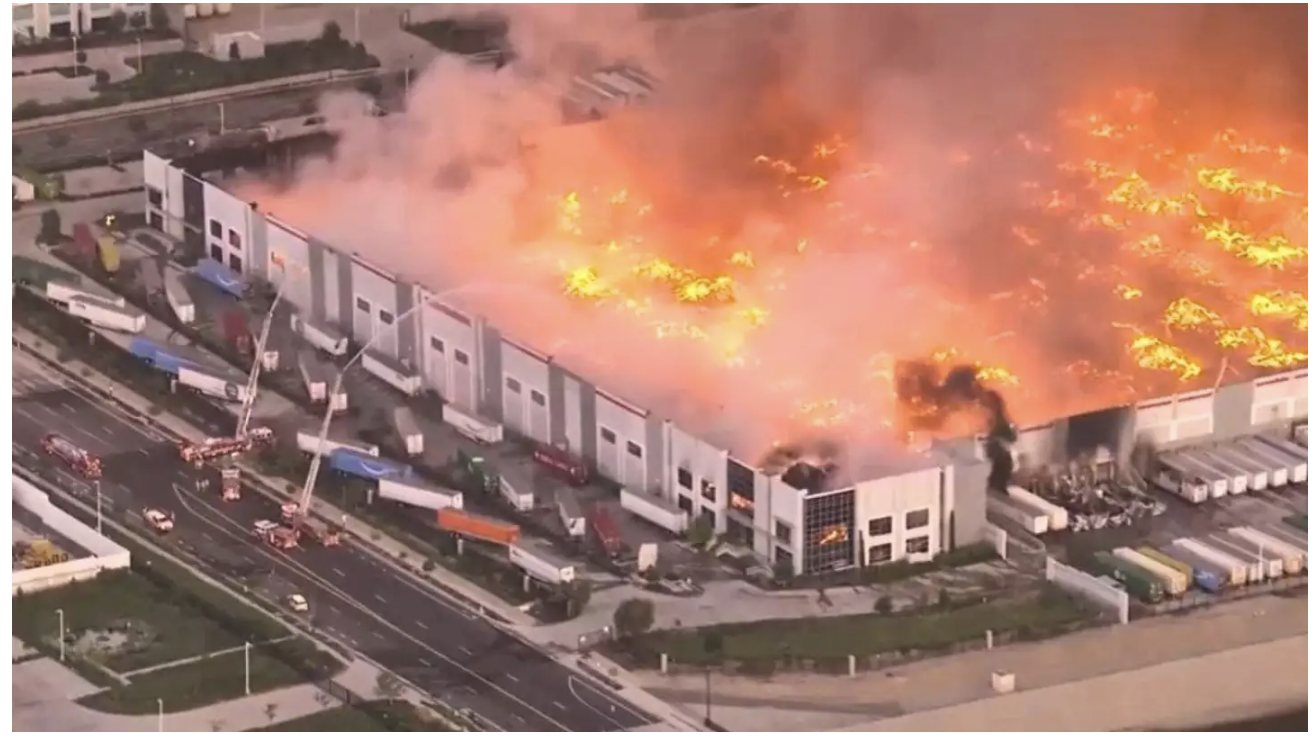
Chamel Abdulkarim* pleaded not guilty to charges tied to the $500M Kimberly-Clark facility blaze in Ontario
A disgruntled Inland Empire employee accused of causing $500 million in damage invoked Luigi Mangione as he filmed himself torching a warehouse as he railed against wages, authorities said.
Chamel Abdulkarim, 29, of Highland, California, is charged with deliberately setting the April 7 inferno that destroyed a 1.2 million-square-foot Kimberly-Clark distribution center in Ontario. He pleaded not guilty Monday to federal and state charges, authorities said.
According to a Department of Justice criminal complaint, Abdulkarim, who worked at the facility through a third-party logistics provider, filmed himself setting multiple pallets of paper goods on fire in the early morning hours.
In the video, he allegedly complained about wages, saying, "If you’re not going to pay us enough to [expletive] live… at least pay us enough not to do this," according to the DOJ affidavit.
Federal prosecutors say the flames quickly spread, collapsing the roof and leveling the entire facility, which stored household products like Kleenex and Cottonelle.
Investigators allege Abdulkarim later bragged about the destruction in texts and phone calls, including one message that read, "I just cost these [expletive] billions," while railing against corporate profits and shareholders.
In a separate call, U.S. Attorney Bill Essayli said Abdulkarim compared himself to Mangione — the suspect accused in the killing of UnitedHealthcare CEO Brian Thompson.
"Luigi popped that mutherf---er," Abdulkarim said, according to the federal complaint, adding "a lot of people are going to understand."
Fox News contributor and former FBI special agent Nicole Parker told Fox News Digital that Abdulkarim seems to have used similar tactics as Mangione, calling it the "Luigi effect."
"Luigi garnered a substantial amount of attention and empathy from many because of his ‘cause’ as a justification for his grievance," she said. "Several are now copying him to one degree or another in an effort to gain that same level of attention and hero status."
"I refer to it as the ‘Luigi effect’ where offenders have learned to focus attention on their grievance through violence due to the sensationalization from online platforms and social media.
*As American as Baklava
AI Overview
Abdulkarim is a masculine name of Arabic origin, meaning "servant of the Most Generous" or "servant of Allah". It is derived from the Arabic elements 'abd (servant/slave) and al-Karīm (the Generous/Noble), referring to one of the 99 attributes of God in Islam.
Key Details About Abdulkarim:
Origin: The name has deep roots in Arabic, Islamic tradition, and culture.
Meaning: It translates directly to "Servant of the Generous One" or "Servant of the Noble One," referencing Al-Kareem, a name for God in Islam.
Usage: It is a common name in Muslim-majority countries across the Middle East, North Africa, and parts of Asia.
Variants: Common variations in spelling include Abdelkarim, Abdul Karim, and Abdulkareem.
Significance: Parents often choose this name to reflect religious faith, devotion, and the admiration of virtues like generosity.
Historical Context: Historically, this name has been used for centuries throughout Islamic history to emphasize humility and service to God.