Imagine the lifespan of EV chargers* when (well, if) they start installing them on public streets
/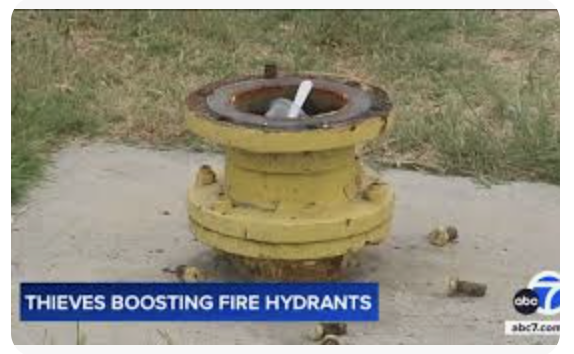
The New Hotness? Thieves destroy nearly 75 Detroit fire hydrants to steal metal parts, putting lives at risk.
Thieves have destroyed nearly 75 fire hydrants on the west side of Detroit in the last 48 hours, stealing parts and putting lives at risk.
Crews with the Detroit Water and Sewerage Department are racing to repair the broken hydrants along Southfield Road and across the west side after thieves tore through dozens in about two days.
“We think the number is about 75 so far,” DWSD Deputy Director Sam Smalley said.
The thieves are targeting metal nozzles and stems on top of the hydrants, which are worth about $600.
Executive Fire Commissioner Chuck Simms said the vandalism is a serious and unacceptable situation that puts lives at risk.
“No matter how fast we get to a fire, if we don’t have an operable fire hydrant, it takes seconds, sometimes even minutes away from maybe us saving lives,” Simms said.
And not just in Detroit, naturally:
2024:
Thieves are now targeting fire hydrants across Los Angeles County
"The theft rate is alarming and getting worse. GSWC is taking serious steps to mitigate the problem by installing locks and working with local fire and law enforcement authorities. GSWC has also written letters to local scrap yards reminding them that receiving stolen hydrants is a federal offense," the company said in a statement.
*There’s only about five bucks of copper in an EV charger, but that hasn’t stopped thieves
A new report from CBC News in Canada has looked into a spate of EV charging cable thefts that has rocked provinces north of the border. The attacks on EV charging stations have seen vandals cut into the charging cable to swipe the copper metal inside, which they then attempt to sell in order to turn a profit.
While that might sound like an easy way to make a few bucks, there's just one problem: most EV chargers only contain about $5 worth of copper metal. So if you're hoping to become a millionaire via this scheme, you'd need to raid 200,000 EV chargers, which is more than you'll find in both the U.S. and Canada combined.
"The charging cable is typically copper inside, but it's not much," William York, president of the EV Association of Alberta, told CBC News. "So for it to be theft, I think it's a misconception on behalf of the person that's perpetrating it. They think there's a lot more value in those cables than there actually is, it's only a couple of dollars, but that cable to the owner of the charging station to replace is in the hundreds to thousands of dollars.
The spate of attacks on EV charging stations isn't limited to Canada either. According to the U.S. Department of Energy, instances of copper theft across the country have spiked as the cost of the metal has soared. While the cost has risen from its low in 2022, the cost of copper still only sits around $3.80 per pound here in the U.S.
"This is not a good way of getting metals," Travis Allan, chief legal and public affairs officer at FLO, told CBC News. "It's not a good way of making money, it's dangerous, it's not worth the costs or the risks."