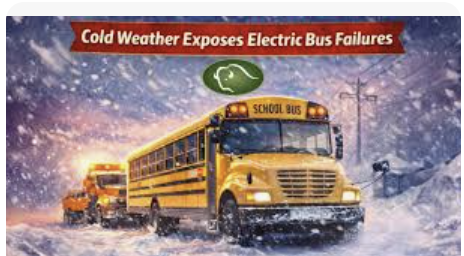
Known for years, ignored by their advocates for just as long; Northern school districts should have consulted with their physics teachers before committing millions to new Kamala Bus fleets
/
AAA Finds EV Range Drops 39% in Cold Weather and Costs Jump
Updated AAA data shows that EVs and hybrids lose up to 40 percent of their range in 20-degree weather.
Key Points
AAA study finds EVs lose 39 percent range and 35.6 percent efficiency at 20°F.
Winter EV operating costs rise by up to $76.93 per 1,000 miles using public charging.
35 percent of buyers now favor hybrids, which perform better than EVs in cold weather.
AAA Temperature Study
In an expansive May 2026 study, AAA engineers strapped modern electrified powertrains to climate-controlled dynamometers – simply put, automotive treadmills operating in extreme temperatures ranging from 20°F to 95°F. The results shatter the narrative of consistent range and robust drivetrains. While automakers have successfully engineered a defense against summer heat by using advanced liquid cooling and heat pumps, the cold weather penalty remains significant.
When the mercury drops to 20°F, electric vehicles lose an agonizing 39 percent of their driving range and suffer a 35.6 percent collapse in overall efficiency. For the everyday commuter, this is not merely a logistical headache; it is a direct financial penalty. AAA calculates that winter EV operating costs surge by $32.11 per 1,000 miles when charging at home. If a driver is forced into the wild to rely on public charging infrastructure, that cold-weather penalty skyrockets to an extra $76.93 per 1,000 miles.
Hybrids are not immune to the freeze. Vehicles utilizing internal combustion engines alongside battery packs saw fuel economy plummet by 22.8 percent at 20°F, adding an extra $28.44 per 1,000 miles to the operational burn rate. However, because hybrids can harvest engine heat to warm the cabin, their drop in efficiency remains far less catastrophic than their fully electric counterparts.
Does the EV Buyer Care?
According to AAA’s accompanying survey data, 35 percent of prospective buyers are currently pivoting toward hybrid platforms. If you live in a region that regularly sees winter weather, the EPA-estimated range is hugely inaccurate. Until industrial battery chemistry can robustly withstand the elements, buying a modern BEV means accepting that nearly 40 percent of your range—and a larger chunk of your wallet—will simply vanish into the cold.
I just checked GROK:
Yes, it's accurate.
AAA released a study on May 1, 2026, testing EVs (and hybrids) on a chassis dynamometer at different temperatures with the cabin HVAC set to 72°F. At 20°F (cold conditions) compared to a baseline of 75°F (moderate), they found:
EVs: ~39% decrease in calculated driving range and a 35.6% drop in MPGe (efficiency).
newsroom.aaa.com
This matches what you read exactly.
For context, hot temperatures (95°F) only reduced range by about 8.5% on average.
Quick notes on the study
It tested multiple modern EVs.
The big cold-weather hit comes from two main factors: battery chemistry performs worse in low temps (slower chemical reactions), and a lot of energy goes to heating the cabin (unlike gas cars that use engine waste heat).
This is consistent with AAA’s prior tests (e.g., ~41% loss in 2019, ~32–41% in earlier cold tests), showing limited improvement in winter performance despite battery/tech advances.
npr.org
Real-world results can vary based on the specific EV model, driving style, preconditioning (warming the car while plugged in), battery size, and how aggressively you use heat. Many owners mitigate it by preconditioning and using seat/steering wheel heaters instead of full cabin heat. But the AAA lab figures are a solid, standardized benchmark.
Of course, this little difficulty is not confined to school buses (or semis); the same physics apply to passenger cars. These wretched things will get you to Starbucks and Whole Foods, but you won’t be driving one to your Stratton Mountain condo.