Food Stamp Fraud
/
And why would CT do such a thing? Well, that article headline’s from July of last year; here’s what was going on yesterday:
Watch Sec. Rollins School Dem Rep on SNAP Fraud, Then JD Vance Lands the Crushing Blow
Rep. Angie Craig (MN-02) asked Rollins if she knew what the most recent Supplemental Nutrition Assistance Fraud (SNAP) fraud rate was, according to the United States Department of Agriculture Data. She apparently thought she had a "gotcha" point to poo-poo concerns about fraud. It did not go well for her.
.@USDA has NEVER had access to State SNAP data. Not until this Administration demanded it.
— Secretary Brooke Rollins (@SecRollins) June 4, 2026
That’s why every figure from years past is meaningless. From the 29 states that DID share data, we’ve already identified at least $3 billion a year in fraud.
Extrapolated nationwide: more… pic.twitter.com/st2Nf58fIR
Rollins explained that the number isn't accurate because it was based on data that they are unable to verify. She pointed, for example, to California or Minnesota (Craig's state). As we have seen, Minnesota has been a hotbed for fraud. That's when Craig started interrupting, "Reclaiming my time! Reclaiming my time!"
Craig then tried to insist that SNAP had the lowest fraud rate of any program in America. Rollins couldn't quite believe she said that, and almost laughed out loud. "You can't be serious when you say that!" she said. She nailed Craig, saying that if states like Minnesota wouldn't provide the data, they can't properly verify the accuracy.
@USDA has NEVER had access to State SNAP data. Not until this Administration demanded it. That’s why every figure from years past is meaningless. From the 29 states that DID share data, we’ve already identified at least $3 billion a year in fraud. Extrapolated nationwide: more than $10 billion. This isn’t “erroneous payments.” This is FRAUD — and yes, @RepAngieCraig, I know the difference. Do you?
Then Vance weighed in:
If the fraud rate is really as low as Democrats claim, why are they fighting so hard to hide the data? Why not just work with USDA to audit and validate where the money is going? Their resistance to us going after fraud is part of why these programs ballooned in the first place. https://t.co/ZaO6i9mKia
— JD Vance (@JDVance) June 4, 2026
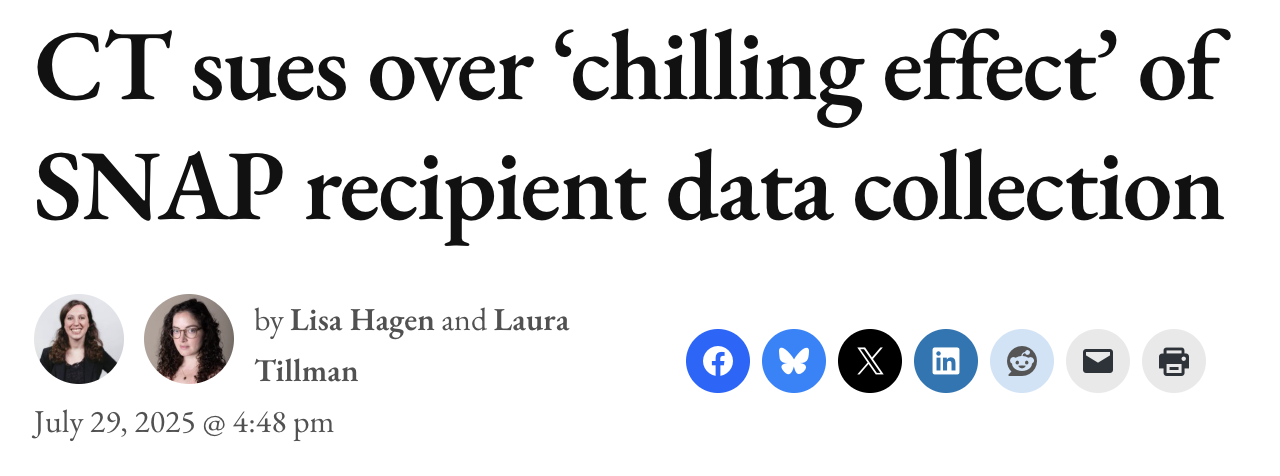
Here’s the story behind this post’s illustration:
CT sues over ‘chilling effect’ of SNAP recipient data collection
Attorney General William Tong joined a multistate lawsuit challenging the Trump administration’s effort to require states to share personal data of individuals who have received or applied for nutrition assistance.
The lawsuit cites concerns about the “chilling effect” it could have on participation in a program to help low-income families.
States must provide the U.S. Department of Agriculture, which oversees the Supplemental Nutrition Assistance Program, with information on beneficiaries and applicants of the last five years by Wednesday. USDA has indicated it could withhold funds that help states administer SNAP if they don’t comply.
In May, USDA’s Food and Nutrition Service informed state officials that they would need to provide records to identify enrollees and applicants from the beginning of 2020 until present day by July 30. That information includes, but isn’t limited to, names, dates of birth, personal addresses and Social Security numbers. If they don’t send that information, the guidance notes that could “trigger noncompliance procedures,” which includes the withholding of funds.
The request is part of a wide-ranging effort to collect data from all state programs that receive federal funding and to comply with President Donald Trump’s executive order. According to USDA guidance, receiving such information will combat “bureaucratic duplication and inefficiency” and help detect fraud.
…. Tong joined Democratic attorneys general in 20 other states plus the District of Columbia in a lawsuit filed Monday, alleging the demand is unconstitutional and violates federal privacy laws. The lawsuit asks the federal court in California to block the administration from conditioning funding on whether states provide SNAP data.
In a statement, Tong said it was unclear why USDA is collecting information and worried about possible misuse. The lawsuit points to additional data collection across the federal government, warning the latest push could be used to help carry out the president’s mass deportation efforts.
“The USDA’s actions are an unprecedented, illegal threat to the privacy of families here in Connecticut and across the country,” Tong said. “By law, Connecticut cannot disclose personally identifying SNAP data unless under very specific and strict circumstances. In this instance, none of those limited circumstances exist. No one knows why this data is being collected, who would be allowed to see it, or if it would even be stored correctly. This is simply yet another attempted illegal power grab by this administration, and we will not bow down to these baseless and reckless demands.”
Not saying that this has any possible connection, of course, but $157 million spent on state employees sounds like aa lot of phoney-baloney jobs to protect:
Noncompliance could affect the funding that Connecticut and other states receive to help operate nutrition assistance. Connecticut had about $157 million in SNAP administrative costs for fiscal year 2024, and half was reimbursed by the feds.