Standard Time is Good Time
/
Because what else do they have to do?
House Passes Legislation to Make Daylight Saving Time Permanent
I agree with the argument that moving our clocks back and forth twice a year is stupid, but the answer is to just stay with standard time, and consign our first Progressive, Woodrow Wilson’s brilliant WW1 experiment to the dustbin of history. Congressmen may still be abed with comely staffers at 9:00 AM, but the rest of us have lives, places to go, things to do before then, and it sucks having to do that in early morning darkness. Besides, this has been tried before, with exactly the result you’d (should) expect:
AI Overview:
The 1974 year-round daylight saving time experiment failed primarily because of dangerous winter morning darkness and a lack of actual energy savings.
President Richard Nixon signed the Emergency Daylight Saving Time Energy Conservation Act in response to the 1973 OPEC oil embargo. The law pushed clocks forward on January 6, 1974, for a planned two-year trial to reduce evening electricity demands. While initially backed by 79% of Americans, public approval plummeted to 42% within three months.
Why the Experiment Failed
Pitch-Black Morning Commutes: In many major regions, the sun did not rise until after 8:00 AM or even 9:00 AM. Millions of workers and schoolchildren had to commute in total winter darkness.
Schoolchildren Fatalities: Public panic erupted following heavily publicized tragedies, including eight children killed in traffic accidents in Florida while walking to school or waiting for buses in the dark.
Negligible Energy Savings: The U.S. Department of Transportation analyzed data from the 10-month period and found no meaningful fuel or electricity conservation.
Severe Practical Disruptions: Groups like farmers and outdoor construction workers faced immense difficulties starting their workdays blindly in freezing, dark mornings.
The Prompt Repeal
Faced with overwhelming public backlash, Congress aborted the trial early. President Gerald Ford signed a reversal amendment, and the nation returned to standard time on October 27, 1974, abandoning the experiment after less than a year.
Here’s some fun background material on time zones:
Time Zones Are Based on Longitude Overruled by Political Geography
….[L]ongitude is to a significant extent a matter of time. Historically, every town kept its own time based on its longitude. Wherever you found yourself, “noon” was the moment when the sun reached its highest point, with the other hours of the day set around that time. Travelers reset their watches as they came into new towns if moving east or west, but there were no “time zones” as there are today. When railroads were developed in the mid-1800s, allowing much faster travel, local timekeeping made it almost impossible to schedule the arrival and departure of trains. In response, uniform time-zones were established at one-hour intervals.
The entire world was eventually divided into 24 time zones, one for each hour of the day. As there are 360° of longitude around the Earth (180° west and 180° east of the Prime Meridian), and as 360 divided by 24 is 15, geographical units of one hour of time are equivalent to swaths of 15° degrees of longitude. Modern time zones are thus theoretically centered on lines of longitude in multiples of 15 (15°, 30°, 45°, 60° and so on), extending 7.5° to the east and west of those central meridians.
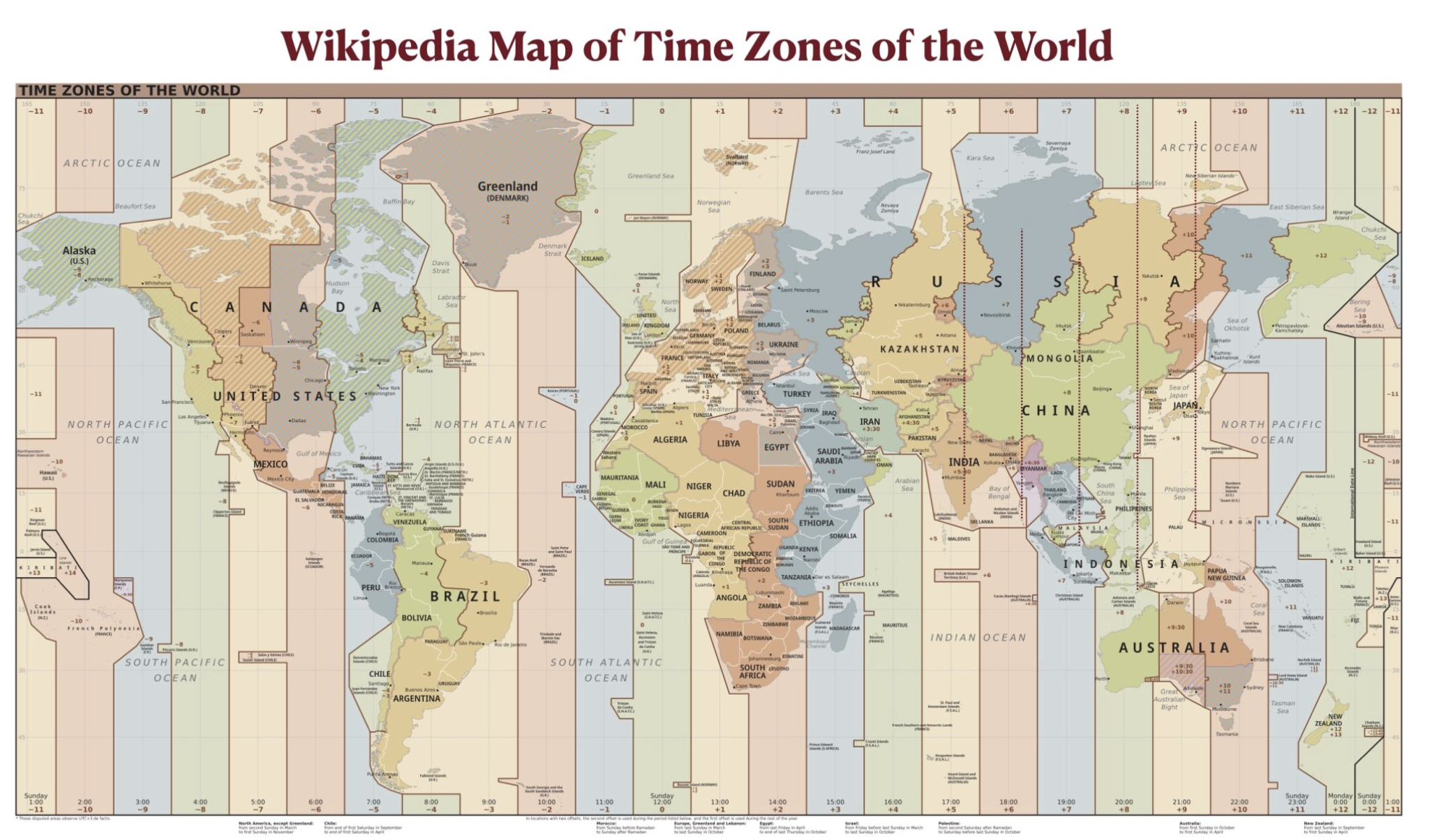
But as can be seen on the first map posted below, time zones are only structured this way in the uninhabited polar regions. Everywhere else, geopolitical considerations intrude. On land, time zones almost never follow the lines of longitude on which they are ideally based. Even in the open ocean, they often deviate from them to group islands and archipelagoes with other places. In the north Atlantic, for example, Jan Mayen is in the time zone commonly called GMT +1* (one hour ahead of Greenwich Mean Time), whereas by the logic of longitude it would be in time zone GMT -1 (one hour behind of Greenwich Mean Time). Not surprisingly, Jan Mayen is in the same time zone as Norway, the country that controls it. But note that western Norway would be in a different time zone (GMT 0) if longitude were the only factor.
And Maine being Maine …
In The 1880s, Bangor Ran 25 Minutes Ahead Of Its Neighbors
Bangor Mayor Frederick A. Cummings was a fierce holdout in 1883 when railroad companies came up with the four time zones that we in the Continental U.S. know today — Eastern, Central, Mountain and Pacific. Prior to that, the country had a baffling hodgepodge of more than 50 time zones. Rail passengers had to reset their watches five times between Boston and Washington.
Cummings balked at the push for standardization, arguing it was contrary to God’s will. The position of the sun in the sky dictated the time, according to Cummings.
“It is one of the immutable laws of God that the hours of noon, sunrise and sunset should occur at different periods of the day at different localities on the Earth’s surface,” Cummings wrote in January 1884. “The law was undoubtedly established at the creation and has remained upon Nature’s statute book since that day. I do not believe that any municipal regulation or railroad laws have power to change it.”
When Nov. 18, 1883 rolled around and the majority of towns and cities across the U.S. embraced Standard Time, Bangor did not because Cummings had vetoed the city council resolution that would have adopted it. The council tried again on Jan. 1, 1884, and Cummings, a Democrat, again vetoed it.
Yet two of those clocks were in churches and were changed to Eastern Standard Time, despite the mayor’s threats. The other two remained 25 minutes ahead — on Cummings time.
Which clocks were right? Which were wrong? It was all very confusing.
“The whole performance is supremely ridiculous, as those who are engaged in it will realize before long,” declared an editorial in the Bangor Daily Commercial.
Down the coast, the Rockland Free Press had snarkier things to say about Cummings’ effort to keep solar time in Bangor. Its editorial board took the opportunity to take potshots at the Democratic Party.
“The new time table is likely to be adopted, on trial at least, all over the state, except at Bangor, where the Democratic mayor has vetoed it,” it wrote. “Perhaps he doesn’t like the idea of it interfering with the four and eleven o’clock customs of his party in that city of free rum.”
In March 1884, Cummings was up for reelection. March 5, The New York Times noted that he was being challenged by Republican Samuel Humphrey and that Cummings’ stance on time change was controversial. Too controversial, apparently. Cummings lost. Or, you could say that he simply failed to get with the times.
Nevertheless, Bangor’s anti-Standard Time supporters kept their fight alive. And for the next three years there continued to be a 25-minute disagreement between the town’s two church clocks and its other two public clocks.
The dispute continued until 1887, when the state legislature adopted Eastern Time for the whole state.
That wasn’t the end of Maine’s time zone disagreements, though. The idea of Maine’s jumping ahead an hour to Atlantic Standard Time, like in New Brunswick and Nova Scotia, has been bandied about for years. In fact, a bill to switch to Atlantic Time passed the Maine House last year.
The state Senate didn’t vote on it, so the legislation never reached Gov. Paul LePage. That didn’t stop the governor from weighing in. The bill was “insane,” he said, adding that its supporters needed “therapy.”
So, 134 years after Bangor’s clocks battled with each other, time is still a matter of opinion.